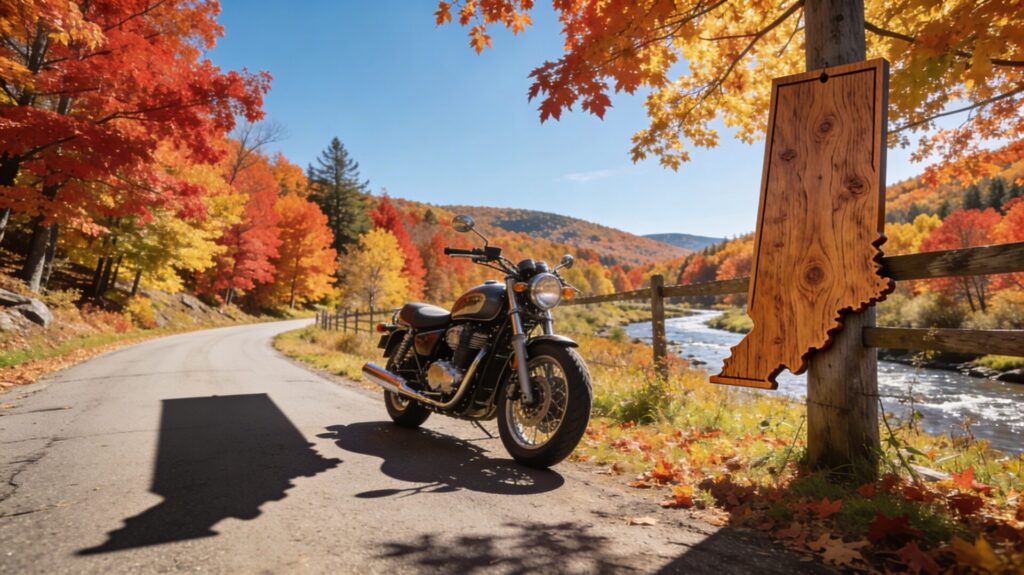
Vermont motorcycle insurance at a glance:
Required UM/UIM: 50/100
Helmet law: Universal
Lane splitting: Illegal
Vermont is a small state with a surprisingly specific insurance and motorcycle-law framework. Riders here deal with short seasons, mountain weather, annual inspections, rural towing realities, and a statute book that is unusually detailed on helmets, lane use, passengers, and equipment. The legal minimum also hides an important twist: Vermont’s basic liability floor is only 25/50/10, but the same insurance chapter requires uninsured and underinsured bodily injury protection at 50/100 on new and renewed policies, plus up to $10,000 in UM/UIM/hit-and-run property-damage protection.1, 2
That matters in a state with roughly 30,000 motorcycles registered each year, where Vermont’s Highway Safety Plan says motorcycle fatalities tend to fall in a range of 7 to 16 per year and where speed and visibility are identified as common factors in motorcycle-related crashes. On top of that, the National Weather Service office in Burlington produces its Lake Champlain recreation forecast only from April through December, and its snow climatology for Vermont shows just how hard winter and shoulder-season conditions can hit large parts of the state.16, 18, 19
This version is written for a motorcycle insurance website, not a legal treatise. The goal is simple: explain what Vermont law actually requires, what happens if you ride uninsured, which riding rules can affect a claim or ticket, and what a sensible Vermont motorcycle policy looks like if you want more than the cheapest quote on the screen.
What Vermont law actually requires on a motorcycle policy
The starting point is 23 V.S.A. § 800. If the motorcycle is required to be registered and used on Vermont roads, the owner or operator cannot ride it without an automobile liability policy, bond, or approved self-insurance. The statutory liability minimum is still the classic 25/50/10: $25,000 for one injured person, $50,000 for two or more injured people in one crash, and $10,000 for property damage in one crash.[1]
The more interesting statute is 23 V.S.A. § 941. Vermont does not let insurers issue a motor vehicle liability policy for a vehicle registered or principally garaged in the state unless the policy also provides protection against uninsured, underinsured, and hit-and-run motorists. For new and renewed policies, the bodily injury portion must be at least $50,000/$100,000. The statute also requires property-damage protection up to $10,000 per claim, typically with a $150 deductible, and says that if your liability limits are above 50/100, your UM/UIM limits are supposed to match unless you direct otherwise.[2]
Key insight for Vermont riders: That creates a practical Vermont reality that many riders miss when they compare quotes. The liability floor is low, but the policy floor is not as bare as the 25/50/10 number suggests. In Vermont, you should read the quote screen for both liability and UM/UIM. If you only look at the liability line, you can misunderstand what the state actually requires and what your own policy is doing for you.1, 2
One more Vermont-specific detail is worth calling out. Section 941 says liability coverage under these policies applies to damages “within this State or elsewhere in the United States and Canada.” For Vermont riders, that is not trivia. If you are near the Quebec border or you take New England cross-border trips, the statutory territorial language is more relevant here than it is in most states.[2]
The mistake that makes “minimum coverage” sound safer than it is
For a Vermont rider, the real weak point in a minimum policy is not just the bodily injury side. It is the $10,000 property-damage limit. That number is the state minimum, but it is easy to see why it is thin: Vermont requires annual inspections for registered vehicles, riders share the road with modern cars, SUVs, pickups, guardrails, utility hardware, and town infrastructure, and even a moderate crash can leave a rider exposed above that floor.1, 13
Coverage concern: The second problem is false confidence. Vermont’s statutes do require meaningful UM/UIM protection, which is good, but that protection does not replace stronger liability, collision, comprehensive, accessory coverage, or optional medical benefits. It just means the state did not leave riders entirely exposed to uninsured and underinsured drivers. A Vermont quote that meets the law can still be a weak policy if it leaves your own bike, gear, deductible exposure, and loss-of-use headaches almost entirely on you.[2]
What happens if you ride uninsured in Vermont
Vermont draws a clear distinction between failing to carry proof and actually riding uninsured. If you were insured at the time of the stop but do not have proof with you, subsection 800(c) lets you fix the problem by sending or producing proof to the issuing enforcement agency within seven business days. If you do that and the policy was in effect when you were stopped, you should not be convicted of the proof-carry violation. The penalty for violating the proof-carry rule itself is a civil penalty of up to $100.[1]
If you were actually operating the bike without the required insurance, subsection 800(b) is the one that matters. The civil penalty can be up to $500. Vermont’s point schedule then adds another problem: operating without financial responsibility is a two-point offense under 23 V.S.A. § 2502.1, 6
That point consequence matters because Vermont’s suspension machinery is cumulative. Under 23 V.S.A. § 2505, once a rider reaches 10 points in a two-year period, the Commissioner initiates suspension proceedings. Under 23 V.S.A. § 2506, that means a 10-day suspension at 10 points, 30 days at 15 points, 90 days at 20 points, and another 30 days for every additional five points. Section 2502 also adds two extra points for any violation that resulted in a crash that was the violator’s fault, once fault has been determined.[6]
Vermont also has a separate financial-responsibility track that riders often describe informally as an “SR-22 problem,” even though the statute does not use that term. Under 23 V.S.A. § 801, the Commissioner can require proof of future financial responsibility after certain convictions, after an unsatisfied judgment arising from a motor vehicle crash, or after a crash involving bodily injury, death, or $3,000 or more in aggregate property damage unless satisfactory insurance proof existed at the time. If proof is required and not furnished within 20 days after notice, 23 V.S.A. § 802 requires suspension until proof is furnished.3, 4
When Vermont requires that future proof, 23 V.S.A. § 804 says it has to be furnished by an insurer in a form satisfactory to the Commissioner, with the policy effectively treated as noncancellable except after 15 days’ notice to the Commissioner. The insurer then files a satisfactory certificate or other approved computer-generated proof. In other words, Vermont has a formal future-proof filing system even if the public-facing label is not “SR-22.”[5]
Reinstatement fees depend on which suspension path you are on. Vermont’s general reinstatement fee is $96, but 23 V.S.A. § 675 expressly says that fee does not apply to suspensions issued under Chapter 11, which is the financial-responsibility chapter. That is a narrow but important detail for riders trying to budget the damage after an insurance-related suspension.[7]
Proof of insurance, inspections, and the Vermont compliance checklist
Vermont is more digital-friendly than some riders assume. Section 800 allows proof of insurance on a portable electronic device, and the same subsection says that using the device for that purpose does not itself authorize an officer to search the rest of the contents. For riders who keep all of their documents in an app, that line matters.[1]
Inspection law matters too. Under 23 V.S.A. § 1222, registered motor vehicles in Vermont generally undergo a safety inspection once each year. Section 800 then gives the Commissioner the authority to require evidence of financial responsibility before motor vehicle inspections are performed. So insurance compliance is not just a roadside issue; it can intersect with the annual inspection cycle as well.1, 13
If you want a clean Vermont compliance checklist, it is straightforward: keep the policy active, keep proof accessible on your bike or phone, do not assume a registration sticker or inspection history proves you are currently insured, and if you ever get cited for no proof, produce the proof quickly so you can use the seven-business-day cure rule while it is still available.[1]
How Vermont claims work after a motorcycle crash
Vermont handles motorcycle crash liability through ordinary fault-based rules, and the comparative-negligence statute is 12 V.S.A. § 1036. A rider’s recovery is not barred unless the rider’s negligence is greater than the total negligence of the defendant or defendants. If the rider is 50 percent at fault, recovery can still be reduced and allowed; if the rider is 51 percent at fault, recovery is barred.[14]
That means claim value in Vermont does not just turn on who had insurance. It also turns on how the crash is framed. A rider who ignored Vermont’s lane rules, passenger rules, equipment rules, or eye-protection rule can hand the other side arguments about negligence and visibility. That does not automatically destroy the claim, but it can change leverage, fault allocation, and settlement posture in a hurry.6, 8, 9, 10, 14
Vermont’s required UM/UIM coverage is therefore not a technicality. Section 941 says a vehicle is underinsured when the other side’s liability limits are lower than your applicable UM limits, or when the available liability coverage has been reduced by payments to others injured in the crash to a point below your UM limits. In plain English, that is the part of the policy that can matter most when the person who hurt you has too little coverage to pay for the damage they caused.[2]
What a sensible Vermont motorcycle policy usually looks like
If the objective is the cheapest legal policy, Vermont law tells you where the floor is. If the objective is a policy that makes sense for actual Vermont riding, the conversation changes. The useful upgrade path for most riders starts with higher liability limits and matching UM/UIM limits. Vermont law already points in that direction by requiring UM/UIM and by matching higher liability limits unless the policyholder directs otherwise. The practical move is to lean into that logic instead of fighting it.[2]
From there, the most state-specific first-party choices are usually collision, comprehensive, accessory/gear coverage, and roadside or trip-interruption coverage. That is not because Vermont has exotic insurance statutes. It is because Vermont has a short riding season, meaningful rural mileage, shoulder-season weather, and a road network where a broken bike outside a small town can be much more inconvenient than a similar breakdown in a denser state. The National Weather Service’s Burlington office only issues the Lake Champlain recreation forecast from April through December, and its snowfall climatology shows why many riders treat Vermont as both a touring state and a storage state depending on the month.18, 19
Accessory coverage deserves more attention in Vermont than many generic state pages give it. ADV bikes, touring bikes, commuters, and shoulder-season setups often carry luggage, guards, heated gear connections, windscreens, GPS mounts, auxiliary lighting, and upgraded helmets or textile gear. If your site wants one clean editorial position here, it is this: tell riders to ask for the dollar limit on accessories and gear, not just whether accessories are “included.”
Optional medical coverage is also easier to justify for riders who carry high-deductible health plans or who want help with the first wave of bills after a crash. The statutes gathered here do not make those benefits mandatory for motorcycles, so this is a quote-by-quote decision rather than a legal requirement. For many riders, that is exactly why it gets overlooked.
Practical buying advice for Vermont riders: start your comparison with one quote at the legal floor and one quote with meaningfully higher liability and matching UM/UIM. If the bike still has real value, price collision and comprehensive both ways. If you store the bike in winter, ask how the carrier handles seasonal use before the first warm week in April convinces you that you are “basically covered.”
Vermont riding laws that directly affect insurance, tickets, and claims
Helmet law. Vermont is a universal-helmet state. Under 23 V.S.A. § 1256, a rider or passenger may not operate or ride on a motorcycle on a highway unless properly wearing protective headgear that conforms to the federal standard in 49 C.F.R. § 571.218. The exception is for occupants of fully enclosed autocycles.8, 12
Eye protection. Under 23 V.S.A. § 1257, if the motorcycle is not equipped with a windshield or screen, the operator has to wear glasses, goggles, or a protective face shield. Vermont also requires colorless lenses at night and whenever visibility conditions make vehicles and people harder to see at 500 feet.[8]
Lane splitting and filtering. Vermont does not allow a motorcycle to operate between lanes of traffic or between adjacent lines or rows of vehicles. That means lane splitting is illegal, and Vermont does not create a separate stopped-traffic filtering exception. The same statute also says a motorcycle may not be operated in the same lane with, and alongside or closer than 10 feet ahead of or 10 feet behind, another motorcycle, motor-driven cycle, or motor vehicle. That is a broad restriction on how riders can position themselves in traffic.[9]
Passengers. Vermont allows a passenger only if the bike is designed to carry more than one person. The passenger has to ride on the permanent and regular seat or another seat firmly attached at the rear or side. The rider has to keep both hands available for the handlebars, and neither rider nor passenger can sit in a way that interferes with control or visibility. Vermont also requires passenger footrests unless the passenger is in a sidecar or enclosed cab.[9]
Handlebars, lights, and signals. Vermont bars handlebars more than 15 inches above the portion of the seat occupied by the operator. A motorcycle operating during the lighting period needs at least one lighted headlamp and one lighted tail or rear lamp, and Vermont also requires signals to be used for turns, lane changes, and starting from a parked position, with turn signals given continuously during at least the last 100 feet before turning. Vermont’s motor-vehicle definitions also treat a muffler and rear-view mirror as part of “standard equipment” and “properly equipped” status.9, 10
Points. These are not just technical equipment rules. Vermont’s point schedule assigns two points for illegal riding on motorcycles, illegal operation of motorcycles on laned roadways, illegal footrests and handlebars, lighting violations, eye-protection violations, failure to use required signals, and operating without financial responsibility. By contrast, Vermont’s statutory definition of “moving violation” excludes motorcycle headgear, and Section 2502 does not list the helmet law as a point-bearing offense.6, 8, 9, 10, 12
Licensing, endorsements, permits, and training in Vermont
Vermont requires a valid driver’s license to operate a motor vehicle and uses a motorcycle endorsement structure rather than a separate standalone motorcycle license. The Commissioner also offers a three-wheeled-motorcycle-only endorsement, while operators of autocycles are exempt from the motorcycle learner’s permit and motorcycle endorsement requirements. For a motor-driven cycle, Vermont says the vehicle may be operated only by a licensed driver at least 16 years old.11, 12
A licensed person without a motorcycle endorsement can still operate a motorcycle with a motorcycle learner’s permit, but only during daylight hours and with no passengers. The permit itself lasts 120 days, the application fee is $24, the motorcycle permit exam fee is $11, and the permit may be renewed twice. If the rider does not pass the applicable skill test or rider training course during the original permit period and two renewals, Vermont imposes a 12-month wait before another motorcycle learner’s permit can be obtained unless a statutory exception applies.[11]
The skill test fee for a motorcycle endorsement is $23. But many Vermont riders take the course route instead. The Vermont Rider Education Program’s official Basic Rider Course page says the course includes a five-hour online eCourse plus 12 hours of on-motorcycle riding exercises, and successful completion exempts the student from taking the Vermont motorcycle written and skill examinations to obtain an endorsement.11, 15
That training system is not window dressing. Vermont’s 2022 Highway Safety Plan annual report says the rider education program offered courses at seven locations, ran 112 courses during the 2022 season, served about 950 first-time endorsement seekers, and reported an approximately 85 percent completion rate. For an insurance site, that is useful context: rider training is not an edge case in Vermont; it is part of the state’s motorcycle safety infrastructure.[17]
Motorcycle, scooter, moped, autocycle, e-bike: what Vermont calls each one
Vermont’s definitions are cleaner than the terminology riders use in conversation. Under 23 V.S.A. § 4, a motorcycle is a motor vehicle with a seat or saddle, designed to travel on not more than three wheels in contact with the ground, and it includes autocycles but excludes motor-driven cycles, motor-assisted bicycles, and electric bicycles. An autocycle is a three-wheeled motorcycle whose occupants sit with legs forward, that is controlled with a steering wheel and pedals, and that has safety belts for all occupants.[12]
A motor-driven cycle is Vermont’s small automatic class: up to two brake horsepower, up to 50cc if combustion-powered, top speed no more than 30 mph on a level road unassisted, and a direct or automatic drive system that does not require clutching or shifting after engagement. That is the category many people casually call a moped or a very small scooter. A motor-assisted bicycle is a different category tied to operable pedals and a lower top-speed ceiling, and an electric bicycle is a separate three-class system under the statute, with a motor under 750 watts.[12]
The insurance consequence is straightforward. Motorcycles and motor-driven cycles are motor vehicles for this framework, so the financial-responsibility statutes matter. By contrast, Vermont law says motor-assisted bicycles are governed as bicycles and are exempt from registration, inspection, and operator’s-license requirements, and 23 V.S.A. § 1136a says electric bicycles are exempt from registration, title, operator’s-license, and Chapter 11 financial-responsibility requirements.1, 12
Why Vermont-specific quote advice should look different from a generic national template
Vermont’s statute set and road environment justify a more specific quote checklist than most “state minimums” articles provide. Riders here are more likely than average to care about annual inspection compliance, seasonal use, rural towing, Canada-adjacent touring, universal helmet enforcement, and a strict lane-use rule that eliminates filtering and same-lane pairing. The state’s safety plan also identifies visibility as a recurring issue, which makes equipment, conspicuity, and post-crash fault allocation more than abstract concerns.1, 2, 6, 9, 13, 16
If you are building a quote-comparison section for a Vermont page, the best questions are usually these:
- Are liability and UM/UIM limits both clearly shown, and do the UM/UIM limits match the liability limits unless the rider deliberately chose otherwise?
- What, exactly, is the property-damage limit?
- Is accessory and riding-gear coverage included, capped, or optional?
- If the rider stores the bike in winter, what happens to coverage during a seasonal-use or lay-up period?
- Is roadside assistance motorcycle-specific, or is it just a generic auto add-on?
- How does the carrier handle future-proof filings if the rider ever falls into Vermont’s financial-responsibility system?
That list reads differently from a flat national template because Vermont is different in ways that actually affect claims, tickets, and premium risk.
FAQ for Vermont riders
Is motorcycle insurance required in Vermont?
Yes. If the motorcycle is required to be registered and operated on Vermont roads, the owner or operator must have the liability coverage required by 23 V.S.A. § 800, and the policy also has to satisfy Vermont’s UM/UIM requirements under 23 V.S.A. § 941.1, 2
What is the minimum motorcycle insurance in Vermont?
The liability minimum is 25/50/10. Vermont also requires UM/UIM bodily injury coverage of at least 50/100 on new and renewed policies, plus property-damage UM/UIM protection up to $10,000 per claim.1, 2
Can I show proof of insurance on my phone?
Yes. Vermont expressly allows proof on a portable electronic device, and the statute says that showing the device for that purpose does not itself authorize a search of its other contents.[1]
What is the penalty for no motorcycle insurance in Vermont?
Riding without the required insurance can mean a civil penalty of up to $500 and a two-point violation. Failing to carry proof when you actually were insured is a separate issue, with a civil penalty of up to $100 and a seven-business-day cure rule if the policy was active at the time of the stop.1, 6
Does Vermont require helmets for motorcycle riders?
Yes. Vermont has a universal helmet law for riders and passengers on motorcycles, with an exception for fully enclosed autocycles.[8]
Is lane splitting legal in Vermont?
No. Vermont prohibits riding between lanes or between adjacent rows of vehicles, and it also restricts operating in the same lane with and too close to another motorcycle or motor vehicle.[9]
Do scooters or mopeds need insurance in Vermont?
If the vehicle fits Vermont’s motor-driven cycle definition, it is treated as a motor vehicle in this framework. Motor-assisted bicycles and electric bicycles are treated differently and are exempt from key motor-vehicle requirements, including Chapter 11 financial-responsibility rules for e-bikes.11, 12
Do I need a motorcycle endorsement in Vermont?
Yes for a motorcycle, unless you are operating an autocycle. Vermont uses a motorcycle endorsement system, offers a three-wheel-only endorsement, and allows riding with a motorcycle learner’s permit subject to the statutory restrictions.11, 12
Bottom line
If you want the one-sentence Vermont answer, it is this: do not shop a Vermont motorcycle policy like it is a generic low-minimum state. Vermont’s statutes already build in more than just bare liability, the state imposes universal helmet and lane-use rules, the DMV has a real future-proof filing system for riders who fall out of compliance, and the road-and-weather reality makes first-party coverage decisions more important than a generic quote page suggests.1, 2, 3, 4, 5, 8, 9, 18, 19
For most riders, the smart move is not just to “meet Vermont law.” It is to use Vermont law as the baseline, then buy a policy that fits actual Vermont riding: higher liability, matching UM/UIM, coverage for the bike and gear you would hate to replace, and enough structure around seasonal use and roadside breakdowns that one bad day does not become a six-month financial problem.
Primary Sources
- 23 V.S.A. § 800 — Maintenance of financial responsibility
- 23 V.S.A. § 941 — Insurance against uninsured, underinsured, or unknown motorists
- 23 V.S.A. § 801 — Proof of financial responsibility required
- 23 V.S.A. § 802 — Suspension of license
- 23 V.S.A. § 804 — Method of proof
- 23 V.S.A. § 2502; 23 V.S.A. § 2505; 23 V.S.A. § 2506 — Vermont point schedule and suspension procedure
- 23 V.S.A. § 675 — Reinstatement fee and Chapter 11 exception
- 23 V.S.A. § 1256 — Protective headgear; 23 V.S.A. § 1257 — Eye protection
- 23 V.S.A. § 1114 — Riding on motorcycles; 23 V.S.A. § 1115 — Operating motorcycles on roadways laned for traffic; 23 V.S.A. § 1117 — Footrests and handlebars
- 23 V.S.A. § 1243 — Lighting requirements; 23 V.S.A. § 1064 — Required signals; 23 V.S.A. § 1065 — Hand signals; 23 V.S.A. § 4(37) — “Standard equipment” / “properly equipped” definition
- 23 V.S.A. § 601 — License required; 23 V.S.A. § 615 — Unlicensed operators; 23 V.S.A. § 617 — Learner’s permit; 23 V.S.A. § 634 — Fee for examination
- 23 V.S.A. § 4 — Definitions; 23 V.S.A. § 1136 — Motor-assisted bicycles; 23 V.S.A. § 1136a — Electric bicycles
- 23 V.S.A. § 1222 — Inspection of registered vehicles
- 12 V.S.A. § 1036 — Comparative negligence
- Vermont Rider Education Program — Basic Rider Course
- NHTSA / Vermont Highway Safety Plan (FY2023 plan document)
- NHTSA / Vermont Highway Safety Plan Annual Report 2022
- National Weather Service Burlington — Recreation Forecasts / Lake Champlain forecast information
- National Weather Service Burlington — Vermont snow climatology
Editorial note: This guide reflects Vermont statutes and official materials available as of March 27, 2026. For future updates, re-check the Vermont Legislature’s statute pages and the official Vermont rider-training and safety sources above before revising policy limits, rider rules, or endorsement procedures.