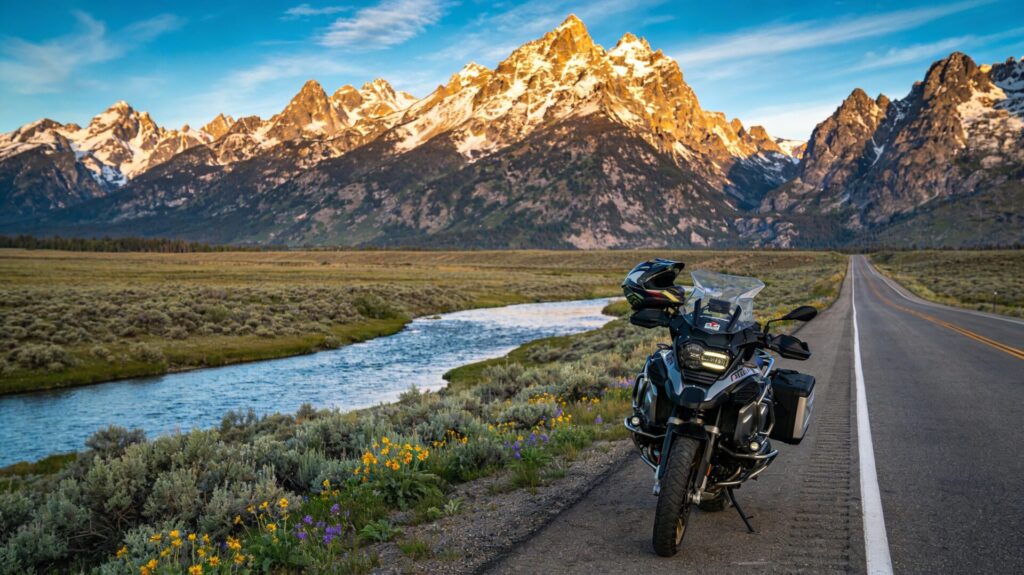
Wyoming Motorcycle Insurance at a Glance
Wyoming makes it easy to stay legal and easy to stay underinsured. The state minimum for a street-legal motorcycle is still 25/50/20, adults 18 and older can ride without a helmet, and lane splitting is flatly prohibited. But the same state also logged 2,467 wild-animal crashes, 83 blow-over crashes, and 265 motorcycle-involved crashes in 2024, while WYDOT’s safety plan notes that riders can legally run 80 MPH on nearly 500 miles of rural interstate and that weather can change road conditions fast.[1, 7, 8, 10]
That is the real Wyoming insurance problem. The law only requires a thin liability layer. It does not automatically build a recovery plan for your bike, your gear, your ER bill, or the long tow that follows a crash somewhere between Rawlins and Laramie. If you want a policy that actually fits Wyoming riding, you need to understand what the state minimum does, what it leaves exposed, and where Wyoming’s wind, wildlife, distance, and seasonal closures change the math.[1, 7, 8, 9]
Wyoming’s minimum motorcycle insurance: 25/50/20, plus uninsured motorist unless you reject it
Wyoming’s compulsory insurance rule starts with W.S. 31-4-103. If your motorcycle is a vehicle that must be registered and you operate it on Wyoming roads, you must keep liability coverage in force in the amounts required by W.S. 31-9-405(b): $25,000 for bodily injury or death to one person, $50,000 for bodily injury or death to two or more people in one crash, and $20,000 for property damage.[1]
The extra rule many riders miss is uninsured motorist coverage. Under W.S. 31-10-101, a Wyoming policy for a motor vehicle registered or principally garaged in the state must include uninsured motorist bodily injury coverage in at least the statutory financial responsibility limits, unless the named insured rejects it. So the default Wyoming motorcycle policy is not just 25/50/20 liability. It is 25/50/20 liability plus UM bodily injury unless you sign that protection away.[1]
What Wyoming does not do is force motorcycles into a no-fault/PIP structure. The compulsory insurance statutes cited here require liability coverage and default UM bodily injury coverage, but they do not create a separate mandatory motorcycle PIP, MedPay, or UIM minimum. That matters later in a claim, because Wyoming riders generally live and die by fault, liability limits, and whatever optional first-party coverage they chose before the crash.[1, 2]
| Coverage | Wyoming rule | Minimum / default amount |
|---|---|---|
| Bodily injury liability | Required | $25,000 per person / $50,000 per crash |
| Property damage liability | Required | $20,000 per crash |
| Uninsured motorist bodily injury | Included unless the named insured rejects it | At least 25/50 bodily injury limits |
| Underinsured motorist | Optional | No separate compulsory minimum identified in the Wyoming compulsory insurance statutes cited here |
| PIP / no-fault benefits | Not part of Wyoming’s motorcycle compulsory insurance structure | No mandatory minimum |
| Medical payments | Optional | No mandatory minimum |
Key Point: Wyoming’s minimum is designed to protect the other person from your liability, not to rebuild your life after a bike crash.[1, 4]
Proof of insurance in Wyoming: card, phone, database, and the seven-day rule
Wyoming is unusually direct about proof. Under W.S. 31-8-201, your insurer must issue an insurance identification card or temporary evidence of insurance valid for up to 60 days, and that card or temporary proof must be carried in the vehicle at all times. Wyoming also ties insurance to registration: under W.S. 31-2-225(e), a county treasurer cannot register a motor vehicle unless the applicant verifies that the vehicle is covered by the required liability policy or bond.[1]
Electronic proof is allowed, but not casually. Wyoming permits an electronic insurance card only when the insurer and insured agreed to electronic issuance and the digital card contains the information the statute requires. A proper e-card on your phone works. A vague login screen or half-loaded app page is not the same thing.[1]
The state also runs an online insurance verification system. Wyoming law requires that system to be available 24 hours a day, seven days a week to law enforcement and other authorized users, and the financial responsibility statute specifically says proof may be shown through a successful online verification search. In other words, Wyoming expects insurance to be checkable in real time even when you do not have paper in your pocket.[1]
Seven-Day Rule: There is a major difference between not having proof at the stop and actually being uninsured. If an officer asks for proof during a moving-violation stop or vehicle inspection and you cannot produce it, W.S. 31-4-103 gives you seven days to show that the policy or bond was in force when the citation was issued. If you later produce valid proof for that date, you should not be convicted. If the policy had actually lapsed, the seven-day grace period does not rescue you.[1]
Do not get clever with a borrowed or altered card. Under W.S. 31-8-202, using a canceled, fictitious, altered, or fraudulently obtained insurance card—or using someone else’s card as your own—can mean a fine of up to $750, up to six months in jail, or both.[1]
What happens if you ride uninsured in Wyoming
Wyoming does not treat uninsured riding like a paperwork nuisance. The offense is a misdemeanor, and the statutes stack practical consequences on top of the criminal penalty.[1, 11]
| Situation | Consequence | Wyoming source |
|---|---|---|
| First conviction for operating or allowing operation without required liability coverage | $500 to $1,500 fine, up to 6 months in jail, or both | W.S. 31-4-103(a) |
| Second or later conviction | Judge must require the registration and license plate for the vehicle involved to be delivered to the county treasurer until legal obligations are satisfied | W.S. 31-4-103(c) |
| After any conviction under W.S. 31-4-103(a) | Three years of proof of financial responsibility required | W.S. 31-4-103(d); W.S. 31-9-401 |
| Failure to provide that proof within 30 days after notice | Driver’s license or nonresident operating privilege suspended until proof is received | W.S. 31-4-103(d) |
| Compulsory insurance suspension already started | No limited driving privileges; suspension remains until SR-22 filed; $50 reinstatement fee generally applies | WYDOT withdrawal guidance / driver manual |
The statutory language says “proof of financial responsibility,” but in day-to-day insurance life this usually means an SR-22 filing. WYDOT’s withdrawal materials explain the practical version: a compulsory insurance suspension lasts until the SR-22 is on file, there are no limited driving privileges for that suspension, and the general reinstatement fee is $50. If the SR-22 is filed before the suspension start date, WYDOT says the suspension can be deleted from your record; after the start date, you need the SR-22 and the reinstatement fee.[11]
There is another Wyoming wrinkle riders rarely hear about until after a crash. WYDOT’s driver manual separately describes an uninsured accident suspension when insurance cannot be verified after a collision. Reinstatement may require notarized releases, a conditional payment agreement, or a cash deposit tied to property damage and injuries, and if you are suspended you still need the reinstatement fee and an SR-22.[11]
That is why a lapse in Wyoming tends to cost more than the premium you skipped. You are not just dealing with a ticket. You may be dealing with court, a plate hold, an SR-22, a suspension, reinstatement fees, and three years of insurer reporting.[1, 11]
What the Wyoming minimum actually protects—and what it leaves exposed
Picture a common Wyoming claim. You are riding through Cheyenne or coming into Casper and a driver turns left across your lane. If the other driver is at fault, you will generally pursue that driver’s liability insurance first, or your own uninsured motorist coverage if the driver has no insurance. But if the fault argument swings toward you, your own 25/50/20 minimum policy pays only the other party’s injuries and property damage up to the policy limit. It does not protect you or your bike directly.[1, 4]
That means Wyoming minimum liability does not pay to repair or replace your motorcycle after a crash you caused. It does not replace your helmet, jacket, boots, panniers, navigation gear, or phone mount. It does not pay your ambulance ride, ER bill, orthopedic follow-up, or lost wages unless you bought optional coverage designed to do that. The Wyoming Department of Insurance says the same thing in plainer language for auto policies: bodily injury liability does not protect you or your vehicle directly.[4]
Wyoming magnifies that gap. The 2024 WYDOT Fact Book lists 2,467 wild-animal crashes, 83 blow-over crashes, and 265 motorcycle-involved crashes. The Strategic Highway Safety Plan adds the context riders already know from experience: nearly 500 miles of rural interstate posted at 80 MPH, long distances between urban areas and sparsely spaced resources, quickly changing weather, and a winter driving season that typically runs from October through April but can show up any time of year.[7, 8]
Put differently, Wyoming is a bad place to discover that your “full coverage” quote was actually just minimum liability. The state minimum keeps you legal. It does not create a serious bike-damage plan, a medical plan, or a travel-recovery plan.[1, 7, 8]
Coverage upgrades that make far more sense in Wyoming
Higher liability limits
For most Wyoming riders, the first smart move is stepping up from 25/50/20 to something like 100/300/100. A crash on an 80 MPH corridor, a passenger injury, or damage to a late-model pickup can burn through state minimum limits fast, especially once towing, roadside property damage, or a second injured claimant enters the picture.[1, 8]
Collision
Collision is what turns “I laid it down” from a financial disaster into a deductible problem. That matters in Wyoming because many severe motorcycle losses are not clean two-car city crashes; they are also curve mistakes, gravel surprises, evasive maneuvers, and single-vehicle departures. WYDOT’s safety plan specifically notes that many curve-related critical crashes involve single vehicles leaving the roadway or overturning.[8]
Comprehensive
Comprehensive is especially valuable here because Wyoming gives riders more non-collision threats than many states: wildlife, hail, windblown debris, fire, theft, and weather damage. The state recorded 2,467 wild-animal crashes in 2024, and WYDOT’s wind guidance says Wyoming regularly deals with strong crosswinds and even hurricane-force winds in some corridors. If you ride dawn, dusk, or shoulder season, comprehensive is not fluff.[7, 10]
Uninsured and underinsured motorist coverage
Wyoming already requires UM bodily injury coverage to be included unless you reject it. Keeping it is the easy part. The more strategic question is whether to buy stronger UM and add UIM, because the other driver may have insurance but only at Wyoming’s thin minimum limits. A bad orthopedic injury can outrun 25/50 much faster than most riders expect.[1]
Medical payments or supplemental medical coverage
Wyoming does not force motorcycles into a PIP system, so first-party medical protection is a voluntary decision. That makes MedPay or similar supplemental medical coverage more important than it looks on a quote screen. It can help with deductibles, copays, ambulance charges, and immediate treatment while the fault fight is still being argued.[1, 4]
Custom parts, accessories, and riding gear coverage
A Wyoming bike often carries more than stock parts. Side cases, heated gear wiring, handguards, auxiliary lights, wind protection, GPS mounts, skid plates, and upgraded seats are common because long distances and shoulder-season weather make them useful, not cosmetic. Standard policies can cap accessory payouts, so riders with outfitted ADV, touring, or commuter bikes should ask exactly how aftermarket parts and riding gear are valued.[4]
Motorcycle-specific roadside assistance
In Wyoming, roadside coverage only matters if it knows how to handle a motorcycle and can reach you where you break down. WYDOT’s road-and-travel pages point riders to wyoroad.info and the 511 system as the authoritative source for current conditions and closures, which tells you something about the state already: closures, wind, and fast-changing conditions are part of ordinary trip planning here. Ask who tows the bike, how far the tow goes, and whether remote recovery is handled differently from a passenger car claim.[9, 10]
Trip interruption
Trip interruption coverage makes more sense in Wyoming than it does in dense metro states because a mechanical failure or crash can strand you a long way from home, lodging, parts, or a dealer. WYDOT’s safety plan describes the long distances between urban areas and sparsely spaced resources, and seasonal closures on routes such as WYO 130 over Battle Pass show how quickly a simple ride can turn into an overnight logistics problem.[8, 9]
Gap insurance
If your bike is financed, gap coverage fills the space between the insurer’s actual cash value payment and what you still owe on the loan. That is especially relevant for newer motorcycles with long terms or expensive accessories, and the DOI’s shopping guidance reminds buyers to make sure the lienholder is correctly listed on the policy from day one.[4]
Laid-up or storage coverage
Wyoming does not have one neat statewide riding season. But WYDOT’s safety planning still says winter driving typically runs from October through April, may arrive any time of year, and certain high-elevation routes close seasonally. A good laid-up arrangement can reduce premium while keeping comprehensive protection in place for theft, fire, animal damage, or storm damage during storage.[8, 9]
Wyoming’s helmet law: adults can choose, but the insurance consequences do not disappear
Wyoming does not have a universal helmet law. Under W.S. 31-5-115(o), a minor operating or riding on a motorcycle on public highways, streets, and thoroughfares must wear approved protective headgear. WYDOT’s motorcycle safety page states that rule plainly as applying to anyone under the age of 18. The statute does not apply to a rider in an enclosed cab and does not apply to a moped.[1, 12]
Once you are 18, Wyoming lets you ride without a helmet. That is a legal choice, not a financial shield. WYDOT has also highlighted the safety side of that choice: in a 2022 highway safety report, the agency noted that Wyoming has no helmet law for operators over 18 and that nearly 62% of motorcyclist fatalities over the prior five years involved riders who were not wearing a helmet.[12]
From an insurance standpoint, the bigger point is this: Wyoming motorcycle claims still run through fault and damages, not a no-fault PIP formula. So even where riding without a helmet is legal, the severity and cause of a head injury can still become part of the argument over damages. The statute does not create a special adult medical-coverage condition for bare-headed riding, but a serious injury claim is still a serious injury claim.[1, 2]
Lane splitting, filtering, and other Wyoming motorcycle rules worth knowing
- All motorcycles are entitled to the full use of a lane. Two motorcycles may ride abreast in one lane by consent of both riders.[1]
- Lane splitting is illegal. Wyoming law says no person shall operate a motorcycle between lanes of traffic or between adjacent lines or rows of vehicles.[1]
- Lane filtering is not separately legalized. Wyoming does not create a stoplight exception, so filtering is treated the same way as splitting.[1]
- You cannot ride three or more abreast in a single lane.[1]
- If you carry a passenger outside a sidecar or enclosed cab, the bike must have passenger footrests.[1]
- Your headlamp must be activated at all times, including daylight hours.[1]
- Wyoming requires a left-side mirror with a rearward view.[1]
- Your motorcycle must have a horn in good working order, and the horn statute expressly applies to motorcycles.[1]
- Every motorcycle must have a muffler or other effective noise suppressing system in good working order and in constant operation; a cut-out or bypass is not allowed.[1]
- Minors on motorcycles must wear approved headgear; adults do not have a universal helmet mandate.[1, 12]
Licensing and endorsement: the insurance-relevant version
Wyoming uses a Class M designation for motorcycles. Under W.S. 31-7-109, it can be added to another license class or issued by itself. A motorcycle instruction permit is available at age 15; after a written test and vision screening it may be issued for 90 days without a passenger, and if the applicant also passes a driving test, Wyoming may issue a one-year motorcycle permit without a passenger. The Basic Rider Course on WYDOT’s Motorcycle Safety page waives all testing requirements for the Class M endorsement if the completion card is presented within two years, and WYDOT says registration for the 2026 season opens in April 2026. The Class M designation fee is $6. If you test on your own bike, WYDOT requires that motorcycle to be legally licensed, registered, and insured and completely street legal.[1, 5, 6]
Motorcycle, scooter, moped, or e-bike? Wyoming does not treat them the same
| Vehicle Type | Wyoming definition | Insurance required? | License required? |
|---|---|---|---|
| Motorcycle | A motor vehicle with a seat or saddle for the rider and designed to travel on not more than three wheels in contact with the ground. For registration and titling, “motorcycle” includes motorized bicycles and scooters, but excludes mopeds, motorized skateboards, multipurpose vehicles, electric bicycles, and certain off-road recreational vehicles.[1] | Yes, if it is a street vehicle required to be registered.[1] | Yes. Class M.[1] |
| Street scooter / motor-driven cycle | Any motorcycle, including motor scooters and motorized bicycles, with less than 150cc displacement or five brake horsepower or less.[1] | Yes, if operated as a registered street vehicle.[1] | Yes. Class M.[1] |
| Moped | A motor-driven cycle with foot pedals, no more than two brake horsepower, a top speed of no more than 30 mph on a level road, and—if it uses an internal combustion engine—no more than 50cc plus an automatic/direct power drive system. Wyoming also lists mopeds as a registration exemption.[1] | Generally no for compulsory liability, because W.S. 31-2-224(a)(viii) exempts mopeds from registration and W.S. 31-4-103 applies to vehicles required to be registered.[1] | A valid driver license is still required; any person licensed to drive any class of vehicle may also drive a moped.[1] |
| Electric bicycle | A bicycle or tricycle with fully operable pedals, a seat or saddle, and an electric motor of less than 750 watts that fits Class 1, 2, or 3 statutory limits.[1] | No. The operator is not subject to Title 31 provisions relating to financial responsibility.[1] | No. The operator is not subject to driver’s license or registration provisions, and an electric bicycle is not a motor vehicle under the statute.[1] |
The practical takeaway is simple. If it is really a street motorcycle or street scooter, insure it like one. If it falls into Wyoming’s statutory moped or electric-bicycle bucket, the legal treatment is much lighter—but you still need to know which bucket you are actually in before assuming you are exempt.[1]
How Wyoming’s insurance system changes a motorcycle claim
Wyoming is a fault-based state for motorcycle claims. The statutes above create liability insurance requirements and default UM coverage, but they do not shove motorcycles into a mandatory no-fault PIP system. In practice, the claim usually starts with the at-fault driver’s liability coverage, your own UM/UIM coverage, or your own first-party coverages such as collision, comprehensive, or medical payments if you bought them.[1, 2, 4]
Wyoming also uses modified comparative fault. Under W.S. 1-1-109, your own fault does not bar recovery unless it is more than 50% of the total fault of all actors, and any damages you recover are reduced in proportion to your share of fault. So if an insurer convinces a jury that you were riding too fast for wind, ice, dusk wildlife conditions, or a tightening curve, your payout can shrink sharply—or disappear if your share passes the 50% line.[2, 8]
One more Wyoming-specific claim point matters in multi-party crashes: under the same statute, each defendant is liable only to the extent of that defendant’s proportion of the total fault. That can matter in a motorcycle case involving more than one driver, a commercial vehicle, or another contributing actor. The percentages are not just academic. They directly control who pays what.[2]
What affects motorcycle insurance prices in Wyoming
- Rider age and years licensed. Insurers price experience, not just birthdays. A long-clean Class M history usually helps more than simply getting older.[4]
- Bike type, engine size, and repair cost. A small commuter, a fully faired sport bike, and a big touring or ADV machine do not produce the same claim severity. Wyoming DOI specifically notes that make, model, and age of the vehicle can affect premiums.[4]
- Driving record. Wyoming DOI says insurers commonly ask for three years of driving history and may rate based on at-fault accidents and traffic violations.[4]
- Claims history. Prior losses often signal future loss potential, especially if the claims involved speed, weather, theft, or collision damage.[4]
- ZIP code and garaging location. DOI guidance names ZIP code as a rating factor, and even notes that parking off-street or in a garage can lower premiums.[4]
- Annual mileage and use pattern. Wyoming DOI identifies miles driven annually as a pricing factor. A short-season pleasure bike and a daily commuter are not rated the same way.[4]
- Credit-based insurance score. Wyoming DOI says insurers may use a credit-based insurance score as one factor in underwriting and rating, alongside other variables such as ZIP code and annual mileage.[4]
- Coverage mix and deductibles. Collision, comprehensive, medical payments, UM/UIM, accessory coverage, and deductible levels all move the premium.[4]
- Training and endorsement history. Completing WYDOT’s rider course can streamline licensing and may help with insurer underwriting if a carrier rewards formal training.[5, 6]
- Bundling, payment method, and lienholder status. Multi-policy, paid-in-full, homeowner or renter bundling, and financed-bike paperwork all affect how a carrier builds the quote and which endorsements it requires.[4]
Wyoming-specific exposure also quietly shapes premiums even when the insurer does not say it out loud. Wildlife, high-speed rural roads, wind, weather, and long-distance travel all change expected loss cost here compared with a compact urban state.[7, 8, 10]
How to compare Wyoming motorcycle quotes without fooling yourself
- Quote two liability levels on the same bike. Get one quote at Wyoming minimums and another at something like 100/300/100. That shows you the real cost of upgrading instead of guessing.[1]
- Hold deductibles constant. Wyoming DOI warns that quotes often do not match on coverages and limits. A cheap quote built on bigger deductibles is not actually cheaper coverage.[4]
- Ask exactly how UM is handled. Because Wyoming default UM can be rejected, two quotes may look similar while hiding very different protection levels.[1]
- Ask how OEM parts, accessories, and gear are valued. This matters more in Wyoming because many bikes carry real touring or ADV equipment, not just cosmetic add-ons.[4]
- Bring up winter storage and seasonal use. Ask whether comprehensive stays active during storage and whether the carrier offers a true lay-up option for Wyoming’s long winter window.[8]
- Confirm roadside assistance is motorcycle-specific. In a state that points travelers to 511 and wyoroad.info as the authoritative road-conditions source, towing details matter. Ask about remote recovery, mileage caps, and who actually handles the bike.[9]
- Check licensing and complaints before you pay. Wyoming DOI tells shoppers to verify that the company and agent are licensed and to inquire about complaints. The DOI Consumers page also provides company lookup and complaint links.[3, 4]
- If the bike is financed, confirm the lienholder and ask about gap. DOI guidance says the lienholder should be correctly listed on the policy. That is also the moment to decide whether actual cash value coverage alone is enough for your loan balance.[4]
Before you buy, also ask about paid-in-full, multi-policy, homeowner or renter bundling, and rider-course discounts. Wyoming DOI’s guidance is simple and good: compare matching limits, verify the company, and do not assume the lowest quote is the best quote.[4]
Wyoming motorcycle insurance FAQ
Do I need motorcycle insurance in Wyoming?
Yes, if the motorcycle is a vehicle required to be registered and you ride it on public roads. For a street-legal motorcycle, Wyoming requires liability coverage at 25/50/20. The rule is tied to registration status, which is why mopeds and electric bicycles are treated differently.[1]
Is the Wyoming state minimum enough?
For most riders, no. It keeps you legal, but it mainly protects the other person if you cause the crash. It does not pay to repair your own bike or cover your own injuries unless you added the right optional coverage.[1, 4]
Does Wyoming’s no-fault or PIP system apply to motorcycles?
Wyoming does not run motorcycle claims through a mandatory no-fault PIP structure. Motorcycle claims are generally handled through liability, comparative fault, UM/UIM, and any optional first-party coverages you bought such as collision, comprehensive, or medical payments.[1, 2]
What happens if I ride without insurance in Wyoming?
A conviction under W.S. 31-4-103 can mean a $500 to $1,500 fine, up to six months in jail, or both. After conviction, Wyoming can also require three years of proof of financial responsibility, usually through an SR-22, and can suspend your license if you do not provide that proof after notice.[1, 11]
Do mopeds and scooters need insurance in Wyoming?
Usually scooters do and mopeds generally do not. A street scooter typically falls under Wyoming’s motorcycle or motor-driven-cycle definitions and is treated like a registered street bike. A statutory moped is exempt from registration, and Wyoming’s compulsory liability rule applies to vehicles required to be registered.[1]
Does a Wyoming motorcycle safety course lower my insurance rate?
It can with some insurers, but that is a carrier pricing decision, not a special Wyoming statutory discount. What Wyoming definitely gives you is licensing value: WYDOT says successful completion of the Basic Rider Course waives all testing requirements for a Class M endorsement if you present the completion card within two years.[6]
What if my bike is financed or leased?
Expect the lender or lessor to care about more than Wyoming minimum liability. Comprehensive and collision are usually expected on financed bikes, and Wyoming DOI says the lienholder should be correctly listed on the policy. This is also where gap coverage deserves a serious look.[4]
Does Wyoming require uninsured motorist coverage on motorcycle policies?
Wyoming requires UM bodily injury coverage to be included unless the named insured rejects it. The statute does not create a separate mandatory UIM minimum, so riders who want stronger first-party protection should ask for it directly.[1]
Can I show proof of motorcycle insurance on my phone in Wyoming?
Yes, if the electronic insurance card was issued under the statute’s rules and contains the required information. If you cannot show proof during the stop, Wyoming gives you seven days to produce proof that was valid when the citation was issued—but that is very different from actually being insured.[1]
Do I have to wear a helmet after I turn 18 in Wyoming?
No. Wyoming’s helmet statute applies to minors, which WYDOT’s safety page describes as anyone under 18. Adult riders can legally go without a helmet, but legality does not eliminate the safety or damages arguments that follow a head injury claim.[1, 12]
Is lane splitting or lane filtering legal in Wyoming?
No. Wyoming bans operating a motorcycle between lanes of traffic or between adjacent lines or rows of vehicles, and there is no separate statutory exception for filtering to the front at a stoplight.[1]
What happens if I am uninsured in a Wyoming crash?
Beyond the criminal citation risk, WYDOT’s driver manual describes an uninsured accident suspension when coverage cannot be verified after a crash. Reinstatement may require releases from the other party, a conditional payment agreement, or a cash deposit, and suspension relief still involves an SR-22 and the reinstatement fee.[11]
Numbered sources and where to verify
- Wyoming Legislature, Title 31 – Motor Vehicles. This is the main primary source for insurance minimums, proof rules, UM coverage, licensing classes, helmet law, lane-splitting ban, moped/e-bike definitions, and registration exemptions.
- Wyoming Legislature, W.S. 1-1-109 Comparative Fault. Primary source for Wyoming’s modified comparative fault rule and proportionate liability language.
- Wyoming Department of Insurance, Consumers. Official consumer portal for complaint filing, company lookup, and agent lookup.
- Wyoming Department of Insurance, Insurance Topics. Official DOI guidance used here for quote-comparison tips, rating factors, garage/ZIP/mileage considerations, lienholder reminders, and basic coverage explanations.
- Wyoming Department of Transportation, Driver License Testing. Official WYDOT page for Class M testing, street-legal motorcycle requirements, and proof that the test bike must be licensed, registered, and insured.
- Wyoming Department of Transportation, Motorcycle Safety – Get Trained. Official source for the Basic Rider Course, waiver of Class M testing, age minimums, and 2026 registration timing.
- Wyoming Department of Transportation, 2024 Fact Book. Official statewide crash figures used here, including motorcycle, animal, and blow-over crash counts.
- Wyoming Department of Transportation, Wyoming Strategic Highway Safety Plan – 2022. Official source for Wyoming-specific safety context, including 80 MPH rural interstate mileage, long distances between resources, and winter/weather conditions.
- Wyoming Department of Transportation, Road & Travel Information. Official source stating that wyoroad.info / 511 is the authoritative road-conditions resource for Wyoming travel.
- Wyoming Department of Transportation, Wyoming Wind. Official source on Wyoming crosswinds, blow-over risk, and wind-related road management.
- Wyoming Department of Transportation, Driving Privilege Withdrawal. Official WYDOT suspension and reinstatement guidance used here for SR-22, compulsory insurance suspension, and reinstatement fee details.
- Wyoming Department of Transportation, Motorcycle Safety – Safety Laws. Official WYDOT summary for under-18 helmet language and core motorcycle traffic rules.
This article is written for March 2026. If you update it later, re-check the official sources above before changing limits, no-fault language, or registration-related insurance rules.