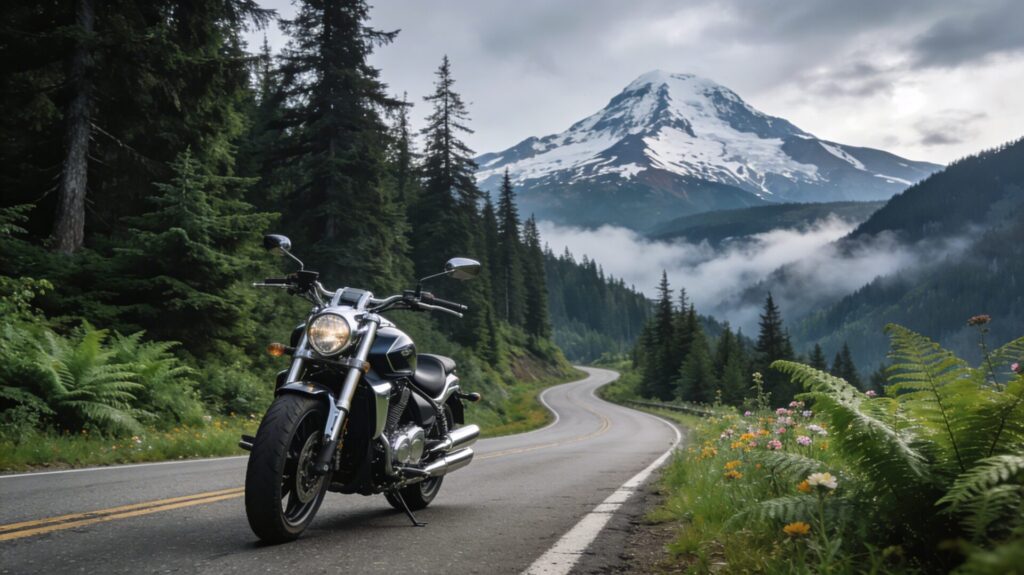
Oregon motorcycle insurance at a glance:
Required PIP: $15,000
Required UM BI: 25/50
Helmet: Required
Lane splitting: Illegal
Oregon’s minimum motorcycle insurance is broader than most riders expect. To ride legally on public roads, Oregon does not stop at 25/50/20 liability. The state also requires $15,000 in personal injury protection (PIP) and 25/50 uninsured motorist bodily injury coverage. On top of that, a January 1, 2026 law change altered what happens after an uninsured conviction or uninsured crash, so older Oregon insurance articles are already out of date.[1, 10, 11]
What’s in this guide
- Oregon minimum motorcycle insurance requirements
- Proof of insurance, registration, and what to carry
- What happens if you ride uninsured in Oregon
- Why Oregon’s minimum limits are usually not enough
- Coverage options that make sense for Oregon riders
- Oregon motorcycle laws that affect claims and tickets
- Licensing, permits, and Team Oregon discounts
- Motorcycle vs. moped vs. scooter vs. e-bike in Oregon
- How Oregon claims work after a motorcycle crash
- What changes motorcycle insurance prices in Oregon
- How to shop Oregon quotes without missing the fine print
- Oregon motorcycle insurance FAQ
Oregon minimum motorcycle insurance requirements
Oregon’s core financial-responsibility rules live in ORS chapter 806, while the required PIP and uninsured motorist rules live in ORS chapter 742. The Oregon DMV’s consumer-facing guidance is the cleanest summary: if a motorcycle or moped is operated on a highway or on premises open to the public, the legal minimum package includes liability coverage, PIP, and uninsured motorist bodily injury coverage.[1, 2, 3]
| Coverage | Oregon minimum | Why it matters |
|---|---|---|
| Bodily injury liability | $25,000 per person / $50,000 per crash | Pays for injuries you cause to other people. |
| Property damage liability | $20,000 per crash | Pays for damage you cause to someone else’s vehicle or property. |
| Personal injury protection (PIP) | $15,000 per person | Pays certain first-party medical and related losses for you, regardless of fault, up to the statutory minimum. |
| Uninsured motorist bodily injury | $25,000 per person / $50,000 per crash | Protects you if the driver who injures you has no insurance or not enough bodily injury coverage. |
The part many riders miss is that Oregon’s “minimum” is not just a liability number. A legal bike policy in Oregon needs PIP and uninsured motorist coverage too. That makes Oregon different from states where riders can stay legal with bare liability only. It also means the quote you get from a national carrier in Oregon may include pieces that riders in another state never have to buy.[1, 3]
Key detail about PIP: Oregon is not a pure no-fault state, but it does require PIP on the policy, so your own insurance can pay certain medical and related losses after a crash even before fault is sorted out. That helps with the first round of bills. It does not make liability questions disappear, and it does not transform a thin policy into strong protection.[1, 3, 19]
Proof of insurance, registration, and what to carry in Oregon
Oregon expects you to carry proof of compliance, but the state is modern about how you show it. Under Oregon law, proof of insurance can be displayed on an electronic device, and using your phone to show proof does not count as consent for an officer to search the rest of the device. That is one of the clearer rider-friendly proof-of-insurance rules in the country.[2]
There is a second Oregon-specific detail many riders never hear until registration day: DMV says you must provide your insurance policy number every time you register a vehicle or buy a light vehicle trip permit. In other words, insurance is tied into routine DMV transactions here more directly than in many other states.[1]
Also important: not carrying proof is not always the same as actually being uninsured. Oregon’s financial-responsibility statutes allow the court to dismiss a no-proof charge if you provide proof that you were insured at the time of the stop before the court date on the citation. That distinction matters because one situation is a fixable documentation problem; the other is a true uninsured-driving violation with much steeper consequences.[2]
What happens if you ride uninsured in Oregon
Under ORS 806.010, operating a motor vehicle in Oregon without the required insurance is unlawful on public roads and on premises open to the public. The offense is a Class B traffic violation. Oregon’s statewide schedule of fines lists a presumptive fine of $265, a minimum of $135, and a maximum of $1,000 for a Class B violation for an individual.[2, 12]
Critical 2026 change: As of January 1, 2026, an uninsured-driving conviction triggers a one-year future-responsibility filing requirement instead of the old three-year period. In practice, that usually means an SR-22 filed with Oregon DMV by an insurance company that does business in Oregon.[2, 10, 11]
That 2026 change is important because a lot of Oregon insurance content online still repeats the old three-year rule. The current statute is different. If you are quoting or writing about Oregon for 2026 and still using the older three-year conviction filing period, you are giving stale advice.[10, 2]
Uninsured crashes changed too. Oregon repealed the old automatic one-year suspension that followed an uninsured crash. The current rule is narrower but still serious: if DMV determines you were uninsured in the crash and you do not make the required filing within 30 days after the date of the accident, DMV must suspend your driving privileges until you comply or until the filing requirement terminates under Oregon law.[10, 11]
And yes, DMV’s SR-22 page confirms uninsured driving and uninsured crashes are both among the reasons Oregon can require an SR-22. To avoid a suspension for failing to file, DMV says it must receive the SR-22 before the deadline. If the suspension already starts, you will also be dealing with reinstatement requirements before you are fully back on the road.[11]
Why Oregon’s minimum limits are usually not enough
The legal minimum keeps you compliant. It does not do much to protect a rider with a modern bike, expensive gear, or any real injury exposure. Oregon’s required property damage limit is only $20,000. That can disappear fast if you hit a newer SUV, pickup, storefront, traffic signal hardware, or a utility installation. The required PIP layer is only $15,000, which is helpful immediately after a crash but not hard to exhaust once imaging, orthopedics, or follow-up rehab enter the picture.[1]
The risk is not abstract in Oregon. ODOT’s 2022 crash summary reports 1,016 motorcycle crashes, 1,059 people injured, and 101 deaths in motorcycle crashes that year; of those deaths, 98 were motorcyclists. When the exposure is that severe, minimum limits stop looking like savings and start looking like a very small cap on a potentially large loss.[26]
For most Oregon riders, a more realistic starting point is often 100/300/100 instead of the legal floor. That recommendation is not because the law requires it. It is because Oregon’s actual crash math makes 25/50/20 look thin the moment the loss involves an ambulance, surgery, multiple injured people, or late-model property damage. If you can afford the step-up, quote it side by side rather than assuming it will be overpriced.[1, 26]
Coverage options that make sense for Oregon riders
Higher liability limits. This is the simplest upgrade and usually the most important. A rider commuting in Portland traffic, crossing busy Salem corridors, or riding fast rural roads east of the Cascades has more to lose than the state minimum acknowledges. Higher bodily injury and property damage limits give you room when the crash is more than a scrape and a mirror.[1]
Stronger UM/UIM protection. Oregon already requires uninsured motorist bodily injury coverage, which is good, but the required amount is still only 25/50. If you are hurt by a driver carrying little or no insurance, that floor can be inadequate. For riders, this is not fringe coverage. It is one of the most valuable parts of the policy because it protects you from somebody else’s weak insurance decision.[1, 3]
Collision. State minimum liability does nothing for your own motorcycle. Collision is what gets your bike repaired or paid for when you dump it in a curve, get clipped by a turning driver, or choose to use your own carrier instead of waiting on an adversarial fault fight. In Oregon’s fault-based system, that speed and control matter.[18, 15]
Comprehensive. This one is unusually easy to justify in Oregon. The Division of Financial Regulation says comprehensive covers damage caused by fire, smoke, or ash and can also cover losses from falling trees or limbs. DFR separately explains that collision, not comprehensive, is the coverage that applies when you hit storm debris or slide on ice while driving. For Oregon riders dealing with winter storms, branches, fire seasons, and ash, that distinction matters.[19, 20]
Gap coverage. If your bike is financed, this deserves a real look. Oregon DFR’s FAQ notes that gap coverage might not pay every dollar you owe, but it exists for exactly the problem riders run into after a total loss: actual cash value and loan balance are not the same number. If your motorcycle totals early in the loan, the gap between those numbers can become your problem unless you planned for it.[17, 18]
Accessory and gear coverage. Oregon riders spend money on gear that is not cosmetic: hard luggage, comm systems, heated gear, upgraded lighting, crash bars, and navigation mounts. Ask each insurer what it includes automatically, what it caps, whether riding gear is covered separately, and whether aftermarket parts are valued fairly. The answer varies more than most shoppers expect.
Roadside assistance and trip interruption. These are not must-haves for every rider, but Oregon makes them more useful than they sound. Long rural stretches, mountain passes, smoke closures, and cold-weather travel make a motorcycle-specific tow benefit worth pricing. Ask one practical question rather than a vague one: “How many towing miles for a motorcycle are included?”
Lay-up or storage treatment instead of cancellation. Plenty of Oregon riders park the bike for stretches of winter or smoke season. That does not automatically mean canceling the policy is smart. Oregon does not allow insurers to rate you higher solely because of a lapse in coverage, but DFR’s bulletin makes clear a lapse can still be considered with other factors. In plain English: don’t create an avoidable lapse just to save a little premium if the carrier offers a better seasonal option.[24]
Oregon motorcycle laws that affect claims and tickets
Insurance shopping gets easier when you know which Oregon riding rules can also show up in a claim file. The big ones are not obscure.
- Helmet law: Oregon requires motorcycle riders and passengers to wear helmets, with narrow statutory exceptions such as an enclosed cab and certain very low-speed three-wheel vehicles.[5, 13]
- Lane splitting / lane filtering: Still illegal in Oregon. ORS 814.240 continues to bar operating between lanes of traffic or between adjacent lines or rows of vehicles, and the Legislature’s 2025 transportation brief lists HB 3542 as not enacted.[13, 27]
- Two abreast: Allowed, but not more than two abreast in one lane.[13]
- Headlight on: Oregon requires lighted headlights on a motorcycle or moped at all times on a highway.[13]
- Full lane use: Other drivers may not deprive a motorcyclist of the full lane.[14]
- Passengers: Oregon’s motorcycle manual requires permanent seating for a passenger, prohibits seating a passenger in front of the rider, and requires footrests unless the passenger is in a sidecar or enclosed cab.[7, 13]
- Equipment: Oregon’s motorcycle manual requires at least one rear-view mirror, one horn, fenders on all wheels, legal lighting, and compliant exhaust equipment, among other basics.[7]
These are not just ticket issues. A crash file is built from facts, and facts include rider conduct, legal equipment, lane position, lights, and helmet use. A bike policy does not stop those issues from becoming arguments about fault or injury severity after the wreck.
Licensing, permits, and Team Oregon discounts
For a standard two-wheel street bike, Oregon uses the familiar motorcycle endorsement. There is also a restricted three-wheel endorsement path for qualifying three-wheel motorcycles. For most new riders, the modern Oregon process means a valid Oregon driver license, minimum age requirements, a Team Oregon education course, a vision test, and sometimes a DMV knowledge test depending on which course you completed.[5, 6]
If you are riding on a motorcycle instruction permit, Oregon is strict: daylight riding only, no passengers, and supervision by a rider at least age 21 with a valid motorcycle endorsement riding on a separate motorcycle. Those limits matter because a quote application often asks about license status, training, and years endorsed, and insurers rate inexperienced riders differently.[5, 6]
Training matters for pricing too. Team Oregon’s FAQ says carriers in Oregon are required to offer a discount to a rider who passes a Basic or Intermediate course. The Oregon motorcycle manual and DFR filing materials also reflect the course-discount framework. The exact percentage varies by insurer, but the practical takeaway is simple: if you completed qualifying Team Oregon training, make sure the quote actually reflects it.[23, 6]
There is also a safety reason to care. Oregon’s online motorcycle manual says 35% of motorcycle riders involved in fatal collisions in 2022 were riding without a valid endorsement. That is not just a licensing problem. It is a pricing signal, a claim signal, and a reminder that insurers are not irrational when they charge more for inexperience.[6]
Motorcycle vs. moped vs. scooter vs. e-bike in Oregon
In Oregon, the sales label on the showroom floor is not the legal definition that controls insurance, registration, or helmet rules. This is one of the easiest places for riders to get tripped up, especially with small gas scooters and electric devices.[8, 9]
| Vehicle type | How Oregon defines it | Insurance required? | License / endorsement required? |
|---|---|---|---|
| Motorcycle | Self-propelled vehicle, other than a moped or farm tractor, with a seat or saddle and not more than three wheels in contact with the ground. | Yes, when operated on public roads or premises open to the public. | Yes. Oregon driver license plus motorcycle endorsement, subject to limited enclosed-cab exceptions. |
| Moped | Up to 30 mph on a level road; gas engine 35.01–50cc if combustion-powered; automatic drive; no more than three wheels. | Yes. | Any class of driver license; motorcycle endorsement not required unless it falls outside the moped definition. |
| Motor assisted scooter | Motor- or human-propelled device with foot support or seat; top speed up to 24 mph; gas engine 35cc or less or electric motor output 1,000 watts or less. | No. | No driver license, but operator must be at least 16. |
| Electric assisted bicycle | Class 1, 2, or 3 e-bike with pedals under Oregon’s electric-assisted bicycle rules. | No. | No driver license, but operator must be at least 16. |
Key clarification: A gas-assisted bicycle is treated as a moped, not an e-bike. That change in classification affects insurance, registration, licensing, and helmet requirements immediately. If you are writing policy content or shopping coverage, that one sentence saves a lot of confusion.[9]
How Oregon claims work after a motorcycle crash
Oregon uses a fault-based liability system, not a pure no-fault one. In practice, that means you can present a claim to the at-fault driver’s insurer, use your own coverages where appropriate, or do both in parallel depending on the situation. PIP still matters because it can pay first-party medical and related losses early, but it does not eliminate fault arguments on the liability side.[3, 18]
Fault matters because Oregon follows modified comparative negligence under ORS 31.600. If your fault is not greater than the combined fault of the people you are claiming against, you can still recover, but your damages are reduced by your share of fault. If your fault is greater than the combined fault of the others, the liability claim fails. That rule makes lane choice, speed, lighting, and crash reconstruction details matter in motorcycle cases.[15]
Oregon also has a crash-report rule that riders regularly overlook. DMV says that within 72 hours of a reportable motor vehicle collision, drivers must submit an Oregon Traffic Collision and Insurance Report. You must still file even if law enforcement files a report. If you fail to file when required, DMV says Oregon law requires it to issue a suspension notice.[4]
A collision is reportable in Oregon if any of these are true: someone was injured or killed; damage to your vehicle is over $2,500; damage to any vehicle is over $2,500 and any vehicle is towed from the scene; or damage to non-vehicle property is over $2,500. DMV also says you must immediately notify police if the collision meets the reporting requirements.[4]
If the bike is a total loss, Oregon gives consumers more structure than many riders realize. DFR says the insurer must provide a written notice explaining total loss, including how vehicle values are determined and what to do if you disagree with the insurer’s offer. That is useful because total-loss disputes on motorcycles often turn on mileage, condition, accessories, and whether the comparison vehicles are actually comparable.[18]
If a claim gets messy, Oregon also gives you regulatory tools. DFR’s complaint information page includes a complaint comparison tool so you can compare insurer complaint history, and the agency publishes an annual auto complaint report. Those resources are not a substitute for policy language, but they are good due diligence when you are deciding which carrier deserves your premium.[21, 22]
What changes motorcycle insurance prices in Oregon
Some price drivers are obvious: your age, riding history, bike type, engine size, claim record, annual mileage, storage situation, ZIP code, and deductibles. But Oregon has a few state-specific pricing details worth calling out.
- Driving record: Oregon DFR says premiums reflect your driving record for the past three years, and insurers pull records from Oregon DMV and other states.[16]
- Training: Team Oregon course completion can qualify you for a discount, and insurers are required to offer one for riders who pass a Basic or Intermediate course.[23, 6]
- Credit-based insurance score: Oregon still allows credit-related auto rating, and DFR says consumers may request an annual rerate if improved credit could lower premiums. The rerate can improve pricing or leave it unchanged, but DFR says it will not make the premium worse.[25]
- Lapse in prior coverage: Oregon does not let insurers charge higher premiums solely because of a lapse in coverage, although DFR’s bulletin explains that lapse can still be considered with other factors and that driving uninsured remains a serious problem.[24]
The useful implication for shoppers is straightforward. In Oregon, “same rider, same bike” does not necessarily mean “same premium” if one carrier missed the Team Oregon discount, one carrier is using a stale credit profile, or one application coded your prior coverage incorrectly.
How to shop Oregon motorcycle quotes without missing the expensive fine print
- Quote two tiers, not one. Run Oregon minimum limits and a stronger package such as 100/300/100. That shows you the real price spread instead of letting the minimum anchor the whole decision.
- Keep deductibles the same. Changing the deductible between carriers makes the comparison useless.
- Ask specifically about UM/UIM limits. In Oregon, this is one of the most valuable coverages on the whole policy because it protects you from someone else’s weak insurance.
- Check comprehensive details. Oregon weather and wildfire seasons make comp more valuable than riders sometimes assume. Ask about fire, smoke, ash, vandalism, theft, and falling-object claims.[19, 20]
- Ask how accessories and riding gear are handled. Do not assume your hard bags, upgraded seat, electronics, helmet, or jacket are fully covered.
- Verify the Team Oregon discount is in the quote. Do not assume the rating system found it automatically.[23]
- Use Oregon complaint data. Check the DFR complaint comparison tool and the annual auto complaint report before you bind coverage.[21, 22]
- For financed bikes, ask about gap. DFR notes gap may not pay everything, but it can still be the difference between walking away and writing a check after a total loss.[17]
If you want the shortest version of the buying advice: in Oregon, spend less time arguing over the last five dollars of premium and more time checking liability limits, UM/UIM limits, accessory caps, and claim reputation. Those are the line items that tend to matter after the crash instead of before it.
Oregon motorcycle insurance FAQ
Do you need motorcycle insurance in Oregon?
Yes. Oregon requires motorcycle and moped insurance when the vehicle is operated on a highway or on premises open to the public. The minimum package includes liability, PIP, and uninsured motorist bodily injury coverage.[1]
What is the minimum motorcycle insurance in Oregon?
The legal minimum is $25,000 per person / $50,000 per crash for bodily injury liability, $20,000 property damage liability, $15,000 PIP, and $25,000 / $50,000 uninsured motorist bodily injury.[1]
Is Oregon a no-fault state for motorcycle accidents?
No. Oregon uses a fault-based liability system, but the state still requires PIP, so your own policy can pay certain first-party injury losses regardless of fault.[3, 15]
Does Oregon require uninsured motorist coverage on motorcycles?
Yes. Uninsured motorist bodily injury coverage at 25/50 is part of the required minimum package in Oregon.[1]
Can you show proof of motorcycle insurance on your phone in Oregon?
Yes. Oregon law allows proof of insurance to be shown on an electronic device, and using the device for that purpose does not authorize a search of the other contents of the device.[2]
What happens if you ride uninsured in Oregon?
Driving uninsured is a Class B traffic violation. A conviction now requires a one-year future-responsibility filing, typically an SR-22, and an uninsured crash can lead to a suspension if the required filing is not made within 30 days after the accident.[2, 10, 11, 12]
Is lane splitting legal in Oregon?
No. Oregon still prohibits riding between lanes of traffic or between adjacent lines or rows of vehicles, and the 2025 lane-splitting/lane-filtering bill was not enacted.[13, 27]
Do you have to wear a helmet in Oregon if you are over 21?
Yes, with narrow statutory exceptions. Oregon’s default rule is helmet use for motorcycle riders and passengers.[5, 13]
Do mopeds need insurance in Oregon?
Yes. Mopeds need insurance when used on public roads or premises open to the public. Motor assisted scooters do not.[1, 9]
Does Team Oregon lower motorcycle insurance rates?
Often yes. Team Oregon says insurers in Oregon are required to offer a discount to riders who pass a Basic or Intermediate course.[23]
Do you have to file a crash report with Oregon DMV after a motorcycle accident?
Yes, if the collision is reportable. In general, Oregon requires a DMV collision and insurance report within 72 hours when there is injury, death, or damage meeting the state’s reporting thresholds.[4]
Can you cancel motorcycle insurance for the winter in Oregon?
You can change or cancel coverage, but a storage or lay-up approach is often smarter than creating a lapse. Oregon does not allow insurers to rate you higher solely because of a lapse, but lapse can still matter with other rating factors.[24]
Bottom Line
Oregon’s minimum motorcycle insurance gets you legal, not well protected. The state requires more than bare liability, the uninsured-driving rules changed in 2026, reportable crashes must be filed with DMV within 72 hours, and lane splitting is still off the table. For most riders, the smart Oregon policy is not the smallest one you can buy; it is the cheapest policy that still gives you enough liability, UM/UIM, and physical-damage protection to survive a real crash.[1, 4, 10, 13]
Sources
- Oregon DMV — Insurance Requirements
- Oregon Revised Statutes, Chapter 806 — Financial Responsibility Law
- Oregon Revised Statutes, Chapter 742 — Insurance Policies
- Oregon DMV — Collision Reporting and Responsibilities
- Oregon DMV — Motorcycle Instruction Permit and Endorsement
- Oregon Online Motorcycle & Moped Manual — Section 1
- Oregon Motorcycle & Moped Manual (PDF)
- Oregon DMV — Vehicle Types
- Oregon Micromobility, Moped and Mini Motorcycle Guide (PDF)
- Oregon Legislature — Enrolled SB 840 (2025 Regular Session)
- Oregon DMV — SR-22 Information
- Oregon Judicial Department — Schedule of Fines on Violations (SOF24)
- Oregon Revised Statutes, Chapter 814 — Motorcycle and Moped Rules
- Oregon Revised Statutes, Chapter 811 — Rules of the Road
- Oregon Revised Statutes, Chapter 31 — Comparative Fault
- Oregon Division of Financial Regulation — Auto Insurance 101
- Oregon Division of Financial Regulation — Car Insurance FAQs
- Oregon Division of Financial Regulation — Totaled Vehicle
- Oregon Division of Financial Regulation — Winter Weather and Insurance Claims
- Oregon Division of Financial Regulation — Wildfires / Storm Damage
- Oregon Division of Financial Regulation — Complaint Information and Data
- Oregon Division of Financial Regulation — 2024 Auto Complaint Report
- Team Oregon — FAQ
- Oregon Insurance Division Bulletin INS 2013-04 — Lapse in Coverage as a Rating Factor
- Oregon DFR — Credit-Based Insurance Score Rerate Notice (April 4, 2024)
- Oregon Traffic Crash Summary 2022
- Oregon Legislative Policy and Research Office — 2025 Transportation & Infrastructure Session Brief
Editorial note: This guide is written for March 2026 and should be rechecked against current Oregon statutes, DMV guidance, and DFR pages before future updates.