A New York Senate bill introduced September 14, 2026 would restrict retail sales of fast electric vehicles that the bill calls “e-motos” and create a separate dealer route for certain electric off-highway motorcycles.
S.10700 is still in the Senate Rules Committee as of September 26; none of its proposed sales restrictions is in force.
For a rider looking at an electric dirt bike, the proposed text matters because it draws a line between two types of machine that can look similar in a showroom.
It also contains a warning requirement whose wording appears to conflict with the bill’s own permitted dealer-sale route. Those details deserve more attention than a headline saying New York would simply “ban electric motorcycles.”
Key points:
- Status: S.10700 was referred to the Senate Rules Committee on September 14. It has not passed either chamber or become law.
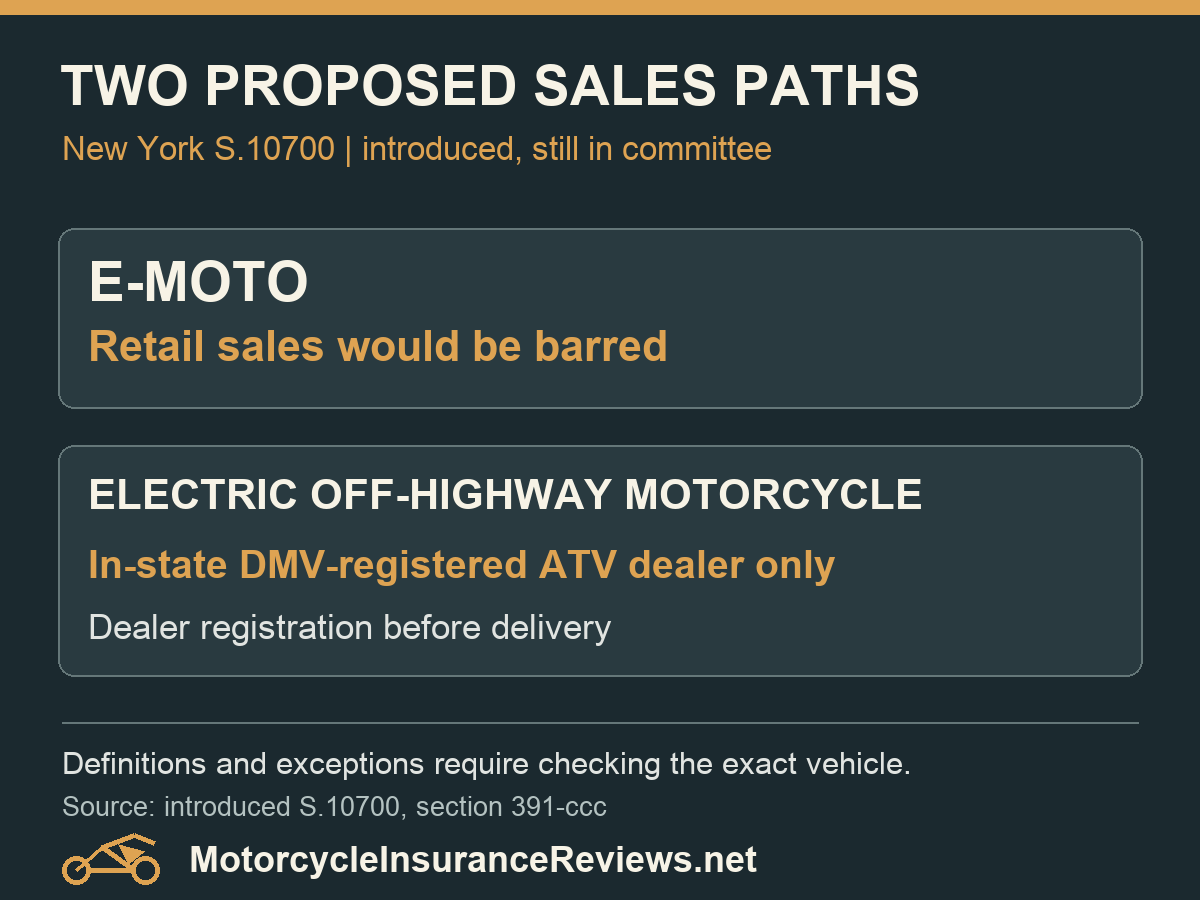
- Proposed e-moto rule: The bill would bar New York physical and online retailers from selling a device that meets its new “e-moto” definition.
- Different off-highway route: A qualifying electric off-highway motorcycle could be sold only by a New York DMV-registered ATV dealer physically in the state, with dealer registration before delivery.
- Text issue: The bill’s required point-of-sale warning says a covered device is not legal to sell to a New York purchaser, even though a prior subsection would allow the off-highway category through registered dealers. That tension needs legislative clarification.
S.10700 is a sales proposal, not a new riding ban today
Sen. Kristen Gonzalez introduced S.10700 on September 14. The official bill page lists one action: referral to the Senate Rules Committee that day.
A September 16 sponsor announcement describes the measure as a response to high-speed devices being marketed as lawful e-bikes or scooters.
The introduced bill would add three sections to New York’s General Business Law covering sales, warning notices and deceptive marketing. It also proposes an amendment to the Vehicle and Traffic Law’s seizure provision.
Its stated effective date is immediate if enacted, but introduction is only the start of the legislative process.
The bill does not by itself tell an owner that a machine already purchased must be surrendered, and it is not a blanket prohibition on all electric motorcycles. Its central restrictions would apply to sellers and to specific classifications.
A buyer still has to determine whether the actual vehicle can be registered and where it may legally be ridden under rules in force now.
The proposed “e-moto” definition has two exceptions
In proposed General Business Law § 391-ccc(1)(a), an e-moto would be a device with a motor capable of propelling it faster than 20 mph. That speed alone does not finish the classification.
The same sentence excludes devices expressly left out of the Vehicle and Traffic Law’s motor-vehicle definition and devices eligible for registration under that law.
Those exceptions matter for a normal street motorcycle. A road-registrable electric motorcycle capable of more than 20 mph would not become the bill’s prohibited “e-moto” simply because of its speed.
The proposal is aimed at the gap between legal micromobility and registrable motor vehicles, not at every electric motorcycle a dealer sells.
The bill separately defines an electric off-highway motorcycle by referring to New York’s existing off-highway-motorcycle definition in Vehicle and Traffic Law § 125-a.
That section describes a motorcycle made and sold primarily for off-highway trails or competitions, lacking equipment required by § 381 and not qualifying as a limited-use motorcycle if properly equipped. S.10700 adds an electric motor and registration eligibility to the proposed sales category.
It expressly says pedals do not decide whether a machine is in that category.
This is a vehicle-by-vehicle question. A seller’s “e-bike,” “moped” or “dirt bike” label cannot establish the legal classification. Ask for the manufacturer’s identification, certification, equipment list and New York DMV registration pathway for the exact model and model year.
The proposed dealer route for off-highway motorcycles
The introduced § 391-ccc(2) would prohibit physical and online retailers from selling, offering or reselling an “e-moto” in New York.
Subsection (3) would prohibit an online retailer from selling an electric off-highway motorcycle, but it would allow that separate category to be advertised, offered and sold by a DMV-registered ATV dealer physically located in New York.
The dealer would have to register the machine with DMV before delivering it to the buyer.
That is a narrow route, not a promise that every electric dirt bike will qualify. The model must meet the bill’s definition and the registration requirement.
A buyer should ask the dealer what registration document would be issued and whether the bike can be used at the intended riding location. Registration of an off-highway machine is not the same as authorization to ride it on a public street.
New York DMV’s ATV dealer requirements explain that a business already registered as a motor-vehicle dealer does not need a separate ATV-dealer registration for ATV sales.
S.10700’s introduced language, however, specifically calls for an ATV dealer “physically located in this state and registered with” DMV.
How that language would interact with existing dealer registrations is another point to check if the proposal advances.
The proposed sales rule speaks to sellers, including online sellers, and a retail transaction in New York. It does not set out a new insurance product or say that ordinary motorcycle liability insurance would make an unregistrable device legal for road use.
A warning that conflicts with the proposed sale exception
Proposed § 391-cccc would require a conspicuous warning for devices meeting either the e-moto or electric off-highway-motorcycle definition. The notice would appear before purchase in bold print at the same size as the price.
It says, in part, that the device is not legal to ride on a public highway or street and is not legal to sell to a purchaser in New York State.
That second sentence fits the bill’s proposed ban on e-moto sales. It sits uneasily beside § 391-ccc(3), which expressly gives registered in-state ATV dealers a route to sell electric off-highway motorcycles after registering them before delivery. Both provisions appear in the same introduced text.
We cannot tell from the bill record whether lawmakers intended different notices for the two categories or will amend the language.
The sponsor’s press release also describes the off-highway category as a dealer sale, while summarizing the notice more broadly. The statutory wording controls what the legislature is considering, so the conflict should be resolved in the bill itself.
A retailer should not treat a press summary as a substitute for the enacted text if the measure moves forward.
The bill would set civil penalties for violations of its proposed sales, warning and marketing provisions. Those are seller-facing enforcement provisions; the amounts and procedures are not current penalties for an owner buying or riding a machine today.
Product listings would need to match the actual machine
The third proposed section, § 391-ccccc, would prohibit false or misleading marketing of e-motos, electric scooters, electric-assist bicycles and electric off-highway motorcycles. It specifically targets presenting a machine as an e-bike, e-scooter or off-highway motorcycle when it does not meet the applicable legal definition.
For a buyer, that is the practical point behind the proposal. A web listing can show pedals, a bicycle-like frame or a low-speed mode while leaving out the machine’s maximum capability or registration status.
The bill’s more-than-20-mph threshold and its registration exceptions would require information about the actual device, not just a category selected by an online marketplace.
New York DMV already describes limited-use motorcycles, often called mopeds, in separate speed classes. Its registration guide says only a manufacturer-certified model can be registered as a moped.
That is why a seller’s use of the word “moped” does not settle whether the vehicle is eligible for a plate.
Existing Vehicle and Traffic Law § 410 also requires a motorcycle operated on public highways to be registered, with exceptions expressly provided elsewhere in law.
The proposal should not be read as a change to those current road rules. It is a possible new point-of-sale filter layered onto existing vehicle definitions and operating requirements.
What a New York buyer can check now
There is no need to guess whether S.10700 has taken effect. Check its official bill page for a new committee action, floor vote, identical Assembly measure, governor action or amended text. If the bill changes, use the current version before making a purchase decision.
For a particular electric motorcycle or dirt bike, ask the seller to put five answers in writing:
- Exact model and top capability: What model year and vehicle identification number will be delivered, and what speed is the motor capable of producing?
- Classification: Is the manufacturer presenting it as a registrable road motorcycle, a registrable off-highway motorcycle, a certified limited-use motorcycle or something else? Ask for the supporting DMV pathway, not a marketing nickname.
- Registration document: What certificate or registration will the New York buyer actually receive, and who completes the process?
- Permitted use: Can it be ridden on the buyer’s intended public road, private land or designated off-highway area under rules in force at that location?
- Protection: Does a quoted policy cover the exact vehicle and intended use, including theft or transport if those risks matter? An insurance quote alone does not establish legal road eligibility.
S.10700 could change before any vote. For now, its news value is the proposed split between an e-moto sales ban and a registered off-highway dealer route, plus the unresolved warning language.
A rider can follow the bill while relying on today’s DMV classification and the actual machine’s paperwork for a purchase decision.
References
- New York Senate S.10700 bill record and introduced text — Current Rules Committee status, definitions, sale categories, warning text, penalties and immediate-if-enacted effective clause.
- New York Vehicle and Traffic Law § 125-a off-highway motorcycle definition — Current statutory definition incorporated by S.10700.
- New York DMV limited-use motorcycle registration guide — Current moped speed classes and manufacturer-certification requirement.
- New York Vehicle and Traffic Law § 410 motorcycle registration — Current public-highway motorcycle registration rule.
- New York DMV ATV dealer requirements — Current registered ATV versus motor-vehicle dealer context.
- Sen. Gonzalez September 16, 2026 S.10700 announcement — Sponsor-stated rationale and description of proposed sales paths.