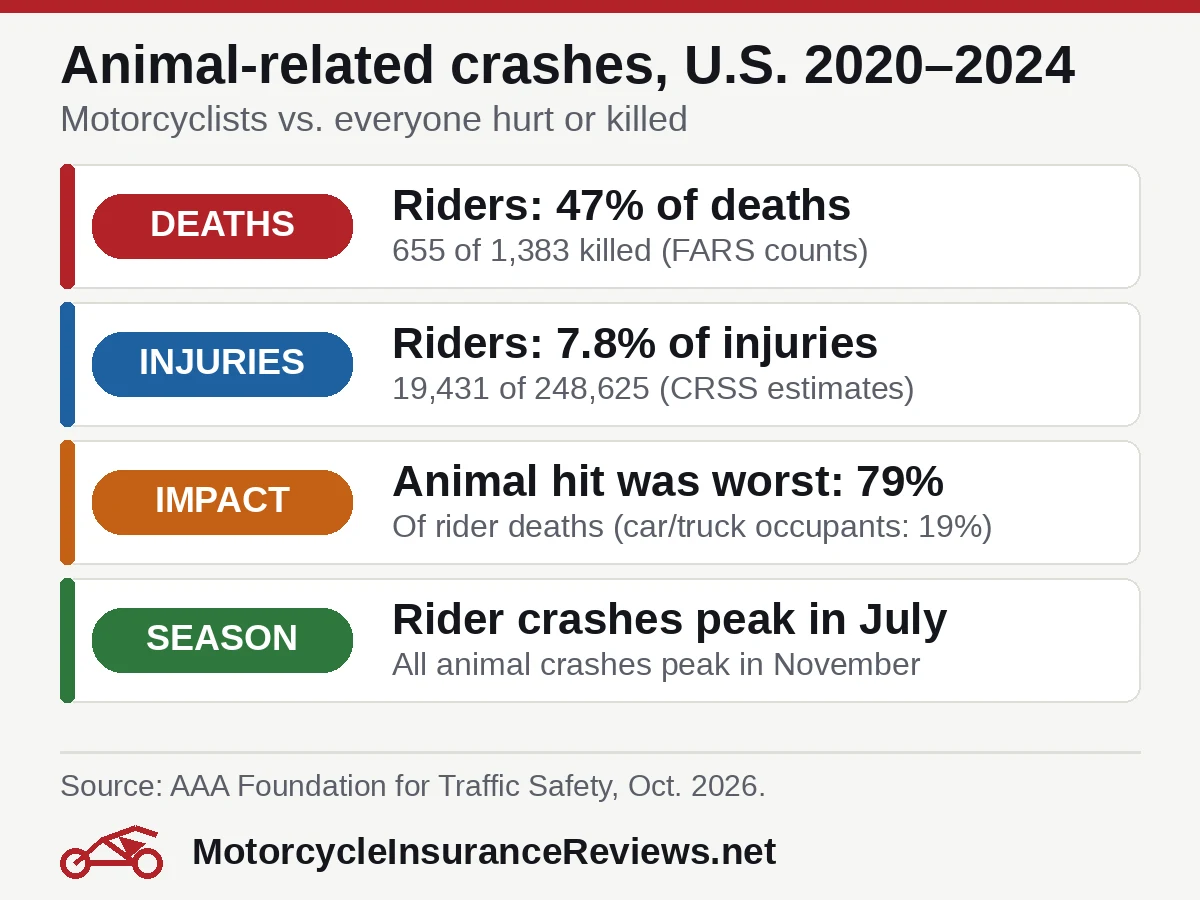
Motorcycles are a tiny slice of the vehicles involved in animal-related crashes on U.S. roads, but riders made up nearly half of the people those crashes killed. A research brief published in October 2026 by the AAA Foundation for Traffic Safety counted 1,383 deaths in animal-related crashes from 2020 through 2024. 655 of them were motorcyclists, or 47%. Occupants of cars, trucks and other enclosed vehicles accounted for 614 deaths (44%), and the remaining 114 were other or unknown road users.
The injury numbers run the other way. Of an estimated 248,625 people hurt in those crashes, about 19,431 were motorcyclists, just 7.8%. Riders are rarely involved, and when they are, the outcome is far more likely to be serious.
Key points:
- What counts: a crash where a vehicle hit or was hit by an animal, or crashed while trying to avoid one. The national data don't say which animal; the report notes most are believed to be deer.
- Scale: an estimated 1,768,900 police-reported animal-related crashes in five years, about 353,800 a year, with roughly 49,725 injuries and 277 deaths a year.
- Riders: 47% of the deaths, 7.8% of the injuries.
- What hurt riders: for 79% of motorcyclists killed, hitting the animal itself was the most harmful event. For car and truck occupants it was 19%.
- Timing: animal-related crashes involving motorcycles peaked in July. All animal-related crashes peaked in November.
- Setting: most deaths happened on rural roads, in the dark or at dawn or dusk, and on roads posted at 50 mph or higher.
Where the Numbers Come From
The study, by AAA Foundation researchers Kasha, Huang and Tefft, pulled five years of federal crash data from two NHTSA databases. The Fatality Analysis Reporting System (FARS) records every fatal crash on U.S. public roads, so the death totals are actual counts. The Crash Report Sampling System (CRSS) is a weighted sample of police-reported crashes, so crash and injury totals are national estimates.
That has two consequences for reading the figures. First, they cover only crashes police recorded. The authors call their totals a lower bound and cite NHTSA research estimating that nearly a third of crashes with nonfatal injuries go unreported to police. Second, the federal files don't identify the animal. The report says other research points to deer as the large majority; in the Ohio records the team examined, 95% were deer. A moose or an elk changes the picture, and the authors say so.
Animal-related crashes made up about 6% of all police-reported crashes, 2% of crash injuries and 0.7% of crash deaths in the period. The yearly crash estimate climbed from about 303,300 in 2020 to about 400,900 in 2024. Deaths ranged from 241 to 299 a year.
Why the Rider Share Is So High
More than nine in ten vehicles in these crashes were passenger vehicles or large trucks. Motorcycles were involved in an estimated 20,281 animal-related crashes over five years, against roughly 1.75 million for cars and trucks.
The difference is what happens next. The report found that almost every motorcyclist in an animal-related crash was injured or killed. Only about one in eight animal-related crashes involving cars or trucks injured anyone inside.
The report's breakdown of the "most harmful event" helps explain the difference. The term means the event that caused the worst injury, or the most property damage if no one was injured:
- Motorcyclists killed: the impact with the animal was the most harmful event in 518 of 655 deaths (79%). Hitting a fixed object such as a tree accounted for 11%, events coded as a rollover for 6%, and hitting another vehicle for 3%.
- Car and truck occupants killed: the animal impact was the most harmful event in only 19% of deaths. Hitting a tree or other object (33%), rolling over (28%) and hitting another vehicle (17%) did more harm.
The authors suggest the lack of crash structure on a motorcycle likely helps explain the pattern. An animal that would hit a car's bumper, hood or windshield hits a rider directly. They also note a limit in the coding: after a fatal motorcycle–animal crash, a police officer may not be able to separate the harm done by the impact from the harm done by falling or being thrown from the bike.
Animal-Related Crashes Peak in July for Motorcycles, November Overall
Taken together, animal-related crashes are a fall problem. October and November held 32% of them, though those two months account for only 18% of all police-reported crashes. November alone had nearly 18%.
Motorcycles follow a different calendar. The report's month-by-month comparison shows motorcycle involvement in animal-related crashes peaking in July and falling off sharply in October and November. That tracks motorcycle crashes in general, which also peak in summer.
The rider share also shifts the death calendar. June and July held 25% of all animal-related crash deaths, slightly more than October and November (24%). The authors traced that summer bump largely to motorcyclists.
The study doesn't measure miles ridden, so a July peak in crash counts doesn't show that a mile ridden in July is riskier than one in November. It shows when the most riders were involved in animal-related crashes.
Rural, Dark and Fast
The national data describe the setting most deaths share:
- Rural roads: about 81% of animal-related crash deaths happened in rural areas.
- Light: roughly 70% of crashes, injuries and deaths occurred in the dark or at dawn or dusk.
- Speed limits: more than three in four deaths happened on roads posted at 50 mph or higher. Speed limits were missing for many nonfatal crashes, so the report treats the crash and injury figures by speed limit with caution.
- Region: the Midwest had half of all animal-related crashes and a third of the deaths. The South had the largest share of deaths, 38%.
The report's state appendix covers all road users, not riders separately. Texas recorded the most animal-related crash deaths in the period (137), followed by Pennsylvania (88), Wisconsin (77), Michigan (69) and Ohio (59).
A closer look at state records from North Carolina, Ohio and Pennsylvania found the same core scene again and again: a dark, rural road with a 45 to 60 mph limit, most often in the last three months of the year. That state analysis covers all vehicles and doesn't break out motorcycles.
Don't Borrow the Car Advice Wholesale
AAA's Southwest Indiana club used the study for an Oct. 30 "Don't Veer for Deer" advisory aimed at drivers. The study found that for car and truck occupants who died, hitting a tree or another vehicle or rolling over was more often coded as the most harmful event than hitting the animal. The authors suggest that sudden swerving may help explain that pattern. The authors themselves caution that it may not hold for larger animals.
The motorcycle numbers don't test a riding technique. They show that, for riders who died, the animal strike itself was usually the most harmful event. They don't compare braking, swerving or holding a line on two wheels.
The study's one general recommendation applies to anyone on the road: keep speeds low enough that an animal stepping out leaves time to see it and respond. For riders, the data add context about where that matters most. Rural two-lanes at dusk and after dark, posted at 45 mph and up, are where these crashes cluster, and for motorcycles the count peaks in summer rather than fall.
The Insurance Side
Hitting an animal is usually handled under comprehensive coverage on a motorcycle policy rather than collision, while going down or striking a tree or guardrail while avoiding one is generally treated as collision. Wording varies by insurer and state, and a liability-only policy pays for neither the bike nor your own injuries. If you ride rural roads at night, check your declarations page for comprehensive, collision and medical payments coverage before you need them.
References
- AAA Foundation for Traffic Safety: Animal-related Crashes, Injuries, and Deaths in the United States, 2020–2024 (Research Brief, October 2026) — the full 19-page report: methods, Tables 1–4 (national counts and estimates, rider and occupant shares, most harmful event by vehicle type), Figure 3 (monthly pattern by vehicle type), the North Carolina, Ohio and Pennsylvania scenario analysis and the state-by-state death appendix.
- AAA Foundation for Traffic Safety: study page and synopsis — the Foundation's summary, report date and link to the PDF.
- AAA (Southwest Indiana): "Don't Veer for Deer as Clocks Fall Back," Oct. 30, 2026 — a AAA club advisory based on the study, aimed at drivers of cars and trucks.
- Progressive: Motorcycle Insurance Coverages — how motorcycle liability, comprehensive, collision and medical payments coverage work.
- Rider Insurance: New Jersey motorcycle policy form, Part D, p. 17 — an example of how a motorcycle policy classifies animal contact and an upset or impact with another object.