Starting Jan. 1, 2027, California requires manufacturers, importers and sellers of covered electric motor-driven cycles, mopeds and off-highway electric motorcycles to give buyers a notice about registration and possible insurance gaps. That's one piece of SB 1167, which Gov. Gavin Newsom signed on Sept. 30, 2026.
Most of the bill is about e-bikes: labels, classes and what sellers can call an e-bike. The part that matters for riders is the notice it creates for the faster machines that are often sold next to them.
Key points:
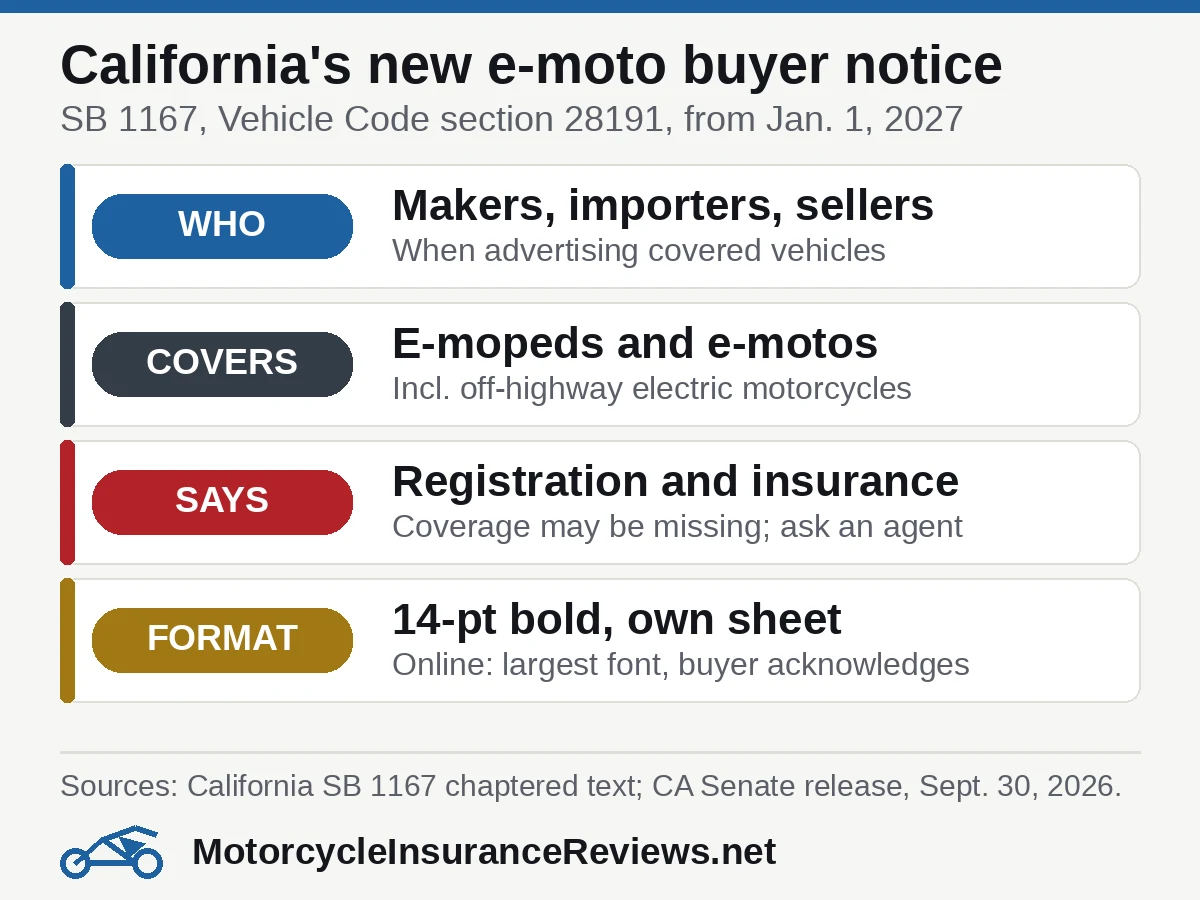
- Who has to give the notice: manufacturers, importers and sellers advertising covered electric vehicles in California.
- Which vehicles: electric motor-driven cycles, electric mopeds and off-highway electric motorcycles.
- What it says: that the vehicle is a motor vehicle subject to applicable registration rules, that existing insurance may not cover it, and that the buyer should check with an insurer or agent.
- How it's shown: at least 14-point bold type on its own sheet on paper; online, at least as large as the biggest text in the ad, and the buyer has to acknowledge it before buying.
- When: the law's general effective date is Jan. 1, 2027.
The Line Between an E-Bike and Everything Faster
California treats a legal e-bike much like a bicycle. Under state law, an e-bike has working pedals, a motor of no more than 750 watts, and stops helping at 20 mph on throttle or 28 mph with pedal assist (Class 3). Inside those limits, there's no license, registration or insurance requirement.
A vehicle outside the e-bike definition needs to be checked against the separate vehicle categories. A seller’s "e-bike," "e-moto" or "electric dirt bike" label doesn't establish whether the model can be registered or ridden on public roads.
The bill's author, Sen. Catherine Blakespear, said the problem is that sellers often call every two-wheeled electric vehicle an e-bike, even when it is far faster than an e-bike can legally be. That can leave buyers unprepared for the higher speeds, and for the license and registration rules that come with them. SB 1167 bars labeling a vehicle as an e-bike when it doesn't meet the definition.
What the New Notice Has to Cover
The disclosure lives in new Vehicle Code section 28191. It applies when a manufacturer, importer or seller advertises one of the three covered vehicle types. The notice has to address three things:
- Registration: that it is a motor vehicle subject to applicable registration rules.
- Insurance: that the buyer's existing insurance may not cover it.
- Next step: that the buyer should check with an insurance company or agent.
Where it applies, the notice also points to the rules for riding on public roads.
The format rules are specific, which makes the notice hard to bury:
- On paper: at least 14-point bold type, on its own sheet.
- Online or in a website sales offer: text at least as large as the largest font used in the ad or offer, plus an affirmative acknowledgement from the buyer that they had the chance to read it before buying.
The notice is information. It doesn't decide whether any particular policy covers a vehicle, and it doesn't make an off-highway motorcycle legal to ride on the street.
Why the Insurance Line Matters
The notice's warning about existing insurance is the part most likely to save a buyer money and trouble.
The law warns that existing policies may leave a gap when a buyer moves from a bicycle to a motor vehicle. Ask the insurer to confirm coverage for the exact vehicle and the way you plan to use it, including whether you'll ride it on public roads.
Before you buy, it's worth asking your insurer or agent three direct questions:
- Liability: Does any current policy cover injury or damage you cause while riding this exact vehicle, on and off the road?
- Theft and damage: Is the vehicle itself covered if it's stolen, crashed or damaged while parked or charging?
- Policy type: If not, what policy is needed, such as a motorcycle or off-road vehicle policy, and what does it cost?
Have the make, model, motor wattage and top speed ready. Those details help identify the vehicle's classification.
How California Classifies the Faster Machines
The City of Sacramento's public works page, updated for SB 1167, sums up the current rules for the two main categories:
- Electric mopeds: riders must be at least 16, hold the right driver's license with a motorcycle endorsement, display registration and plates, and wear a DOT-approved helmet. They aren't allowed in bike lanes, bikeways or shared-use trails.
- Off-highway electric motorcycles (e-motos): are subject to California’s off-highway vehicle identification rules. Check where the vehicle can be used before riding. An OHV permit or plate doesn't make the motorcycle street legal.
The distinction matters if you plan to ride in your neighborhood. A dirt-bike-style electric machine bought for a teenager to ride around the neighborhood can be an off-highway vehicle that isn't allowed on public streets at all.
The E-Bike Rules That Come With It
SB 1167 also changes what legal e-bikes must carry. Starting in 2027, every e-bike sold in California needs a visible label showing its class, top assisted speed and maximum motor wattage. Police reports on crashes or injuries must include the information from that label, and note when a label is missing.
For riders, those changes help in a different way. A missing or wrong e-bike label on a fast machine is a signal to ask the seller exactly what you're buying.
What to Do If You Already Own One
The buyer notice applies to sellers and advertising. Current owners still need to follow the rules that apply to their vehicle and where they ride it.
Still, the same questions apply. If you own a fast electric two-wheeler and aren't sure how it's classified, check its motor wattage, top speed and whether it has working pedals. Then confirm registration with the DMV and coverage with your insurer before you ride it on public roads.
References
- California Senate District 38 release: Governor Signs Legislation to Improve E-Bike Consumer Protections (Sept. 30, 2026) — confirms the signing, the e-bike definition, the ban on mislabeling faster vehicles as e-bikes, the e-bike label and police-report rules, and the Jan. 1, 2027 effective date.
- California SB 1167 chaptered text, including Vehicle Code sections 28191 and 28192 — the enacted disclosure requirement, the three covered vehicle types, and the 14-point paper and online font and acknowledgement rules.
- City of Sacramento Public Works: Electric Bicycle Safety and Law — summary of SB 1167 and current rules for e-bike classes, electric mopeds and off-highway electric motorcycles.
- California DMV, Off-Highway Electric Motorcycle Identification (VIN 2026-01) — defines off-highway e-motos and explains the separate OHV identification requirement.