
If you ride in big groups with Cardo intercoms, your ceiling just went up. Cardo's Mesh Boost update, announced on August 17, 2026, lets supported devices run a single mesh group of up to 31 riders, up from 15.
It's a software update, not new hardware. It reaches Cardo's second-generation mesh units, the PACKTALK PRO, PACKTALK EDGE and PACKTALK NEO, over the air through the Cardo Connect app. Mesh Boost also adds two features meant to make getting a group connected less of a parking-lot chore: Public Mesh and Remote Grouping.
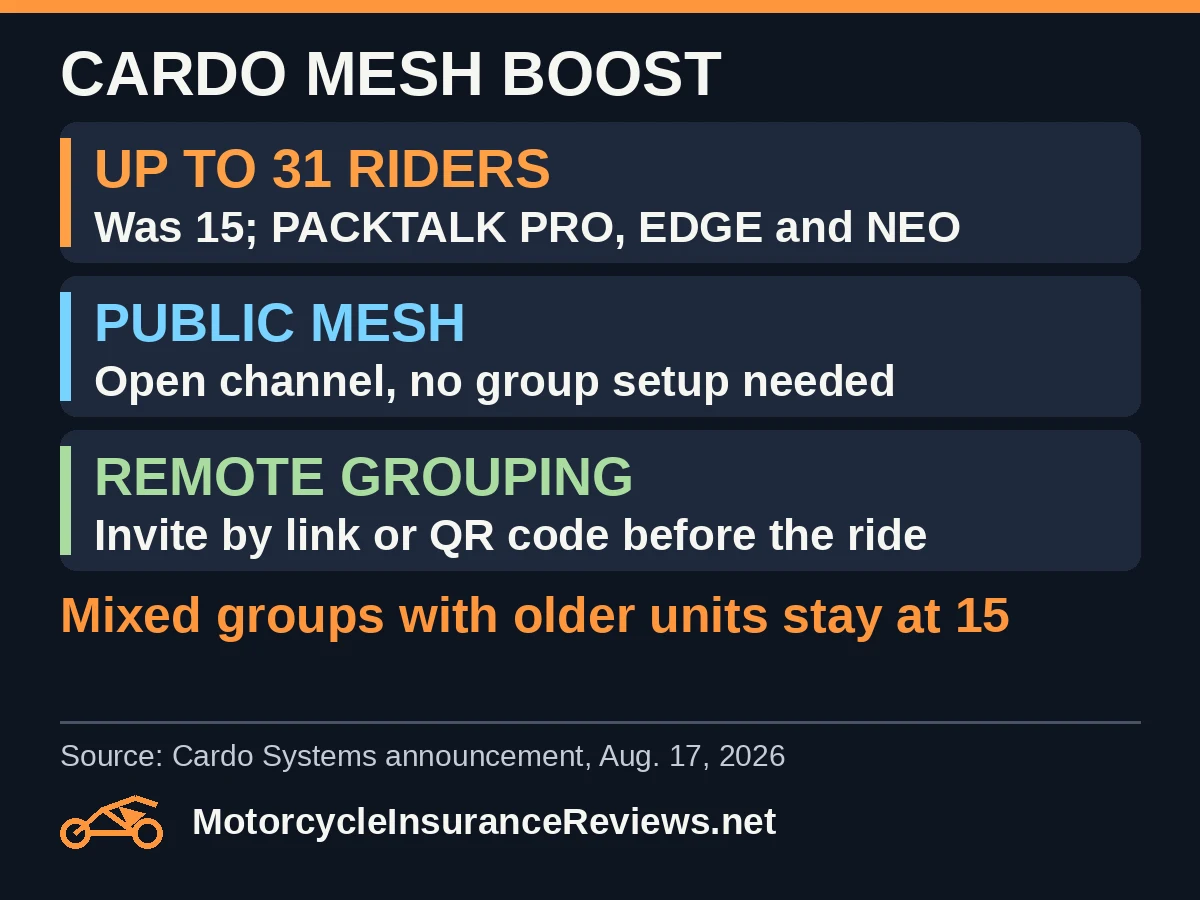
The short version
- Bigger groups: up to 31 riders in one mesh group, versus 15 before.
- Which units: second-generation DMC (Dynamic Mesh Communication) devices: PACKTALK PRO, EDGE and NEO.
- How you get it: an over-the-air update through the Cardo Connect app.
- Public Mesh: an open channel any nearby rider with a supported unit can join, with no group setup.
- Remote Grouping: set up a group ahead of time and invite riders with a link or QR code.
- The catch: mixed groups with older Cardo mesh units stay capped at 15 riders, and some new features need everyone on updated hardware.
What "mesh" means here
Older Bluetooth intercoms connect riders in a chain, one link to the next. If a rider in the middle drops out, the chain can break.
Cardo's DMC mesh works differently. Every unit talks to the units around it, and the group re-forms on its own when riders fall back or pull ahead. That's why group size matters: in a mesh, more riders can share one conversation without someone having to manage pairings.
Mesh Boost doubles that group size on the newer hardware. Cardo hasn't published a new range figure with the update, and every rider still has to be within DMC range of the group.
Public Mesh: join without a group
Public Mesh is an open conversation space. Cardo describes it as having:
- No group creation
- No invitations
- No pairing sequence
- Automatic connection when riders are within range
That's handy for a meetup where half the riders have never met, or a charity ride where nobody wants to collect phones and build a group.
Keep in mind what "public" means. Anyone nearby on a supported, updated unit can hear you. It isn't the place for anything you'd only say to your riding partner, and Cardo doesn't present it as private.
Remote Grouping: set it up before the ride
Remote Grouping moves group setup off the road shoulder. In the Cardo Connect app, the organizer creates a DMC group in advance, generates a link or QR code, and sends it out. Riders join from home and show up ready to go.
For club rides and tours where people arrive at different times, that's the more useful of the two features.
If someone in your group has an older Cardo
Cardo says riders on older mesh units can still join groups with Mesh Boost devices. But those mixed groups are limited to 15 riders, and some of the new capabilities don't work until everyone has upgraded.
In practice, a 20-rider group with even one older unit won't get the 31-rider ceiling. If big groups are the reason you care about this update, find out what hardware your regulars are running.
How to update
Cardo's instructions come down to three steps:
- Update the Cardo Connect app on your phone.
- Update the firmware on your PACKTALK PRO, EDGE or NEO through the app.
- Let the installation finish completely before you unplug or ride.
Do it at home the night before, not at the gas station before a group ride. Cardo specifically recommends finishing the update ahead of time.
What we don't know yet
- Firmware version number. Cardo's announcement doesn't list one.
- Range in big groups. No new range figure was published.
- Independent testing of 31-rider groups. The performance claims are Cardo's.
Bottom line
Cardo's Mesh Boost lets PACKTALK PRO, EDGE and NEO owners run mesh groups of up to 31 riders, plus a no-setup Public Mesh channel and Remote Grouping by link or QR code. It's an over-the-air update through the Cardo Connect app. Mixed groups with older units stay at 15.
References
- Cardo Systems: Mesh Boost announcement (August 17, 2026) — group size, supported devices, Public Mesh, Remote Grouping, mixed groups and update steps.