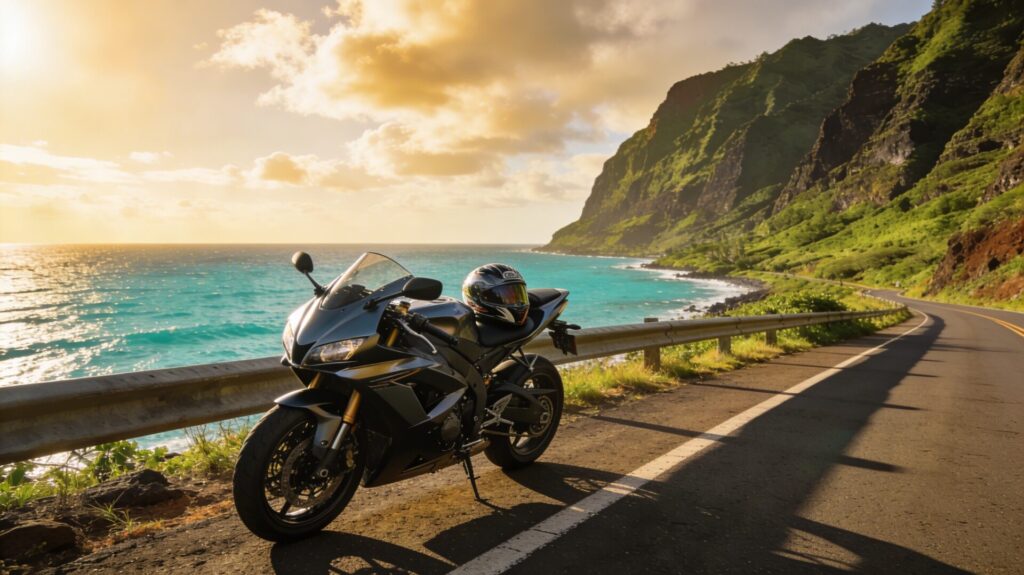
Hawaii motorcycle insurance at a glance:
No standard PIP for riders
Helmet: Optional (18+)
Lane splitting: Illegal
Hawaii has a motorcycle insurance quirk that catches a lot of riders off guard. The state’s auto liability minimums moved up to 40/80/20 on January 1, 2026, but the current motorcycle and motor scooter rule still sits at 20/40/10. At the same time, Hawaii’s famous no-fault system for cars does not give motorcycle riders the same ordinary PIP backstop. If you buy the legal minimum on a bike and assume you are getting “Hawaii auto insurance, but for a motorcycle,” you are buying the wrong thing.[1, 10]
That split matters everywhere in the state. It matters on an Oʻahu commuter bike weaving through Honolulu traffic, on a Maui cruiser headed toward Upcountry, and on a Big Island dual-sport that can leave you a long tow from home. The legal minimum keeps you compliant. It does not, by itself, rebuild your motorcycle, pay your own ER bill, replace your helmet and jacket, or cover lost income after a bad crash. Hawaii’s statute is unusually explicit about that.[1, 2, 12]
Hawaii motorcycles still sit on 20/40/10
For motorcycles and motor scooters, Hawaii Revised Statutes § 431:10G-301 still requires $20,000 bodily injury liability per person, $40,000 bodily injury liability per accident, and $10,000 property damage liability per accident. The Hawaiʻi Department of Commerce and Consumer Affairs (DCCA) says the same thing on its current motorcycle insurance page. That is the legal floor in March 2026, even though the auto minimum moved higher.[1, 2, 10]
What your motorcycle policy does not automatically include is just as important. The same statute requires insurers to offer medical payments coverage up to $10,000, an income disability plan, and higher liability limits. But operators and passengers on motorcycles and motor scooters generally may not claim ordinary Hawaii no-fault/PIP benefits unless a policy expressly provides them. In plain English: the base motorcycle policy is a liability policy first, not a built-in personal injury plan.[1, 2]
| Coverage | Required to buy? | Minimum or required offer | What it does in plain English |
|---|---|---|---|
| Bodily injury liability | Yes | $20,000 per person / $40,000 per accident | Pays other people if you injure or kill them and you are legally responsible. |
| Property damage liability | Yes | $10,000 per accident | Pays for damage you cause to someone else’s vehicle or other property. |
| Medical payments coverage | Insurer must offer it | Up to $10,000 | Optional help for your own medical bills after a crash. |
| Income disability plan | Insurer must offer it | Offer required by statute | Optional wage-loss style protection if you miss work after an injury. |
| Higher liability limits | Insurer must offer it | Above the state minimum | Lets you move beyond the thin legal minimum. |
| Ordinary no-fault / PIP benefits | No standard motorcycle minimum | Only if expressly provided by policy | Motorcycle riders do not get normal Hawaii car-style PIP by default. |
Key takeaway: Hawaii’s current motorcycle minimum is a liability compliance rule, not a full recovery plan for a rider who gets hurt.[1, 2]
Proof cards, phone screens, and the safety-check trap
Hawaii lets you carry proof of motorcycle insurance on paper or electronically. Under HRS § 431:10G-106 and HRS § 286-116, the insurer can issue a paper or electronic card, and you can display the electronic card on a mobile device when an officer asks for it. The officer is only supposed to view the insurance card itself, not the rest of your phone.[2, 3]
Hawaii also distinguishes between not having proof on you and actually being uninsured. If you were covered at the time of the stop and later prove that coverage to the court, the proof-of-possession issue can be cured. That is very different from knowingly operating an uninsured motorcycle, which triggers the penalty section discussed below.[3]
The second enforcement point is more Hawaii-specific: annual safety inspections. The current safety-inspection rules require proof of current Hawaii insurance before an inspection certificate is issued, and the motorcycle inspection materials also fail a bike if the Hawaii insurance card is not original or the insurance is not in effect. Hawaii also does not have one statewide DMV; registration is handled by the counties, so the practical compliance pipeline is police stop plus county registration and safety-check process, not just roadside enforcement.[5, 6]
What happens if you ride uninsured in Hawaii
For motorcycles and motor scooters, HRS § 431:10G-108 authorizes a nonsuspendable fine of not less than $100 and not more than $1,000, up to 30 days in jail, up to a one-year driver’s license suspension, or any combination of those penalties, for each violation. That is a broad penalty range. It is more serious than a routine equipment ticket, and the law does not create a softer motorcycle-specific first-offense ladder inside the statute itself.[2]
Good-faith defenses exist: The same section gives a rider an opportunity to present a good-faith defense, including lack of knowledge or proof of insurance. It also creates narrow exceptions, including a rider whose own insurance covers operation of someone else’s bike, a rider using an employer’s bike in the normal scope of employment, or a rider who reasonably believed a borrowed motorcycle was insured.[2]
What I did not find in Hawaii’s motorcycle insurance statute was a motorcycle-specific SR-22 or FR-44 requirement, a mandatory impound provision, or a graduated repeat-offense schedule. The law says each violation is a separate offense. Practically, getting legal again means getting compliant insurance back in force and satisfying whatever court and license-suspension conditions were imposed in your case.[2]
What the minimum policy does not protect in a real Honolulu-style crash
Take a common Oʻahu scenario. You are riding on Kapiʻolani Boulevard, a driver turns left across your lane, and the impact sends you over the bars. Your Hawaii minimum policy does not automatically fix your bike, replace your helmet, pay your ambulance bill, or cover the week or month you miss from work. The legal minimum is aimed at the other person’s bodily injury and property damage when you are the legally responsible party.[1, 2]
If the driver is at fault, Hawaii’s motorcycle framework pushes you into a more traditional liability claim. HRS § 431:10G-105 says tort liability is not abolished for motorcycle and motor scooter accidents. That is why optional coverages such as MedPay, higher liability limits, physical damage coverage, and whatever UM/UIM your carrier offers matter so much more on a bike than many Hawaii drivers assume.[2]
And the legal floor is thin by Hawaii’s own standards. DCCA’s 2026 auto minimum FAQ says the old 20/40/10 auto floor no longer kept pace with medical and vehicle-repair costs, which is why the state raised auto minimums to 40/80/20. Motorcycles are still sitting on that older floor. Add HDOT’s 2025 fatality breakdown showing 31 motorcyclist deaths and 8 scooter deaths statewide, and the risk of treating the minimum as “good enough” becomes obvious.[10, 12]
Coverage upgrades worth buying in Hawaii
Higher liability limits
A realistic step-up is 100/300/100. In Hawaii, that upgrade does more than protect your assets in a serious injury case; it also closes the gap between a 20/40/10 motorcycle minimum and a state where even ordinary auto policies have already moved past those numbers. Because motorcycles do not come with standard built-in PIP, thin liability limits leave less margin for error than many riders expect.[2, 10]
Collision
Collision is what pays for your own bike after you hit a vehicle, barrier, curb, or pavement. DCCA’s motorcycle page notes that insurers may offer damage coverage for your motorcycle, and this is where a newer, financed, or higher-value bike stops being a “state minimum only” purchase. If your lender still has a stake in the bike, liability-only coverage is usually fantasy, not thrift.[1]
Comprehensive
Comprehensive matters more in Hawaii than mainland riders sometimes think. DCCA was still issuing storm and flood guidance in March 2026, and Hawaiʻi Emergency Management Agency says flash flooding is most frequent from October through April, with the wet season typically running October to March. A parked motorcycle damaged by floodwater, storm debris, theft, or vandalism is outside the protection of liability-only coverage.[11]
Uninsured and underinsured motorist coverage
Do not assume UM/UIM is automatically sitting inside a Hawaii motorcycle quote. The motorcycle statute expressly spells out required liability coverage and required offers of MedPay, income disability, and higher liability, but it does not make UM/UIM part of the basic motorcycle package in the same way. On a bike, where you also do not get ordinary no-fault/PIP by default, that omission matters. Ask for UM/UIM by name and price it on purpose.[2]
MedPay and income-disability protection
This is one of Hawaii’s biggest motorcycle-specific quirks. The insurer must offer up to $10,000 in medical payments coverage and an income disability plan. That is not filler. It is Hawaii’s way of telling you that the standard bike policy is otherwise light on first-party injury protection. If you rely on your body to earn money, this is one of the smartest conversations to have before you buy the policy.[1, 2]
Custom parts, accessories, and riding gear
Hard bags, upgraded bars, slip-ons, lighting, GPS mounts, crash protection, and expensive protective gear add up fast. HDOT’s current rider-information page specifically notes Hawaii’s laws on after-market modifications, and the inspection rules still care about things like handlebar height and equipment condition. If you have added value to the bike, get the endorsement in writing instead of assuming the base physical-damage settlement will treat every add-on kindly.[4, 6]
Roadside assistance
Motorcycle roadside assistance should be motorcycle-specific, not generic car towing dressed up with a bike logo. A breakdown in urban Honolulu is one problem; a dead battery or shredded tire on Hāna Highway or a long stretch of Hawaiʻi Island is another. Ask about flatbed towing, distance limits, fuel delivery, and whether the coverage works on inter-island trips instead of only near your home ZIP code.
Trip interruption
Trip interruption sounds like a luxury until a covered loss strands you overnight. In Hawaii, “not far from home” can still mean hotel costs, meals, and awkward transportation because you are on another island or simply nowhere near your normal repair option. If you do regular inter-island riding or longer weekend loops, this coverage is easy to justify.
Gap insurance
Gap coverage is for riders who financed too much bike for the loan balance to match actual cash value in the early years. State law only tells you what liability minimum you must buy to be legal. It does nothing to stop you from owing a lender after a total loss. On a newer bike with a low down payment, that can be the most painful uncovered bill in the entire claim.
Laid-up, storage, or reduced-use coverage
Hawaii is not a six-month snow-state lay-up market, so this discount works differently here. It is more useful for a bike that will truly sit during extended travel, military deployment, or a longer project period than for a rider who simply uses the bike less often in winter. The weather angle is still real, though: Hawaii’s wetter season is roughly October to March, and storm exposure remains part of the storage conversation.[11]
Hawaii’s helmet law is partial, and the insurance angle is real
Hawaii does not have a universal motorcycle helmet law. Under HRS § 286-81, riders and passengers under 18 on a motorcycle or motor scooter must wear a safety helmet securely fastened with a chin strap. Adults on their own motorcycles can legally ride without a helmet, but if the motorcycle or motor scooter does not have a windscreen or windshield, the operator and any passenger must wear safety glasses, goggles, or a face shield. The same statute is stricter for rentals: a person operating a rented moped or motor scooter must wear a helmet unless that person already has a valid motorcycle license or equivalent out-of-state license.[3, 4]
There is also a narrow modern exception: the helmet requirement does not apply to certain three-wheeled electric machines with a roll bar or full enclosed cab and seat-belt or child-restraint systems. That is a very Hawaii-specific statutory carve-out and one more reason to avoid assuming that every “scooter” or “three-wheeler” is treated the same way under local law.[3]
Insurance consequence: Legal no-helmet riding by an adult is still a claims issue. Hawaii uses comparative negligence, and a defendant insurer will absolutely argue over injury severity if a head injury could have been reduced by helmet use. That does not mean every no-helmet rider loses the claim. It means “legal” and “harmless to your payout” are not the same thing in a contested injury case.[2]
Road rules Hawaii riders get wrong
- Lane splitting and lane filtering: Not legal. HRS § 291C-153(c) bars operating a motorcycle between lanes of traffic or between adjacent lines or rows of vehicles.[3]
- Full use of a lane: Hawaii gives motorcycles the full use of a lane, and other vehicles may not crowd you out of it. The same statute also says a motorcycle may not pass another vehicle in the same lane.[3]
- Riding two abreast: The statute allows up to two motorcycles abreast in one lane, but no more than two.[3]
- Shoulder riding: No. HDOT’s shoulder-riding authorization sunsetted at the end of 2020.[4]
- Bike lanes: Motorcycles are not bicycles and may not use bicycle lanes under Hawaii’s definitions and HDOT guidance.[4]
- Passenger age: You may not carry a passenger under age 7 on a motorcycle or motor scooter, except for the narrow enclosed three-wheel electric exception in the statute.[3]
- Eye protection: No windshield or windscreen means safety glasses, goggles, or a face shield for the rider and passenger.[3]
- Mirror rule: The motorcycle inspection materials require at least one mirror with a view of the highway at least 200 feet to the rear.[6]
- Handlebar height: Handlebars more than 15 inches above the portion of the seat occupied by the operator fail inspection.[6]
- Passenger setup: The inspection materials require a permanently mounted seat for each occupant, and Hawaii’s motorcycle manual also requires footrests for passengers not in a sidecar or enclosed cab.[6]
- Insurance at inspection: Current Hawaii insurance proof is part of the safety-check process, and the rules now expressly recognize an electronic card accessed directly through the insurer’s website, app, or database.[6]
License class, permit rules, and the course discount
To operate a motorcycle or motor scooter in Hawaii, you need a Class 2 motorcycle driver’s license, often called the Type 2 designation. By March 2026, Hawaii’s current rider-information pages say a state-approved Basic Rider Course must be completed before applying for a Class 2 instruction permit, and Honolulu’s licensing page reflects that Act 66 change. The permit comes with real restrictions, including no passengers and no riding after dark, and you still need the written test plus an off-street skills test unless you qualify for the Hawaii waiver path. The insurance side matters too: DCCA says you need a valid motorcycle or motor scooter license to buy liability coverage, and HRS § 431:10G-201 requires at least a 15% reduction on liability premiums for riders who successfully complete a DOT-approved motorcycle education course.[1, 4, 5, 2]
Motorcycle, scooter, moped, or e-bike? Hawaii treats them differently
In Hawaii, the label riders use in conversation is not always the label the law uses. That matters because insurance and licensing shift quickly once a machine crosses the line from low-speed e-bike to moped, or from moped to motor scooter.[3, 7, 8]
| Vehicle Type | Hawaii definition | Insurance required? | License required? |
|---|---|---|---|
| Motorcycle | A motor vehicle with a seat or saddle for the rider, designed to travel on not more than three wheels, excluding mopeds. | Yes. Liability coverage is required under HRS chapter 431:10G. | Yes. Class 2 motorcycle license. |
| Motor scooter | Either a handlebar-and-straddle-seat motor vehicle with up to three wheels, or certain three-wheel autocycle-style vehicles meeting Hawaii’s definition, excluding mopeds. | Yes. Treated with the same basic liability structure as motorcycles. | Yes. Class 2 motorcycle license. |
| Moped | Two or three wheels, no more than two horsepower or 1,492 watts, no more than 50cc if combustion, top speed no more than 30 mph, and automatic/direct drive. | Usually no for a privately owned standard moped. A three-wheeled side-by-side moped must carry liability and property damage coverage, excluding PIP. | Yes. Any valid driver’s license; if you do not have one, a Class 1 moped license. |
| Low-speed electric bicycle | Currently treated as a low-speed electric bicycle: fully operable pedals, motor under 750 watts, and top speed under 20 mph. | No motorcycle-style liability requirement identified while it stays in the low-speed e-bike category. | No motorcycle license. Operator must be at least 15; riders under 16 must wear a bicycle helmet. |
Two Hawaii quirks deserve repeating: First, a privately owned standard moped generally does not need insurance, but a three-wheeled side-by-side moped does. Second, if an “e-bike” goes over 20 mph, Hawaii no longer treats it as a bicycle under the current rule summary, so it may fall into moped, motor scooter, or motorcycle territory instead. And for mopeds themselves, HDOT’s current rule update says riders under 16 cannot drive one and helmets are mandatory for moped drivers.[4, 7, 8]
How Hawaii’s insurance system changes a motorcycle injury claim
Hawaii is a no-fault state for ordinary auto insurance, but motorcycles sit in a carve-out. HRS § 431:10G-105 says tort liability is not abolished for motorcycle and motor scooter accidents, and HRS § 431:10G-301 says motorcycle riders generally may not claim personal injury protection benefits unless a policy expressly provides them. In practice, that means a hurt rider is usually dealing with the at-fault driver’s liability insurance, the rider’s own optional coverages, or both.[2]
Hawaii also uses modified comparative negligence. Under HRS § 663-31, a rider’s negligence does not bar recovery unless it is greater than the combined negligence of the people sued, but any damages are reduced in proportion to the rider’s share of fault. So if the defense convinces a jury you were speeding, cutting between cars, or otherwise contributed to the wreck, your payout can shrink sharply. If your fault is greater than the other side’s combined fault, recovery is barred.[2]
What moves motorcycle insurance prices up or down in Hawaii
Hawaii’s motorcycle rate statute is more revealing than most riders realize. HRS § 431:10G-201 says rates can reflect past and prospective loss experience, catastrophe hazards, Hawaii-specific expenses, vehicle type, occupation, and past accident involvement. DCCA adds two blunt consumer warnings: high-performance motorcycles can be costly to insure, and a poor driving record can make coverage hard to get.[1, 2]
- Bike type and performance: A high-performance sport bike is usually harder and pricier to insure than a smaller standard, dual-sport, or mild cruiser.[1]
- Past accidents: Hawaii’s motorcycle rate statute explicitly allows insurers to consider involvement in past accidents.[2]
- Loss history: Prior claims signal future cost and are part of loss-experience rating.[2]
- Coverage choices: Adding collision, comprehensive, MedPay, and higher limits raises premium because you are buying real first-party protection instead of a thin legal minimum.[1]
- Use and annual mileage: DCCA’s consumer comparison materials say use and mileage matter in motor-vehicle pricing generally, and motorcycles are no exception in the real world.[9]
- Catastrophe exposure: Hawaii’s own statute specifically names catastrophe hazards, which is unusually on point in a flood-, storm-, and weather-exposed state.[2, 11]
- Island-specific expenses: The statute also points to costs specially applicable to Hawaii in selling and administering coverage.[2]
- Occupation: Hawaii expressly allows occupation to be treated as a potentially relevant rating factor if it can be shown to affect loss or expense.[2]
- Deductibles: Higher deductibles usually lower the cost of physical-damage coverage.[9]
- Safety-course completion: A DOT-approved motorcycle education course is worth at least a 15% liability-premium reduction by statute.[2]
- Discounts: DCCA’s consumer materials note that discounts can affect the final number, so ask about multi-policy, paid-in-full, homeowner, and renewal discounts rather than comparing only the base rate.[9]
How to compare Hawaii motorcycle quotes without fooling yourself
- Get one quote at the legal minimum and another at a realistic protection tier such as 100/300/100. In Hawaii, the price difference matters, but so does the fact that the legal minimum is still stuck at the older 20/40/10 level.[1, 10]
- Hold deductibles constant across carriers. A $500 collision deductible and a $1,000 collision deductible are not the same quote, even if the premium sheet looks competitive.[9]
- Ask whether the quote includes MedPay, an income disability plan, and whatever UM/UIM options the carrier offers. In Hawaii, these details matter more because ordinary bike PIP is not built into the standard rule.[2]
- Ask how custom parts and aftermarket equipment are valued. Hawaii’s current rider materials still call out aftermarket modifications, and the inspection rules still care about equipment specifics.[4, 6]
- Confirm roadside assistance is written for motorcycles, not just cars. Ask for towing-distance limits and whether service works when you are far from your home island base.
- Make sure the rider-course discount was applied. Hawaii law says it should be at least 15% off liability premium charges for qualifying riders.[2]
- Ask about multi-policy and paid-in-full discounts before you compare final numbers. DCCA’s consumer shopping materials explicitly note that discounts can change the premium outcome.[9]
- Check financial strength and complaint history before you bind. AM Best is the common quick screen for insurer strength, and Hawaii’s Insurance Division consumer-resources page links the current complaint-ratio publication and other shopping tools.[9]
Frequently asked questions
Do I need motorcycle insurance in Hawaii?
Yes. Hawaii law requires motorcycle and motor scooter operators to carry liability insurance, and DCCA says a valid ID card must be kept with the bike or carried by the operator. The current legal minimum is 20/40/10 for motorcycles and motor scooters.[1, 2]
Is the state minimum enough?
Usually not. It keeps you legal, but it mainly protects other people when you are at fault. It does not automatically repair your bike or create ordinary Hawaii car-style PIP benefits for your own injuries. Hawaii’s own 2026 auto FAQ says the old 20/40/10 floor was outdated for autos, which is a good clue about how thin it is on a motorcycle too.[2, 10]
Does Hawaii’s no-fault / PIP system apply to motorcycles?
Not in the normal car-insurance way. Hawaii is a no-fault state for ordinary autos, but riders and passengers on motorcycles and motor scooters generally may not claim PIP under a motor vehicle policy unless that benefit is expressly provided. Motorcycle claims are handled in a more traditional tort framework.[2]
What happens if I ride without insurance in Hawaii?
You can be cited and face a nonsuspendable fine of $100 to $1,000, up to 30 days in jail, up to a one-year license suspension, or a combination of those penalties. Hawaii’s motorcycle statute also allows certain good-faith defenses and narrow borrowed-bike or employer-bike exceptions.[2]
Do mopeds and scooters need insurance in Hawaii?
Motor scooters do. A privately owned standard moped generally does not. But Hawaii has a specific exception for three-wheeled mopeds designed for side-by-side seating: those must be insured for liability and property damage, excluding PIP. Also, many machines people casually call “scooters” are legally motor scooters, not mopeds, and the insurance rule changes with the classification.[3, 7]
Does a motorcycle safety course lower my insurance rate?
Yes. Hawaii law requires insurers to provide a 15% reduction off liability premium charges on qualifying new and renewal motorcycle policies when the rider has successfully completed a DOT-approved motorcycle education course. That is a real statutory discount, not just a marketing perk that varies by carrier.[2]
What if my bike is financed or leased?
The state only tells you the minimum liability coverage needed to be legal. A lender or lessor will usually require physical-damage protection too, which means collision and comprehensive, and sometimes gap coverage. Liability-only protection is rarely enough for a financed bike.[1]
Does Hawaii require uninsured motorist coverage on motorcycle policies?
The motorcycle statute does not make UM/UIM part of the required minimum package in the same way it expressly requires liability and the offer of MedPay, income disability, and higher liability limits. The safe move is to ask for UM/UIM by name and compare the premium with and without it instead of assuming it is already there.[2]
Can I show proof of motorcycle insurance on my phone in Hawaii?
Yes. Hawaii allows electronic proof of insurance, including a card accessed through the insurer’s website, app, or database. An officer may view the electronic insurance card, but the statute says the officer is otherwise prohibited from looking through the rest of the device.[2, 3]
Can I lane split or filter at a stop in Hawaii?
No. Hawaii’s statute is direct: you may not operate a motorcycle between lanes of traffic or between adjacent lines or rows of vehicles. That takes out both classic lane splitting and stoplight filtering.[3]
Do I have to wear a helmet in Hawaii?
If you are under 18 on a motorcycle or motor scooter, yes. Adults can legally ride without a helmet on their own motorcycles, but eye protection is still required if the bike does not have a windshield or windscreen. Rental moped and motor-scooter rules are stricter, because renters without the right license must wear helmets.[3, 4]
Do Hawaii’s 2026 auto minimum increases raise motorcycle minimums too?
No, not based on the current Hawaii materials reviewed for this guide. DCCA’s 2026 auto FAQ addresses the 40/80/20 auto change, while the current DCCA motorcycle page and HRS § 431:10G-301 still show 20/40/10 for motorcycles and motor scooters. That split is one of the easiest Hawaii insurance details to miss.[1, 2, 10]
Do rental scooters have different helmet rules in Hawaii?
Yes. Hawaii’s rental rule is stricter than the general adult helmet rule. A person operating a rented moped or motor scooter on a Hawaii roadway must wear a helmet unless that person already holds a valid motorcycle license or equivalent out-of-state license.[3]
Primary Sources
- DCCA Insurance Division — Motorcycle Insurance Information
- Hawaii insurance law for motorcycles and motor scooters — HRS § 431:10G-301; HRS § 431:10G-106; HRS § 431:10G-108; HRS § 431:10G-105; HRS § 431:10G-201; HRS § 663-31
- Hawaii traffic, helmet, licensing, and vehicle-definition statutes — Chapter 286; Chapter 291; Chapter 291C; HRS § 286-81; HRS § 286-116; HRS § 291C-153; HRS § 291-11; HRS § 291C-1
- HDOT — Motorcycles, Motor Scooters, and Mopeds General Information; HDOT FAQ
- Honolulu — Motorcycle or Moped Driver’s License Information; HDOT Motor Vehicle Registration; Leeward Community College Motorcycle Training
- HAR chapter 19-133.2 — Safety inspection rules; HDOT motorcycle inspection manual; HDOT motorcycle operator manual
- HDOT — “So you want to drive a MOPED”
- County of Kauai — Overview of Laws Regulating Bikes and E-Bikes in Hawaii; HRS § 291C-143.5
- DCCA Insurance Division Consumer Resources; 2024 Complaint Ratios; 2026 Motor Vehicle Premium Comparison Guide
- DCCA 2026 Auto Minimum Limits FAQ
- DCCA — Understanding Flood Insurance Coverage; Hawaii Emergency Management Agency flood page
- HDOT — State of Hawaii Traffic Fatalities (2025 breakdown)
Editorial note: This guide reflects Hawaii statutes, DCCA guidance, and HDOT materials available as of March 2026. Re-check the official sources above before changing limits, no-fault language, or registration-related insurance rules.