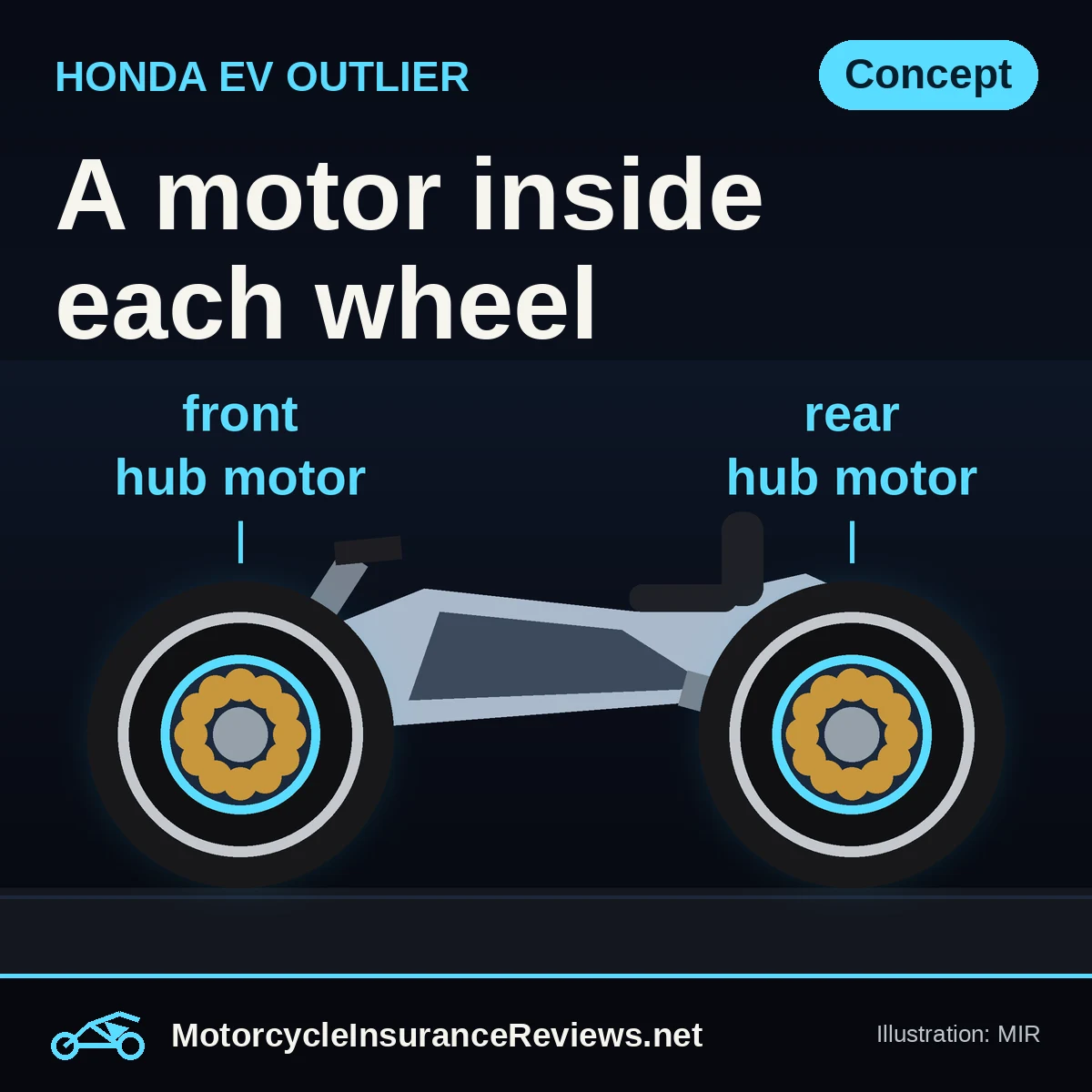
Honda's EV Outlier Concept is an electric motorcycle with a motor inside each wheel, front and rear, and almost nothing where a conventional bike keeps its engine.
Honda unveiled it at its Japan Mobility Show press conference in Tokyo on October 29, 2025, and describes it as a vision for motorcycles beyond 2030. It is a design concept, not a model you can order. Honda’s materials for the concept give no production version, price or U.S. plans.
What makes it worth a closer look is the layout. Putting a motor in both hubs is a different answer to the question every electric motorcycle has to solve: where the drive goes, and what that frees up.
Key points:
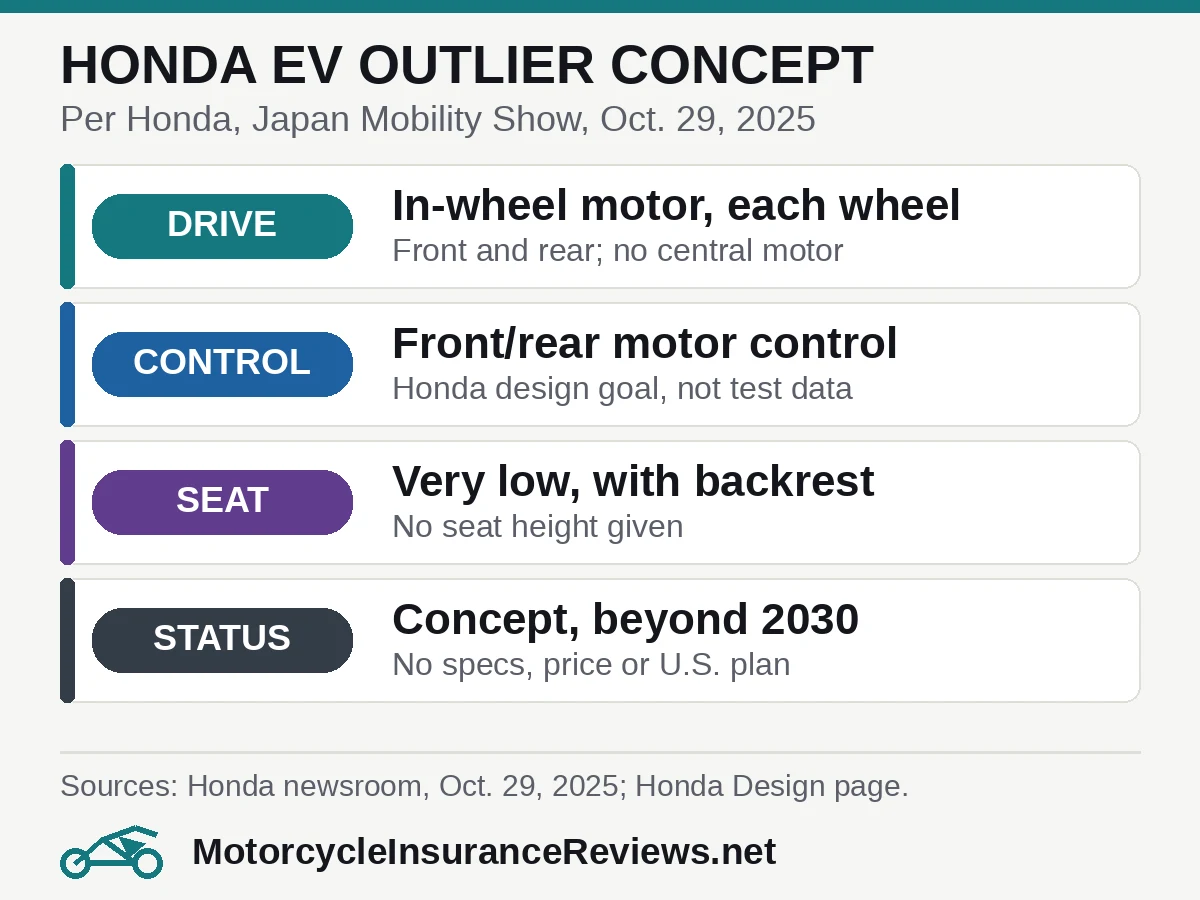
- What it is: an electric motorcycle concept, first shown Oct. 29, 2025 at Japan Mobility Show.
- Drive layout: an in-wheel electric motor on both the front and rear wheels.
- Why Honda did it: the layout freedom of electric power, used here for a low, long, low-profile shape.
- Riding position: Honda says it aimed for a seat height that is exceptionally low even among Honda motorcycles, plus a bucket-style backrest.
- What Honda didn't say: power, torque, battery size, range, weight, exact seat height, price or a production date.
What an In-Wheel Motor Changes
On most electric motorcycles, one motor sits in the frame roughly where an engine would be, and a chain or belt carries its power to the rear wheel.
An in-wheel motor, also called a hub motor, is built into the wheel itself and turns it directly, with no chain or belt in between.
Honda's newsroom release says the Outlier "features in-wheel motors on both the front and rear wheels," and links that choice to "the high degree of freedom of the layout unique to electric motorcycles."
With both motors in the wheels, the designers had more room to pull the bike down and stretch it out.
That is the visible result in Honda's images: a body that sits very low between the wheels, and a rider who sits low inside it.
There are tradeoffs engineers generally weigh with hub motors.
Putting the motor in the wheel adds weight that the suspension has to control, and the motor has to be sealed against water, grit and impacts at the road surface. Honda's material doesn't discuss how the Outlier handles either point, which is normal for a concept at this stage.
Two Driven Wheels, Controlled Separately
The more interesting idea is that both wheels are driven. Nearly every road motorcycle sends power only to the rear wheel.
Honda Design's page for the concept describes "freely controlling the front and rear in-wheel motors to transmit driving force more directly to the road surface according to the situation." In other words, the plan is to adjust how much each wheel pushes, depending on conditions.
Honda presents that as a feel goal rather than a measured result. It doesn't publish a torque split, a traction figure or test data, and it doesn't claim the system makes the bike safer or grippier.
Treat the two-wheel-drive control as Honda's stated intent for a concept, not a proven riding benefit.
Honda's Three Design Themes
Honda Design frames the Outlier around three ideas, each tied to what electric drive allows:
- "Gliding." Smooth, quiet propulsion, with acceleration, deceleration and cornering transitions that Honda describes as "exceptionally smooth." The design team pairs that with smooth surfaces and a smoke-clear body to suggest lightness.
- "Ecstasy." The instant response of motor drive, the front-and-rear motor control described above, and a bucket-type backrest meant to brace the rider under hard acceleration and let them pivot through corners from the hips.
- "Low." A deliberately low hip point and eye point. Honda says the team aimed for a seat height that stands out as exceptionally low even among its own motorcycles, and calls the result a "Dynamic & Low Position" that is possible because the bike is electric.
Honda also places the Outlier under its shared electric-motorcycle design theme, "Precision of Intrinsic Design," while describing it as a deliberate break from conventional thinking. The name follows that idea: Honda defines "outlier" as "an entity unconstrained by boundaries."
Honda Gave No Specs, Dates or Markets
A concept bike is a statement of direction, and the Outlier's limits are clear from what Honda left out.
- No numbers. Honda gives no output, torque, battery capacity, range, charging details, weight or exact seat height.
- No timeline. "Beyond 2030" is a design horizon, not a launch date.
- No market. Nothing in Honda's material says the Outlier, or a production bike based on it, is coming to the U.S.
- No road test. The riding feel Honda describes is the design team's goal. The cited material supplies no independent test data.
It is also a separate project from Honda's other electric and concept motorcycles. The Outlier shouldn't be confused with the EV Fun or EV Urban concepts, the WN7 electric motorcycle, or Honda's electrically supercharged combustion-engine concept.
A Different Way to Build an Electric Bike
Even without specs, the Outlier is a useful signal of how Honda is thinking about electric motorcycles. Instead of building an electric bike that looks and sits like a gas bike, it is exploring what happens when the drive moves to the wheels and the middle of the motorcycle opens up.
A very low seat, a backrest and driven front and rear wheels would make for a motorcycle that rides differently from today's sportbikes and cruisers.
How differently, and what it would mean for owners, is impossible to say from a concept. For now, the Outlier tells you what Honda's designers want electric motorcycles to feel like a few years from now, not what you will find at a dealer.
References
- Honda: Overview of Honda CEO Speech at the Japan Mobility Show 2025 (Oct. 29, 2025) — Honda's original release: world premiere of the EV Outlier Concept as a vision for motorcycles beyond 2030, with in-wheel motors on both front and rear wheels for low-proportion styling.
- Honda Design: EV Outlier Concept (project page, dated 2025/12) — Honda's design description: front and rear in-wheel motors, the "Gliding," "Ecstasy" and "Low" themes, front/rear motor control as a design goal, bucket-type backrest and an exceptionally low seat height target.