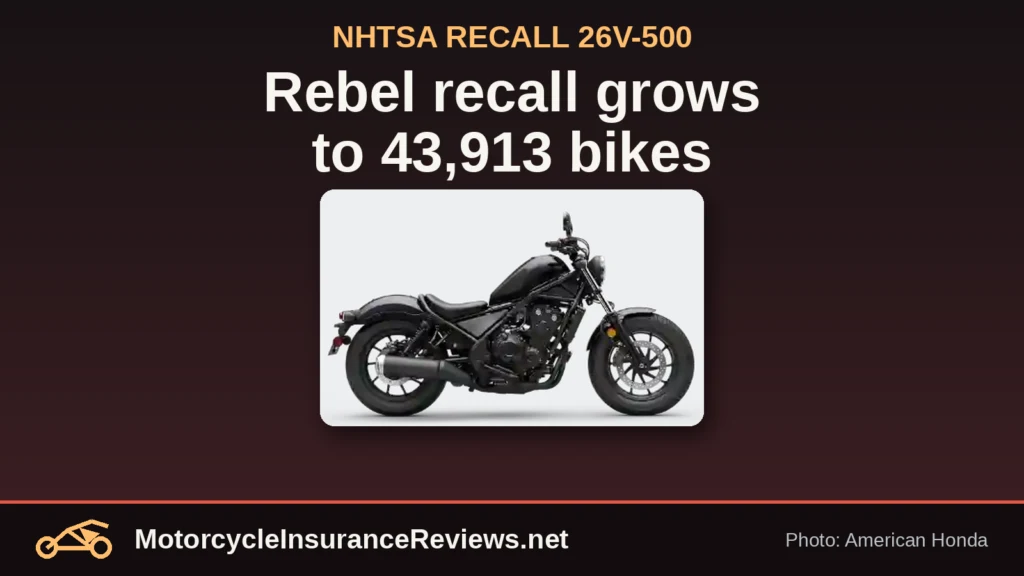
If you own a Honda Rebel, there’s a decent chance you’ve already heard about the handlebar-lock screw recall. This is the sequel, and it’s much bigger. Honda has told NHTSA that 43,913 motorcycles may have a handlebar-lock screw that can work loose, drop between the frame and the steering stem, and interfere with steering.
The new recall is NHTSA campaign 26V-500. Honda decided on it on July 23, filed the paperwork on July 30, and NHTSA’s record says owner letters went out on September 29. The big change from the first recall, 26V-146, is how far back it reaches. This one covers Rebels built as far back as January 2017.
So if you looked up your Rebel earlier this year and found nothing, look again. The fix is free, but only a VIN check can tell you whether your bike is on the list.
The featured photo illustrates the Rebel family with a 2026 Rebel 500. That model year is not listed among this campaign’s affected CMX500 motorcycles.
On this page
The short version
- Who: certain 2017–2023 and 2025 CMX500, 2017–2023 and 2025–2026 CMX300, and 2025 SCL500 motorcycles.
- How many: 43,913 motorcycles in this filing.
- The problem: the handlebar lock screw can loosen and fall between the frame and the steering stem.
- The risk: a screw lodged there can interfere with steering and raise the risk of a crash or injury.
- The fix: a Honda Powersports dealer replaces the screw and applies a thread-locking agent, at no charge.
- Contact: Honda customer service at 1-866-784-1870. NHTSA’s number for the recall is 26V500.
Which Rebels are in the new recall
Honda’s report lists six groups, by model and production dates:
- CMX500, 2017–2023: built January 17, 2017 through November 25, 2022, with 23,948 motorcycles.
- CMX300, 2017–2023: built January 17, 2017 through November 17, 2022, with 19,007 motorcycles.
- SCL500, 2025: built March 13 through March 31, 2025, with 545 motorcycles.
- CMX300, 2025–2026: built April 8 through September 19, 2025, with 245 motorcycles.
- CMX500, 2025: built March 19 through May 23, 2025, with 168 motorcycles.
- CMX500, 2019: built October 24, 2018 through August 19, 2019, with 4,221 motorcycles.
Look closely at that last row. Its dates fall inside the broader 2017–2023 CMX500 range, but Honda’s report doesn’t explain how the two rows are counted. Add all six rows and you get 48,134, which doesn’t match the filing’s stated total. Honda’s own total is 43,913, and that’s the figure to use.
NHTSA’s database lists model years 2017 through 2023 for both the CMX300 and CMX500, plus 2025 for both and 2026 for the CMX300. It doesn’t list a 2024 CMX300 or CMX500 for this campaign. That’s the reason it’s worth remembering the first recall, which named 2023–2024 groups. A 2024 Rebel is a 26V-146 question, not a 26V-500 one, and it’s worth checking both numbers.
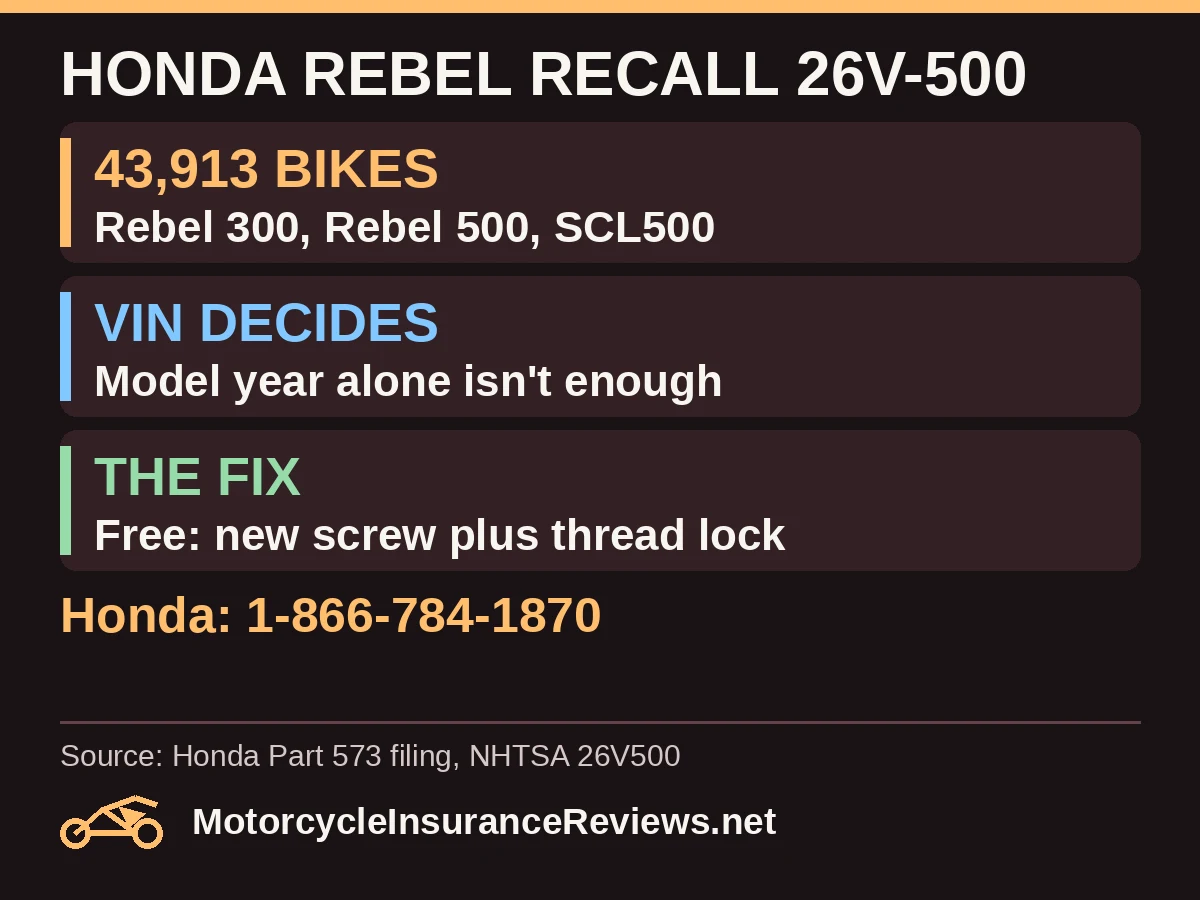
Those production windows are Honda’s way of drawing the line, not a promise about any single bike. Honda says it built the population from manufacturing records, and the only clean answer for a specific motorcycle is its VIN.
How this recall relates to the first one
The first recall, 26V-146, covered 19,406 Rebels and SCL500s, and we wrote it up in April. Honda decided on that recall on March 5.
Then Honda heard about cases it hadn’t expected. According to the chronology in the new filing:
- May 12: Honda received reports of the problem on vehicles outside the first recall’s population and began investigating.
- June 17: another report outside the original population came in.
- June 23: Honda analyzed the affected population.
- July 23: Honda decided on a second recall.
- July 30: Honda filed its report with NHTSA.
NHTSA says the new recall “expands” 26V-146. It doesn’t say the two totals stack into one number. Don’t add 19,406 and 43,913 and assume 63,319 different bikes are affected. The campaigns share some model years, but these records don’t reconcile their VIN populations, so they don’t establish how many unique motorcycles are in play.
What’s actually wrong with the screw
The part is a flat 6 x 16 mm screw, Honda part number 90164-GGK-003, and Honda describes it as a one-way Phillips-type fastener. The filing names Thai Honda Manufacturing Co., Ltd., in Thailand, as the component manufacturer.
Honda told NHTSA that the screw may not have reached its specified tightness. It points to causes in the assembly process:
- Unclear instructions: the work instructions didn’t spell out how to tighten a one-way Phillips screw, including the need to press down hard enough while turning.
- A trainer change: after the assembly-line trainer changed, the step telling workers to use both hands for that downward force dropped out, and the tool was sometimes used at a tilt instead of square to the screw.
- A worn bit: the tightening tool’s bit wore down and wasn’t replaced, which made the tightening inconsistent.
The danger isn’t that the screw gives out in some dramatic way. It’s that a loosened screw can fall into the gap between the frame and the stem, which is exactly where the steering has to move freely. If it lodges there, it can interfere with steering. That’s why Honda treats it as a safety recall, even though the part is tiny.
Honda says the condition was corrected in production on September 22, 2025. The latest production date in the recall is September 19, 2025, so that date fits the scope. It’s still no replacement for a VIN lookup on the exact bike in front of you.
What Honda says about injuries
According to the filing, Honda has had two warranty claims tied to this problem in the United States between March 6 and July 23, 2026, with no reports of injuries and no reports of deaths. That’s Honda’s account as of July 23, not an independent safety review, and it’s already more than two months old.
It’s also a small number next to 43,913 motorcycles. That helps explain why the recall can feel abstract. The point of recalling now, though, is that the failure shows up in a place where a rider can’t see it coming.
The dates and codes that don’t match
Two details in the paperwork don’t agree, and it’s best to know about them so they don’t trip you up on the phone.
- The recall code: the July report calls Honda’s own recall number KUO. NHTSA’s current record calls it KU8. Both appear in official records. If a dealer or Honda’s customer service uses one and your letter uses the other, that’s the reason. NHTSA’s 26V500 is the stable number, so lead with that one.
- The owner letters: Honda’s report planned notification for September 21. NHTSA’s current record says letters were mailed September 29. If you haven’t received one, don’t wait for the mail.
- 2026 CMX300 owners: the filing planned an interim notice for 2026-model-year CMX300 owners rather than the full remedy notice. The filing doesn’t say why the plan differs for those bikes. If you own one, call Honda or a dealer and ask whether the repair is available for your VIN today.
VINs for this recall have been searchable on NHTSA.gov since August 4, 2026, so there’s no need to wait for a letter to check.
Do you have to stop riding?
Honda’s report and NHTSA’s record don’t give an order to park the bike. NHTSA’s “park it” and “park outside” flags for this campaign are both false. The Part 573 form has “Do Not Drive” and “Park Outside” checkboxes, and both are unchecked. Those labels are not active advisories.
What the documents do say is that the consequence is steering interference. That’s a good reason to treat this as something to schedule soon rather than a notice for the glove box. If you’re not sure, call Honda at 1-866-784-1870 or your dealer, give them your VIN, and ask them directly whether they want the bike ridden before the repair.
What the repair involves
Honda says registered owners are contacted by mail and asked to bring the motorcycle to an authorized Honda Powersports dealer. There, the dealer replaces the handlebar lock screw and applies a thread-locking agent using the corrected procedure.
The replacement part is the same screw. What changes is the installation, which Honda says has been improved. There’s no charge to owners, and Honda says it’s using its general reimbursement plan on file.
This isn’t a job to do at home with a tube of thread-locker. The screw sits at the steering head, and the point of the recall is a controlled, specified procedure. Let the dealer do it.
If you’re buying or selling a Rebel
A recall follows the VIN, not the owner. If you’re shopping for a used Rebel from 2017 on, ask the seller for proof of the recall repair and run the VIN through NHTSA’s recall search yourself. Because this recall pairs with an earlier one, check for both 26V-146 and 26V-500.
If you’re selling, get the screw done first. A bike with an open steering recall is a harder conversation than one with a completed repair.
What we don’t know yet
- Your VIN. Whether your Rebel is covered depends on its production range, not its model year alone.
- Unique bike count. Honda hasn’t published how many motorcycles are in both recalls.
- 2026 CMX300 repair status. The filing’s plan was an interim notice; current parts availability for those bikes isn’t in the documents.
- Insurance. None of the recall papers says anything about coverage. If you have a question about your policy, ask your agent or insurer.
For Rebel owners, the next step is quick: look up your VIN, and if it comes up, call a Honda dealer and get the screw replaced.
References
- Honda, Part 573 Safety Recall Report, NHTSA 26V500 (submitted July 30, 2026) — model groups, production dates, unit counts, cause, chronology, remedy and recall schedule.
- NHTSA recalls API, campaign 26V500000 (checked October 2, 2026) — 43,913 units, affected model years, free remedy, letters mailed September 29, Honda customer service number and the KU8 code.
- Honda, Part 573 Safety Recall Report, NHTSA 26V146 — the earlier recall that 26V500 expands, with its own model groups and counts.