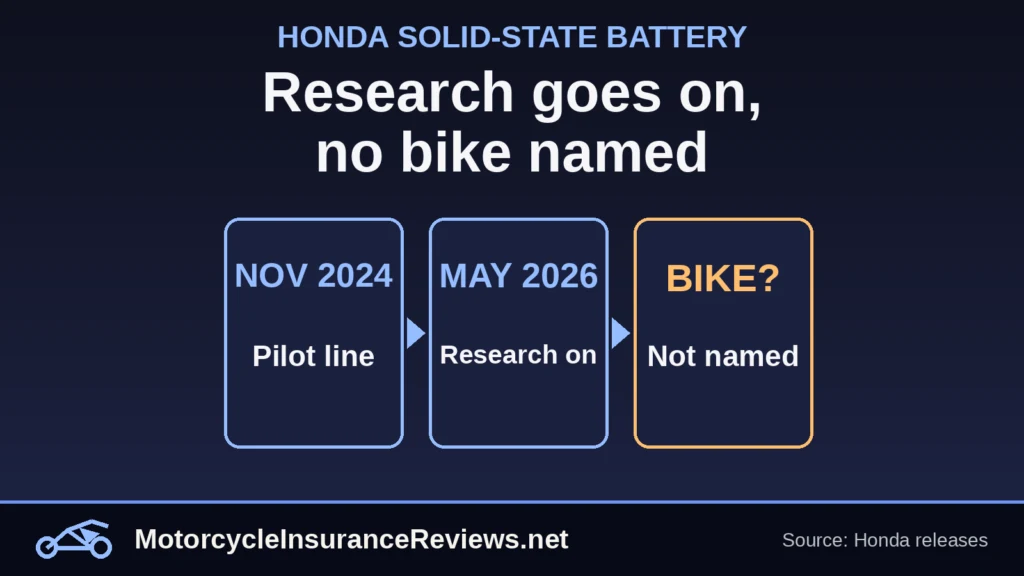
“Solid-state battery” is one of those phrases that sounds like a finish line. For motorcyclists, it usually means lighter electric bikes that go farther and charge faster. Honda is working on all-solid-state batteries, and its own papers say motorcycles are a possible home for them. But what Honda has actually published is a lot less than a battery-powered bike you can buy, and it’s worth reading closely.
Two Honda documents matter here: a November 21, 2024 announcement of a demonstration production line, and a May 14, 2026 business briefing that says Honda will continue its research. Neither names a solid-state motorcycle, a range, a price or a launch date.
The short version
- What Honda built: a demonstration production line for all-solid-state batteries at Honda R&D in Sakura City, Tochigi Prefecture, Japan, unveiled November 21, 2024.
- What it’s for: verifying mass-production processes, costs and cell specifications. It isn’t a motorcycle factory.
- Motorcycles: Honda’s 2024 release lists motorcycles, along with aircraft, as possible applications. It names no model.
- May 2026: Honda said it will continue all-solid-state battery research while taking a “flexible and agile” approach to electric motorcycle launches.
- What’s missing: no solid-state motorcycle, battery pack, range, charging time, price or ship date appears in either document.
What the 2024 announcement actually said
On November 21, 2024, Honda unveiled a demonstration line that “replicates processes required for the mass production” of all-solid-state batteries. The line has a total floor area of about 27,400 square meters (295,000 square feet) and an investment of about 43 billion yen. Honda said part of the funding came from a grant from Japan’s Green Innovation Fund, administered by NEDO.
The line covers weighing and mixing of electrode materials, coating and roll pressing of the electrode assembly, cell formation and module assembly. Honda said it planned to start battery production on the line in January 2025 and use it to verify mass-production technologies and costs while it also worked on cell specifications.
Note that last point. In late 2024, Honda said it would “determine the basic specifications” of the cells on this line. That is a development step, not a finished product.
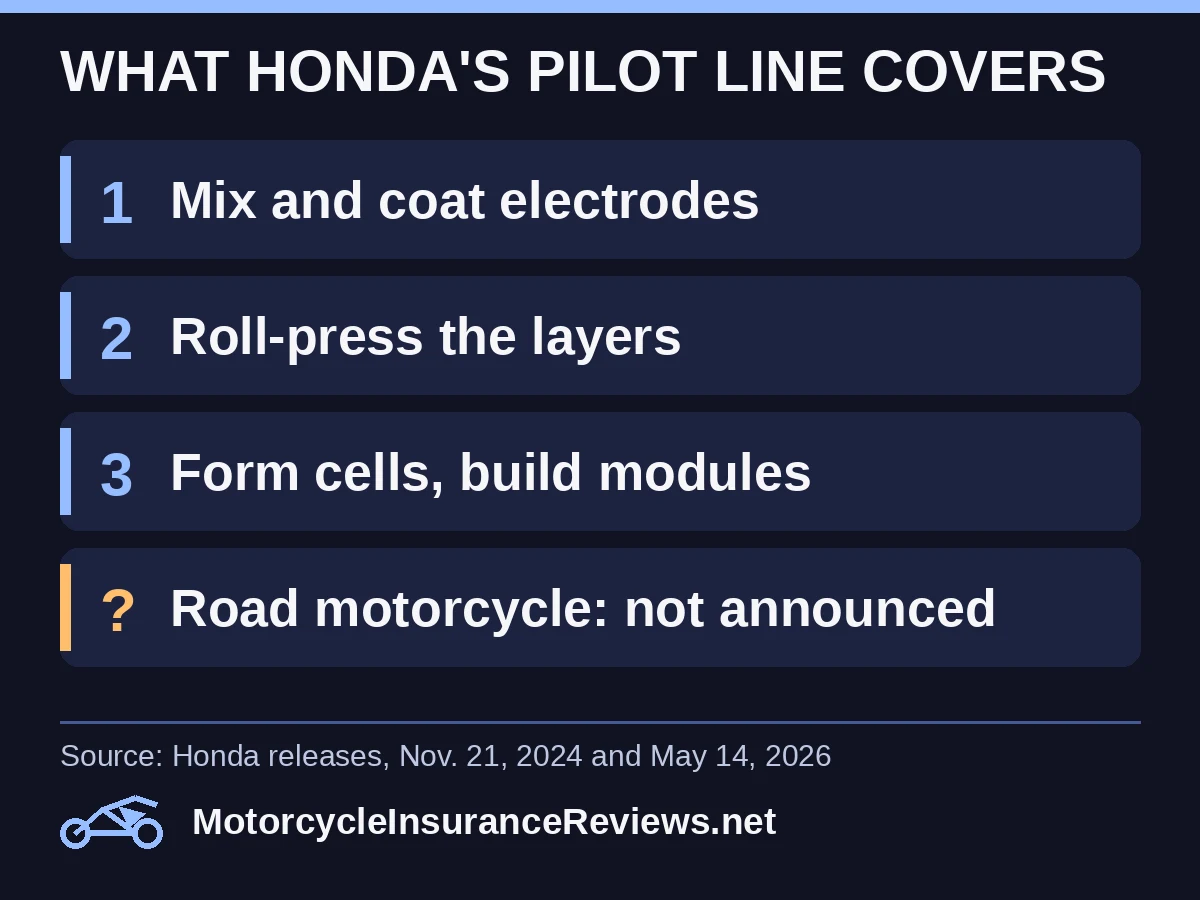
The roll-pressing detail
One technical piece is worth explaining. Honda said its process uses a roll-pressing technique, adapted from conventional lithium-ion battery production. The company says it increases the density of the solid electrolyte layers and makes continuous pressing possible, to improve contact between the electrolyte and electrodes and boost productivity.
That’s a statement of what Honda is aiming for. The release reports no measured results from the process, and nothing in it comes from an independent test.
The motorcycle line in the 2024 release
The motorcycle mention is a single phrase. Honda said it aims to cut battery costs by expanding the batteries’ use across “a wide range of Honda mobility products, not only automobiles but motorcycles and aircraft,” taking advantage of economies of scale.
So motorcycles are listed as a possible future use. The release doesn’t say which bikes, what size of battery, whether the cells would suit a scooter or a large touring bike, or when. The only timing it gives is a target to begin applying the batteries to electrified models introduced in the second half of the 2020s, which covers cars as well as bikes and isn’t a motorcycle commitment.
What the May 2026 briefing says
Honda’s May 14, 2026 business briefing is mostly about its automobile strategy, with hybrids getting new emphasis. On batteries, it says Honda will continue groundwork for a competitive EV platform “as well as the research and development of all-solid-state batteries.”
The motorcycle section of the briefing covers a different subject: Honda’s expected growth in the global motorcycle market, increased production capacity in India, and technologies such as the Honda E-Clutch. On electric motorcycles specifically, it says Honda will “closely monitor changes in customer demand and environmental regulations in each country” and take a “flexible and agile approach to product launches and establishment of production operations.”
Read together: Honda’s solid-state work continues, and its electric motorcycle plans depend on demand and regulation. The briefing doesn’t connect the two into a solid-state motorcycle plan.
What solid-state could mean for riders, and what Honda hasn’t shown
Honda’s 2024 release says all-solid-state batteries are expected to be the next-generation batteries that solve EV issues like range, price and charging time, and it cites high energy density and heat resistance. For a rider, those would be nice things to have. But they’re the company’s expectations. Neither document gives:
- A range figure for any vehicle.
- A charging time.
- A measured energy density or battery life.
- A price or cost-savings number.
- Any statement that these batteries can’t burn or are safer in a crash. Honda mentions heat resistance, which isn’t the same thing.
If you’re comparing a future “solid-state” bike with today’s electric motorcycles, there’s nothing in Honda’s documents to compare against yet.
What this means if you’re shopping or insuring a bike
Nothing changes today. There’s no solid-state Honda motorcycle to buy, insure or recall. Two practical takeaways:
- Treat “coming soon” claims carefully. Honda’s “second half of the 2020s” target covers electrified models generally and isn’t a motorcycle date.
- Insurance questions come later. When a new battery chemistry reaches production bikes, insurers will have to decide how to rate them. Nothing in Honda’s papers addresses that.
What we don’t know
- Whether the demonstration line reached its goals since its planned January 2025 start. Neither document reports results.
- Whether a Honda motorcycle will use these batteries, and when.
- Cell specifications, which Honda said in 2024 it had yet to determine.
- Cost, yield and supplier details. Not in the documents.
- How the May 2026 plans change the timing. The briefing says research continues but gives no schedule for solid-state products.
Bottom line
Honda is still investing in solid-state battery research, and its 2024 release lists motorcycles as a possible application. That’s a milestone for Honda’s battery program, not a milestone for riders. Until Honda names a model, a range and a date, “solid-state Honda motorcycle” is a possibility, not a product.
References
- Honda, “Honda Unveils Demonstration Production Line for All-Solid-State Batteries” (November 21, 2024) — Sakura line, process steps, January 2025 production plan, motorcycle and aircraft application mention and investment figure.
- Honda, business briefing (May 14, 2026) — continued all-solid-state battery R&D and the electric motorcycle approach.