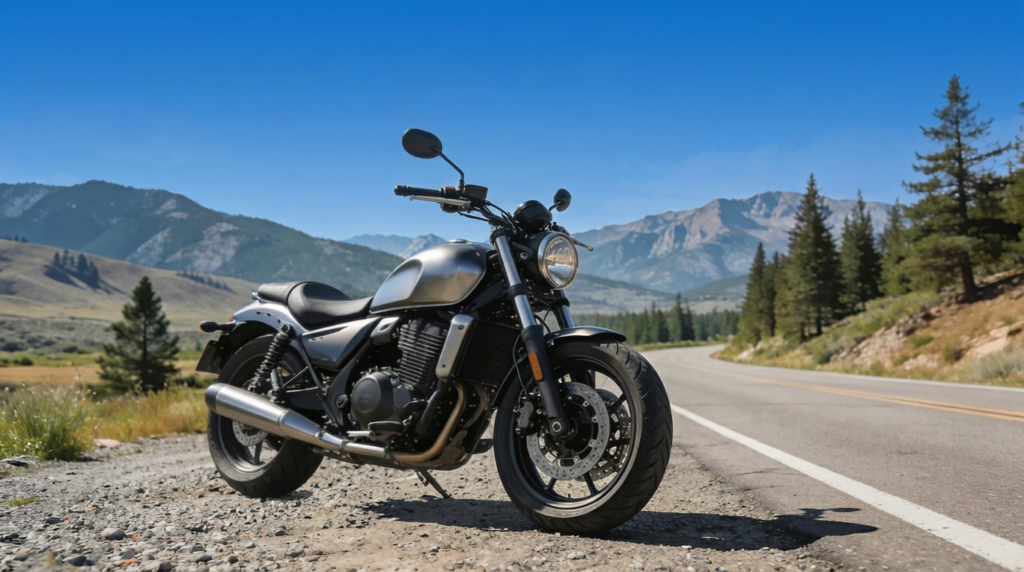
Idaho motorcycle insurance at a glance:
UM/UIM: Must be offered
Helmet law: Under 18 only
Lane splitting: Illegal
Idaho does not make motorcycle insurance complicated. It makes it easy to underestimate. A street-legal motorcycle still needs at least 25/50/15 liability coverage, the state checks coverage through its Drive Insured verification program, and registration can be suspended when the database shows no valid insurance. In 2024, Idaho recorded 629 motorcycle crashes, 47 motorcyclist deaths, and 57,827 registered motorcycles; 46% of motorcycle crashes were single-vehicle crashes. That is the real backdrop for this page: low legal minimums, big exposure, and a state where one deer strike or one solo crash can leave a rider badly underinsured.1
If you ride in Boise, Meridian, Nampa, Idaho Falls, Coeur d’Alene, or on long highway stretches between them, the question is not just “what is legal?” It is “what will still help me after a real Idaho crash?” This guide answers that using Idaho’s own statutes, the Idaho Department of Insurance, the Idaho Transportation Department, Idaho State Police, and the state’s current motorcycle manual.
Quick Idaho answer: The current legal minimum is $25,000/$50,000 bodily injury liability, $15,000 property damage liability. Idaho requires insurers to offer uninsured/underinsured motorist bodily injury coverage, which you can reject in writing or by electronic record. Proof of financial responsibility can be shown on your phone or as a paper card.1
Idaho’s minimum motorcycle insurance in one glance
Idaho’s financial-responsibility rule is straightforward: liability coverage must meet the minimum limits in Idaho Code section 49-117, and section 49-1212 ties the motor vehicle liability policy back to those limits. For a highway motorcycle, that means $25,000 for bodily injury to one person, $50,000 for bodily injury per accident, and $15,000 for property damage. Idaho also requires carriers to offer uninsured/underinsured motorist bodily injury coverage unless the insured rejects it in writing or by electronic record.2
| Coverage | Idaho rule for a street motorcycle | What it means in plain English |
|---|---|---|
| Bodily injury liability | $25,000 per person / $50,000 per accident | Pays injury claims you cause to other people when you are legally at fault. |
| Property damage liability | $15,000 per accident | Pays for damage you cause to someone else’s vehicle, fence, sign, building, or other property. |
| Uninsured/underinsured motorist bodily injury | Must be offered, but you can reject it in writing or by electronic record | Protects you if the other driver has no insurance or not enough liability coverage. |
| PIP / no-fault medical benefits | Not required in Idaho | Idaho is not a no-fault state that forces a PIP layer onto motorcycle policies. |
| MedPay | Not required by statute | Optional medical-payments coverage if the carrier offers it. |
Two Idaho-specific points matter here. First, the legal minimum is liability only. Second, Idaho’s DOI explains that underinsured motorist coverage can be written on an excess basis or on an offset/difference-in-limits basis. That is not legal trivia; it changes how much money may be available after a serious injury claim.1
How Idaho checks coverage and what counts as proof
Idaho lets you satisfy proof-of-insurance requirements with either paper or electronic proof. Section 49-1232 says the proof can be in the operator’s possession or in the vehicle, and it specifically allows an image displayed on a cellular phone or another portable electronic device. So yes, showing your card on your phone is acceptable in Idaho.6
The next layer is enforcement. Idaho maintains an online insurance verification system, and the DMV’s consumer-facing name for the program is Drive Insured. The DMV compares registration records to insurer reports. If the system cannot verify that your registered vehicle has current financial responsibility, you can get a warning and eventually a suspension notice even if the problem is administrative rather than intentional. Idaho’s own FAQ warns that an out-of-state insurer that does not report to the Idaho DMV can cause the vehicle to be classified as uninsured until the owner responds.5
That distinction matters because “no proof on you” and “actually uninsured” are not the same thing in Idaho. If you were insured at the time and later produce proof before conviction, section 49-1232 says there is no conviction for failing to carry proof. The same statute also says the department can rescind a suspension action if insurance was actually in force, and in that rescission scenario the reinstatement fee is not charged. That is much better than being truly uninsured, which triggers the penalty scheme discussed in the next section.6
Best practice for Idaho riders: Keep a paper card in the bike and a digital card on your phone.
If you get a DMV notice: Respond immediately; Idaho says registration can still be suspended even if the notice never reached you because your address was outdated.8
If your carrier is not an Idaho-based company: Verify that it reports correctly into Idaho’s system before you assume Drive Insured will see your policy.8
What happens if you ride uninsured in Idaho
Idaho treats uninsured operation as more than a paperwork issue. Section 49-1428 makes it unlawful to operate a motor vehicle on Idaho highways without valid liability insurance. For a first offense, the penalty is a $75 infraction. For a second or subsequent offense within five years, it becomes a misdemeanor punishable by up to $1,000, up to six months in jail, or both. Section 49-1232 uses the same escalation structure for failure to provide proof of financial responsibility when the person was actually uninsured.9
Separate from the roadside citation, Idaho’s electronic verification program can suspend your registration. Section 49-1234 says the department sends an initial notice after two consecutive months without verified financial responsibility, allows time to respond, then sends a final notice before suspension. The published DMV vehicle-insurance page summarizes the program in shorter language and says owners have 30 days to prove insurance or an exemption before registration is suspended; the current statute itself lays out an initial notice, a 60-day period, and a final 10-day notice before suspension. Either way, waiting is the wrong move. The safe reading for a March 2026 webpage is to treat any Idaho notice as urgent and answer it immediately.5
To get back on the road after a registration suspension, Idaho requires proof of insurance and a $75 reinstatement fee. If you were not actually uninsured and the state rescinds the action after seeing valid coverage was in force, section 49-1232 says no reinstatement fee is due. That is another reason riders should keep records and act fast when the DMV database gets it wrong.5, 6
What Idaho’s legal minimum actually protects—and what it does not
Picture a westbound ride on Chinden Boulevard in the Boise-Meridian corridor. A driver turns left across your lane. If that driver is fully at fault, you pursue that driver’s liability coverage. Your own 25/50/15 policy may pay nothing because liability insurance protects you against claims from other people; it is not a repair plan for your bike. If the evidence shows you were also speeding, following too closely, or made an unsafe move, Idaho’s comparative-fault rules can split blame. Your minimum policy still only protects the other side when you are legally responsible.1
That leaves four obvious holes. Minimum liability does not pay to repair your motorcycle. It does not pay your medical bills. It does not replace your helmet, riding jacket, comms unit, luggage, or other gear. It does not cover lost wages unless you bought separate coverage that reaches those losses. Idaho’s crash data makes that gap hard to ignore: 86% of motorcyclists in crashes were injured in 2024, 46% of motorcycle crashes were single-vehicle, and 58% of fatal motorcycle crashes involved only one motorcycle.18
Idaho also has its own environmental exposure. ITD says the state averages about 1,010 crashes involving wildlife each year on highways and interstates, and its winter-driving guidance warns that bridges and overpasses freeze before the rest of the road. If you hit a deer outside McCall at dusk, slide on a frosty bridge deck near Idaho Falls, or lose the front on gravel after dropping off the pavement edge on a rural county road, minimum liability does not fix your bike. That is why “legal” and “adequate” are very different words in Idaho motorcycle insurance.19, 20
Environmental exposure in Idaho: The state averages about 1,010 wildlife crashes a year on highways and interstates. Bridges and overpasses freeze before the rest of the road. Comprehensive coverage is built for deer strikes, theft, fire, hail, vandalism, falling objects, and many non-collision losses that do not care whether you are a cautious rider.19, 20
Coverage options worth adding in Idaho
Higher liability limits
Moving from Idaho’s 25/50/15 minimum to something like 100/300/100 is usually the cleanest upgrade a rider can make. One injured passenger, one totaled SUV, or one multi-vehicle backup on I-84 can exhaust $15,000 of property-damage coverage fast. If you have income, savings, or a house to protect, Idaho’s minimum is a legal floor, not a good stopping point.1
Collision
Collision pays for damage to your own bike after an impact or crash, regardless of fault, subject to the deductible. In Idaho that deserves serious attention because 46% of 2024 motorcycle crashes were single-vehicle crashes and 58% of fatal motorcycle crashes involved only one motorcycle. Gravel, pavement seams, wildlife avoidance, and solo loss-of-control wrecks are exactly the situations where there may be no other insurer to bill.18
Comprehensive
This is one of the most Idaho-specific coverages on the page. ITD says Idaho averages about 1,010 wildlife crashes a year on highways and interstates, and it also reminds drivers that bridges and overpasses freeze first. Comprehensive is the part of the policy built for deer strikes, theft, fire, hail, vandalism, falling objects, and many non-collision losses that do not care whether you are a cautious rider.19, 20
Uninsured and underinsured motorist bodily injury
Do not reject this casually. Idaho law requires carriers to offer UM/UIM bodily injury coverage unless you reject it in writing or by electronic record, and the Idaho DOI points out that UIM can be written as excess coverage or as offset/difference-in-limits coverage. Two policies with the same UIM limit on the declarations page may behave differently after a bad crash, so ask which version you are buying and how it coordinates with the at-fault driver’s limits.4, 1
MedPay or other supplemental medical coverage
Idaho does not force a PIP layer onto motorcycle policies, and adults 18 and older are not required to wear a helmet. That combination makes optional medical coverage more useful than the minimum-liability framework suggests, especially because Idaho’s 2024 crash report says 86% of riders in crashes were injured. Even a modest medical-payments limit can help with deductibles, ER intake, imaging, ambulance charges, and short-term treatment while the liability fight is still unfolding.13, 18
Custom parts, accessories, and riding gear coverage
Ask exactly how the policy handles hard bags, auxiliary lights, upgraded suspension, crash bars, taller windscreens, navigation equipment, aftermarket seats, and protective gear. A lot of Idaho riders use their bikes for touring, dual-sport travel, or long rural runs, which means the actual value riding around on the motorcycle can be far above the stock machine’s book value. If that equipment is not specifically included or scheduled, the claim payment can disappoint you fast.
Roadside assistance that is actually motorcycle-specific
Do not assume any roadside plan is good enough because it sits on the declarations page. In Idaho, the distance between shops can widen quickly once you are outside the Treasure Valley, and some generic auto programs do not tow motorcycles the way a dedicated bike program will. Ask for the actual tow-mile limit, whether flatbed transport is included, and whether the benefit is designed for motorcycles rather than ordinary passenger cars.
Trip interruption
This is not mandatory, but it fits Idaho better than many riders expect. A breakdown on the way from Boise to Coeur d’Alene, a mechanical failure en route to Salmon, or a major loss near Island Park can force hotel, meal, and transportation costs before the bike ever reaches a repair facility. Trip interruption coverage is built for that stranded-away-from-home problem.
Gap insurance
If you financed a new touring bike, ADV bike, or premium cruiser with a small down payment, ask for a gap quote. If the motorcycle is totaled early in the loan and the actual cash value comes in below the balance you still owe, gap insurance fills the loan shortfall. That is not an Idaho-only rule, but it is a common way riders end up paying for a bike they no longer own.
Laid-up, storage, or seasonal coverage
This is where Idaho’s rules get unusually specific. Section 49-1234 says owners may lawfully suspend insurance for storage, and insurers may report that storage status into the state’s verification system. Do not just cancel a policy and hope Drive Insured understands what you meant. Ask the carrier how it reports stored status to Idaho, what coverages stay on the bike during storage, and what happens when you put the motorcycle back into use.7
Storage coverage tip: Do not simply cancel your policy for winter storage. Arrange a carrier-approved storage or laid-up status instead. Idaho law says owners may lawfully suspend insurance for storage and that insurers may report storage status through the verification system, but the safe move is to work with your carrier on how it reports that status so a seasonal change does not accidentally trigger a DMV suspension notice.7, 8
Idaho’s helmet law and why it still matters for insurance
Idaho uses a partial helmet law. Under Idaho Code section 49-666, operators and passengers under age 18 must wear protective headgear when riding or operating a motorcycle or ATV. Adults 18 and older are not required by that statute to wear a helmet. The Idaho motorcycle manual describes the required headgear for minors as DOT-compliant, and Idaho’s 2024 crash analysis reported helmet use by 69.2% of motorcyclists in crashes overall.13, 14, 18
There is no Michigan-style checklist here. Idaho does not make adult helmet-free riding depend on extra medical coverage, endorsement age, or other special conditions. But the insurance angle is still real. Riding without a helmet where it is legal does not automatically void a claim, yet it can affect injury severity, settlement value, and the way fault and damages are argued after a crash. From a pure risk-management standpoint, a legal right to go without a helmet is not the same thing as a financial recommendation.
Lane splitting, lane filtering, and other Idaho motorcycle road rules
Lane splitting: Illegal. Idaho State Police says lane splitting, lane filtering, and lane sharing with other vehicles are not permitted in Idaho.12
Staying in lane: Idaho’s lane-use statute requires a vehicle to be driven as nearly as practicable entirely within a single lane and not moved from that lane until the driver determines the movement can be made safely.13
Passengers: The motorcycle rules require a proper passenger seat, passenger footrests, and prohibit a child from sitting in front of the operator.13, 14
Helmet rule: Riders and passengers under 18 must wear protective headgear.13
Instruction permit restrictions: No passengers, no highway/freeway riding, and daylight riding only.10, 11
Core equipment: Idaho’s current motorcycle manual lists a horn audible from 200 feet, at least one rear-view mirror reflecting to the rear for 200 feet, muffler noise no louder than stock, and turn-signal visibility requirements.14
One thing Idaho’s published materials do not do in the sources cited here is create a general minimum passenger-age rule. The state does, however, regulate where a child can sit and requires the seat-and-footrest setup for any passenger.14
For insurance content: These motorcycle rules become facts in a claim file. A lane-splitting allegation, an unsafe-pass argument, a no-signal dispute, or an equipment citation can move from “ticket issue” to “comparative negligence issue” very quickly after a crash.13
Licensing details that affect insurance eligibility
Idaho uses a motorcycle endorsement—an M endorsement—on the driver’s license for motorcycles and motor-driven cycles operated on public roads. The normal path is a knowledge test and a skills test, but a qualifying Idaho STAR/MSF course can waive the skills test within two years, and riders under 21 must complete an approved motorcycle safety course to get endorsed. Permit holders are restricted to daylight riding, no passengers, and no freeway/highway use. As of March 2026, the published DMV fees are $15 for the endorsement, $15 for the permit, $5 for the knowledge test, and $25 for the skills test, and Idaho STAR says many insurers offer discounts for completing the course.10, 11
Motorcycles vs. mopeds vs. scooters vs. e-bikes in Idaho
Idaho’s definitions matter because owners regularly assume a step-through scooter is automatically a moped, or that a low-speed machine never needs insurance. The controlling definitions sit in section 49-114, while the current Idaho motorcycle manual adds the practical registration, endorsement, and insurance requirements for public-road use.15, 14, 16
| Vehicle Type | Idaho definition | Insurance Required? | License Required? |
|---|---|---|---|
| Motorcycle | Motor vehicle with a seat or saddle, designed to travel on not more than 3 wheels, meeting FMVSS, and excluding motor-driven cycles, mopeds, and e-bikes. | Yes, for public-highway use. | Yes. Valid driver’s license plus M endorsement. |
| Motor-driven cycle | Cycle with a motor producing 5 brake horsepower or less as originally manufactured, meeting FMVSS, and excluding mopeds and e-bikes. | Yes, for public-highway use. | Yes. Valid driver’s license plus M endorsement. |
| Moped | Limited-speed motor-driven cycle with wheels under 20 inches and max speed of 30 mph; if gas-powered, engine size may not exceed 50cc; if electric, it must meet the statute’s lower-power limited-speed criteria. | For public-highway use, Idaho’s current motorcycle manual says motorized vehicles on public highways require proof of liability insurance. | Yes. Valid driver’s license required, but no motorcycle endorsement. |
| Scooter / motor scooter | Usually treated as a motorcycle or motor-driven cycle when it meets FMVSS; if it can travel over 30 mph, Idaho says it is not a moped. | Usually yes for road-going FMVSS scooters. | Usually yes. Valid driver’s license plus M endorsement unless it truly fits the moped definition. |
| Electric-assisted bicycle | State-defined e-bike treated separately from motorcycles and mopeds under Title 49. | No. Idaho says e-bikes are not subject to financial-responsibility laws. | No. Idaho says e-bikes are not subject to driver’s-license requirements. |
The moped row deserves one extra sentence because this is where riders get tripped up. Section 49-114 removes the title requirement and the motorcycle-endorsement requirement for a moped, but the current Idaho motorcycle manual also says motorized vehicles driven on public highways require proof of liability insurance. So if you ride a true moped on public roads in Idaho, the practical answer is to carry liability coverage and proof of it.15, 14
How Idaho’s insurance system changes a motorcycle claim
Idaho motorcycle claims run on a fault-based system, not on mandatory no-fault PIP benefits. In practice, that means the legally required foundation is liability insurance, and the person who caused the wreck—or that person’s insurer—is the main source of payment. Your own policy helps only if you bought coverages such as collision, comprehensive, MedPay, UM, or UIM.1, 17
Idaho also follows modified comparative negligence. Section 6-801 says a plaintiff can recover damages only when the plaintiff’s negligence was not as great as the negligence of the defendant or combined defendants, and any recovery is reduced in proportion to the plaintiff’s share of fault. In practical terms, if a rider is found 20% at fault, the damages are reduced by 20%; if the rider reaches the 50% bar, recovery is cut off.17
One more Idaho wrinkle: section 6-803 limits joint and several liability in many negligence cases, which means each defendant is often responsible for a judgment according to allocated fault instead of automatically eating the whole loss. In a multi-vehicle motorcycle crash, that can matter a lot if one at-fault driver has weak insurance or no collectible assets.17
What affects motorcycle insurance cost in Idaho
Insurers price Idaho motorcycle policies using the usual national factors, but a few state-specific details are worth calling out. Here are the big levers:
- Rider age: Younger riders generally pay more because claim frequency and severity trend higher.
- Riding experience: A newly endorsed rider usually costs more to insure than someone with several claim-free seasons and a stable endorsement history.
- Bike type and performance: Supersports, high-value touring bikes, and large-displacement machines usually rate higher than lower-value cruisers or smaller dual-sports.
- Driving and riding record: Speeding tickets, DUI history, at-fault crashes, and license suspensions can all move the premium up sharply.
- Claims history: Prior comp, collision, or liability claims matter because insurers price future risk based partly on past loss experience.
- ZIP code and garaging location: Where the bike is kept affects theft exposure, weather exposure, repair-cost patterns, and claim frequency.
- Annual mileage and commuting use: A bike used daily through the Boise metro usually rates differently from a seasonal machine ridden only on weekends.
- Coverage level and deductibles: Higher liability limits, lower deductibles, and adding collision/comprehensive raise premium, but they also change what the policy can actually do after a loss.
- Safety-course completion: Idaho STAR says many insurers offer discounts for course completion, so this is one of the few premium-reduction steps riders can actually control.11
- Credit history: Idaho allows insurers to use credit history, but the DOI’s Bulletin 20-27 says no rate may be based primarily on credit and—under one compliance method—the rate for the worst score cannot be more than double the rate for the best score.23
- Bundling and payment choices: Multi-policy discounts, homeowner/renter bundling, and paid-in-full options can materially change the final number even when the base policy is the same.
- Accessories and stated value of the bike: The more equipment the insurer is agreeing to cover, the more the policy tends to cost.
How to compare Idaho motorcycle quotes without buying a fake bargain
Quote two liability levels, not one. Get one quote at Idaho’s 25/50/15 minimum and one at a higher tier such as 100/300/100. The price gap is often smaller than riders expect, and the comparison forces you to look at value instead of just legality.1
Hold deductibles constant. If one quote uses a $500 collision deductible and another uses $1,000, you are not really comparing carriers. Make the comp and collision deductibles identical before judging price.
Ask how Idaho UIM is written. Specifically ask whether underinsured motorist coverage is written on an excess basis or an offset/difference-in-limits basis. Idaho’s DOI makes clear that both structures exist, and they do not pay the same way.1, 4
Match the physical-damage package. Confirm whether each quote includes collision, comprehensive, accessory coverage, and whether aftermarket parts are valued like OEM parts or on a limited schedule.
Ask the carrier how it handles winter storage with Drive Insured. Idaho lets insurers report storage status. If you plan to lay the bike up, ask exactly how the company reports that status so a seasonal change does not accidentally trigger a DMV suspension notice.7, 8
Confirm roadside assistance is motorcycle-specific. Tow mileage, flatbed handling, and the basic willingness to service a motorcycle differ across programs.
Check financial strength and complaint performance. Look at the carrier’s financial-strength information and then compare its Idaho complaint performance on the Idaho Department of Insurance complaint-index page. The DOI explains that a complaint index above 1.0 means more complaints than average for the amount of business written, and the DOI’s Consumer Affairs team is a free resource if you need help.21, 22
Ask for every realistic discount. In Idaho that means at least safety-course discounts, multi-policy discounts, homeowner/renter bundling, autopay, and paid-in-full pricing.11
Bottom line for Idaho riders
The Idaho minimum gets you legal, but it rarely gets you well protected. A rider who wants a policy that actually behaves like motorcycle protection in Idaho usually ends up looking at stronger liability limits, collision and comprehensive for any bike with meaningful value, and enough medical / add-on coverage that a crash does not immediately become a debt problem. Idaho’s statutes and DMV rules are detailed enough that a good policy build should be deliberate, not accidental.1
Idaho motorcycle insurance FAQ
Do I need motorcycle insurance in Idaho?
Yes, if the motorcycle is street-legal and operated on Idaho highways. Idaho’s minimum liability requirement is 25/50/15, and the state verifies coverage through its online system. You should also keep proof of insurance available in paper or electronic form.2, 5, 6
Is the Idaho minimum enough?
Usually not. It satisfies the law, but it only pays the other side’s injury and property-damage claims up to 25/50/15 when you are at fault. It does not repair your bike or pay your medical bills unless you bought other coverages, and Idaho’s crash data shows that most riders involved in crashes are injured.1, 18
Does Idaho’s no-fault or PIP system apply to motorcycles?
Idaho does not run a mandatory no-fault/PIP system for motorcycle claims. The required policy structure is liability-based, and negligence disputes are handled under Idaho’s comparative-fault rules. That is why optional medical coverage and UM/UIM can matter so much for riders.1, 17
What happens if I ride without insurance in Idaho?
A first offense is a $75 infraction. A second or subsequent offense within five years can be charged as a misdemeanor with up to $1,000 in fines, up to six months in jail, or both. Separate from the roadside penalty, Idaho can suspend the registration through the Drive Insured verification program and require proof of insurance plus a $75 reinstatement fee.9, 7, 5
Do mopeds and scooters need insurance in Idaho?
Scooters often do, because many road-going scooters are treated as motorcycles or motor-driven cycles. Mopeds are different: Idaho removes the title requirement and the motorcycle-endorsement requirement for a true moped, but the current Idaho motorcycle manual also says motorized vehicles driven on public highways require proof of liability insurance. For highway use, the safer practical answer is yes—carry liability insurance and proof of it.15, 14
Does a motorcycle safety course lower my insurance rate?
Often, yes. Idaho STAR says many insurance companies give discounts for taking the class. Riders under 21 also need an approved course to obtain the endorsement, so for younger riders the course can be both a licensing requirement and a rating benefit.11, 10
What if my bike is financed or leased?
Your lender will usually require more than Idaho’s legal minimum. In practice that means collision and comprehensive, and sometimes a maximum deductible or a recommendation to buy gap coverage. Legal minimum liability keeps you street-legal; it usually does not satisfy the loan contract.
Does Idaho require uninsured motorist coverage on motorcycle policies?
Idaho requires the insurer to offer uninsured and underinsured motorist bodily injury coverage, but it does not force you to buy it if you reject it in writing or by electronic record. That makes it optional for the rider, but mandatory for the insurer to present. Because Idaho UIM can be written in different ways, this is a coverage worth reading carefully before you reject it.4, 1
Can I show proof of motorcycle insurance on my phone in Idaho?
Yes. Idaho Code section 49-1232 specifically allows proof of financial responsibility to be shown in electronic form on a cell phone or other portable electronic device. A paper card is still smart backup, but electronic proof is valid.6
Is lane splitting legal in Idaho?
No. Idaho State Police says lane splitting, lane filtering, and lane sharing with other vehicles are illegal in Idaho. The state’s lane-use law reinforces that a vehicle must stay as nearly as practicable within a single lane until a safe move can be made.12, 13
What is Drive Insured?
Drive Insured is the Idaho DMV’s online insurance-verification program. It compares insurer reports with vehicle-registration records and can trigger warning letters or registration suspension when coverage is not verified. Riders with out-of-state insurers need to pay special attention because Idaho says not every carrier reports into the system the same way.5, 8, 7
Can I cancel coverage in winter if I store the bike?
Potentially, yes, but do it carefully. Idaho law says owners may lawfully suspend insurance for storage and that insurers may report storage status through the verification system. The safe move is to arrange a carrier-approved storage or laid-up status, not simply stop paying the premium and hope the DMV does not notice.7, 8
Primary Sources and Live Links
- Idaho Department of Insurance, Required Auto Coverage. https://doi.idaho.gov/consumers/auto-insurance/required-auto-coverage/
- Idaho Code section 49-117, Proof of Financial Responsibility. https://legislature.idaho.gov/statutesrules/idstat/title49/t49ch1/sect49-117/
- Idaho Code section 49-1212, Policy requirements tied to financial responsibility limits. https://legislature.idaho.gov/statutesrules/idstat/title49/t49ch12/sect49-1212/
- Idaho Code section 41-2502, Uninsured and underinsured motorist bodily injury coverage. https://legislature.idaho.gov/statutesrules/idstat/title41/t41ch25/sect41-2502/
- Idaho Transportation Department / DMV, Vehicle Insurance. https://itd.idaho.gov/dmv/registrations-plates-titles/vehicle-insurance/
- Idaho Code section 49-1232, Proof of financial responsibility and penalties. https://legislature.idaho.gov/statutesrules/idstat/title49/t49ch12/sect49-1232/
- Idaho Code section 49-1234, Online insurance verification system and suspension process. https://legislature.idaho.gov/statutesrules/idstat/title49/t49ch12/sect49-1234/
- Idaho DMV FAQ, Drive Insured Questions. https://itd.idaho.gov/faqs/drive-insured-questions/
- Idaho Code section 49-1428, Operation without liability insurance prohibited. https://legislature.idaho.gov/statutesrules/idstat/title49/t49ch14/sect49-1428/
- Idaho Transportation Department / DMV, Motorcycle Endorsement. https://itd.idaho.gov/dmv/drivers-licenses-id-cards/motorcycle-endorsement/
- Idaho STAR Motorcycle Safety Program FAQ. https://idahostar.org/faqs/
- Idaho State Police, Lane Splitting is Illegal in Idaho. https://isp.idaho.gov/lane-splitting-is-illegal-in-idaho/
- Idaho Code Title 49, Chapter 6 PDF (including sections 49-637, 49-665, and 49-666). https://legislature.idaho.gov/wp-content/uploads/statutesrules/idstat/Title49/T49CH6.pdf
- Idaho Motorcycle Manual (current state manual PDF). https://itd.idaho.gov/wp-content/uploads/2025/10/Motorcycle_manual.pdf
- Idaho Code section 49-114, Definitions for moped, motorcycle, and motor-driven cycle. https://legislature.idaho.gov/statutesrules/idstat/title49/t49ch1/sect49-114/
- Idaho Code section 49-726, Insurance, licensing, and registration for electric-assisted bicycles. https://legislature.idaho.gov/statutesrules/idstat/title49/t49ch7/sect49-726/
- Idaho Code Title 6, Chapter 8 PDF, Comparative Negligence and Apportionment of Liability. https://legislature.idaho.gov/wp-content/uploads/statutesrules/idstat/Title6/T6CH8.pdf
- Idaho Office of Highway Safety, 2024 Crash Analysis PDF. https://apps.itd.idaho.gov/Apps/OHS/Crash/24/Analysis.pdf
- Idaho Transportation Department, Wildlife and Highway Safety. https://itd.idaho.gov/environmental/wildlife/
- Idaho Transportation Department, Winter Driving. https://itd.idaho.gov/travel/winter-driving/
- Idaho Department of Insurance, Complaint Index. https://doi.idaho.gov/information/public/reports/complaint-index/
- Idaho Department of Insurance, File a Complaint / Consumer Affairs. https://doi.idaho.gov/consumers/file-a-complaint/
- Idaho Department of Insurance, Bulletin 20-27 on use of credit history. https://doi.idaho.gov/wp-content/uploads/ID/2027.pdf
Editorial note: Verified against Idaho primary sources on March 28, 2026. This guide is informational, not legal advice. Idaho insurance and traffic rules can change, so re-check the linked primary sources before publishing later updates.