Lab tests have shown for years that a motorcycle airbag vest can soften the blow to a rider's chest. Evidence on chest injuries in real crashes is still limited. A short study presented at the IRCOBI 2026 conference in Munich (Sept. 9–11, 2026) adds some: among 943 riders who crashed on the road, those whose airbag vest inflated reported chest injuries about half as often as those without an inflated vest.
The authors estimate a 52% lower relative risk of chest injury after adjusting for differences between the two groups. It's an encouraging result, but it comes from a survey of airbag owners, and the authors themselves warn the effect may be overstated. Here's what the study did and didn't show.
Key points:
- Who was studied: 943 adult riders of motorcycles, scooters and mopeds involved in road crashes, all recruited from users of In&motion airbag vests.
- The comparison: 480 riders whose vest inflated versus 463 who weren't wearing a vest or whose vest didn't inflate.
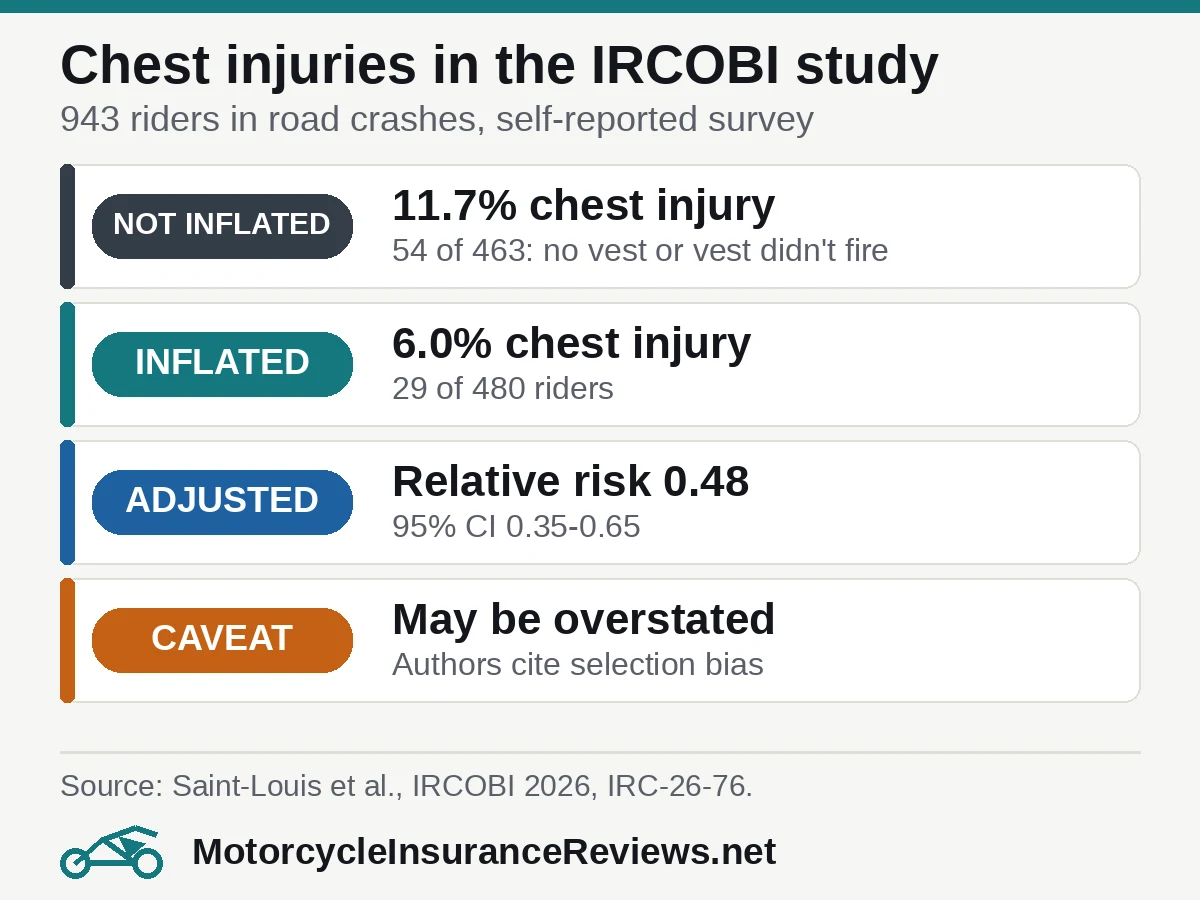
- Raw result: chest injury in 6.0% of the inflated-vest group (29 of 480) versus 11.7% of the comparison group (54 of 463).
- Adjusted result: relative risk 0.48 (95% confidence interval 0.35–0.65), which the authors describe as a 52% reduction.
- Big caveats: self-reported data, a selected group of vest buyers, possible selection bias, and no separate look at severe chest injuries or deaths.
How the study worked
The paper, "Airbag vest effectiveness in reducing thoracic injuries among PTW riders in road crashes: An epidemiological study" (IRC-26-76), is a three-page short communication by Fégens Saint-Louis and five co-authors. "PTW" means powered two-wheeler: motorcycles, scooters and mopeds.
The data come from the EDAIR project, an online survey run from October 2024 to February 2025 among people who use In&motion airbag vests. Riders answered questions about themselves, their bike and gear, how the crash happened, whether their airbag was worn and deployed, and what injuries they had and how they were treated.
The researchers then removed anyone who:
- was under 18,
- was a passenger,
- crashed off-road or on a track, or
- didn't say what their injuries were or whether the airbag deployed.
A chest injury counted if the rider had any injury in the thorax region on the Abbreviated Injury Scale, the standard system doctors and researchers use to classify injuries by body region and severity.
Why "inflated" is the key word
The study didn't compare vest wearers with non-wearers. It compared riders whose vest actually inflated with everyone else. That second group includes riders with no airbag vest and 131 riders who were wearing one that didn't inflate.
The authors explain why. An airbag can only absorb and spread out an impact if it's full of gas, so lumping un-inflated vests in with inflated ones would water down the measured effect.
It does mean the 52% figure isn't the benefit of simply owning or wearing a vest. It describes riders whose vest fired.
Adjusting for differences between riders
The two groups weren't identical. Riders whose vests inflated reported somewhat higher pre-crash speeds (median 45 km/h, about 28 mph, versus 40 km/h, about 25 mph) and were more likely to be on a bike of 125cc or more (96.4% versus 92.1%).
To level that out, the researchers used a statistical method called propensity-score weighting. It gives each rider a weight so the two groups look alike on measured factors: age, gender, job category, obesity, protective gear, engine size, crash location, whether another vehicle or an object was hit, and reported speed. Then they compared chest-injury risk.
After weighting, the relative risk was 0.48, with a 95% confidence interval of 0.35 to 0.65. Because the whole range sits well below 1.0, the link is statistically significant in this sample.
What could push the number up or down
The authors list several reasons to be careful, and they point in both directions.
Reasons the true effect could be smaller:
- Who was recruited. Riders without an inflated vest were drawn from current airbag owners. Some may have bought a vest after the very crash they reported, possibly because they were hurt in it. That would make the no-vest group look worse and overstate the benefit. The authors say this could lead to "effect overestimation."
- Unmeasured differences. Weighting only balances the factors the survey measured.
Reasons it could be larger:
- Deployment timing. The survey didn't establish whether the vest inflated before or after the rider's body first hit something. 37% of riders said the timing was unknown (34%) or that inflation came after the first impact (3%). A bag that fills after the chest hits can't help, so counting those riders as protected could hide some of the real benefit.
- Memory. Riders reported their own crashes and injuries from memory, which the authors expect would blur both groups similarly and pull the result toward no effect.
There are also limits on who the results apply to. The sample was 90.5% men, with a median age of 45, and 82.6% wore a high level of protective gear (a helmet plus at least three other items). The study is based on survey responses from users of one airbag brand, and the paper doesn't say which countries they ride in. And it looked at any chest injury. The authors say future work should examine severe chest injuries specifically. The study doesn't address deaths.
Where this fits
The paper's introduction notes that lab and computer-model studies have shown airbag vests reduce chest compression and the risk of rib fractures and internal injuries. An earlier analysis by the same lead author found a non-significant trend toward 20% lower mortality with airbag vests. This is the first study the authors know of that measures the effect on chest injuries in real-world crashes using detailed injury data.
Disclosure matters here. The lead author is a PhD student at Gustave Eiffel University and at In&motion, and two co-authors are In&motion's lead researcher and co-founder/chief technical officer. The survey was run among In&motion vest users.
You may see this study cited in airbag marketing. Western Power Sports quoted the 52% figure when it launched RST's D3O Essential airbag vest in the U.S. in November 2026. The study didn't test that vest or any specific product. It's evidence about inflated airbag vests in general, from one brand's user base.
What it means if you're weighing a vest
The study supports what the lab work already suggested: when an airbag vest inflates in a road crash, chest injuries appear less common. It doesn't promise a 52% cut for any one rider, and it can't tell you how a vest will perform in a severe crash.
The practical lessons line up with the study's own design. A vest only helps if you're wearing it and it inflates, so it needs to be charged, worn on every ride and set to the right riding mode. And an airbag vest adds to your other gear rather than replacing it. Nearly everyone in this study was also wearing a helmet and several other pieces of protective gear.
References
- Saint-Louis F, Agier L, Cherta-Ballester O, Honoré V, Monneuse O, Vernet C. Airbag vest effectiveness in reducing thoracic injuries among PTW riders in road crashes: An epidemiological study. IRCOBI Conference 2026, paper IRC-26-76 (short communication) — the full paper with methods, the 943-rider sample, Table I results, weighting covariates, author affiliations and limitations.
- IRCOBI 2026 conference proceedings (Munich, Sept. 9–11, 2026) — the proceedings index listing the paper, its authors and the conference dates.