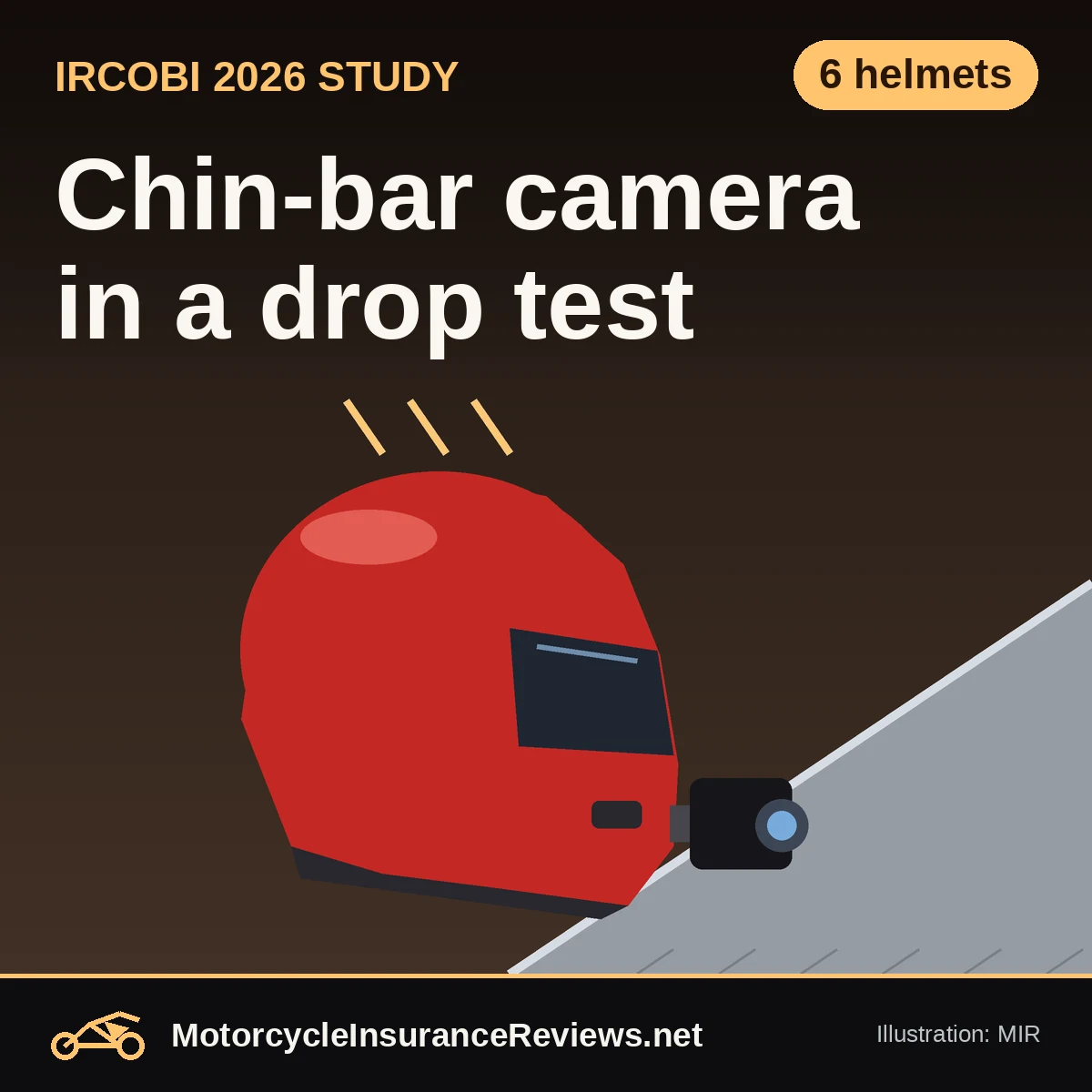
Plenty of riders stick an action camera on the chin bar of a full-face helmet, and plenty of others have wondered whether that lump of plastic could make a crash worse. A small lab study presented at the IRCOBI 2026 conference in Munich (Sept. 9–11, 2026) put the question to a drop test, and the answer surprised the researchers.
In one specific setup, helmets with a chin-mounted camera produced lower head-impact measurements than helmets without one. But the camera mount broke off in every test, the study used one helmet model and one mount, and the authors say the result shouldn't be generalized. It isn't a reason to add a camera for safety.
Key points:
- The test: six helmets of one ECE 22.06-certified model, three with a chin-bar camera and three without, dropped chin-first onto an angled steel anvil.
- The camera: a 3D-printed stand-in matched to the size and weight of a GoPro Hero 10, in a case, on adhesive chin mounts.
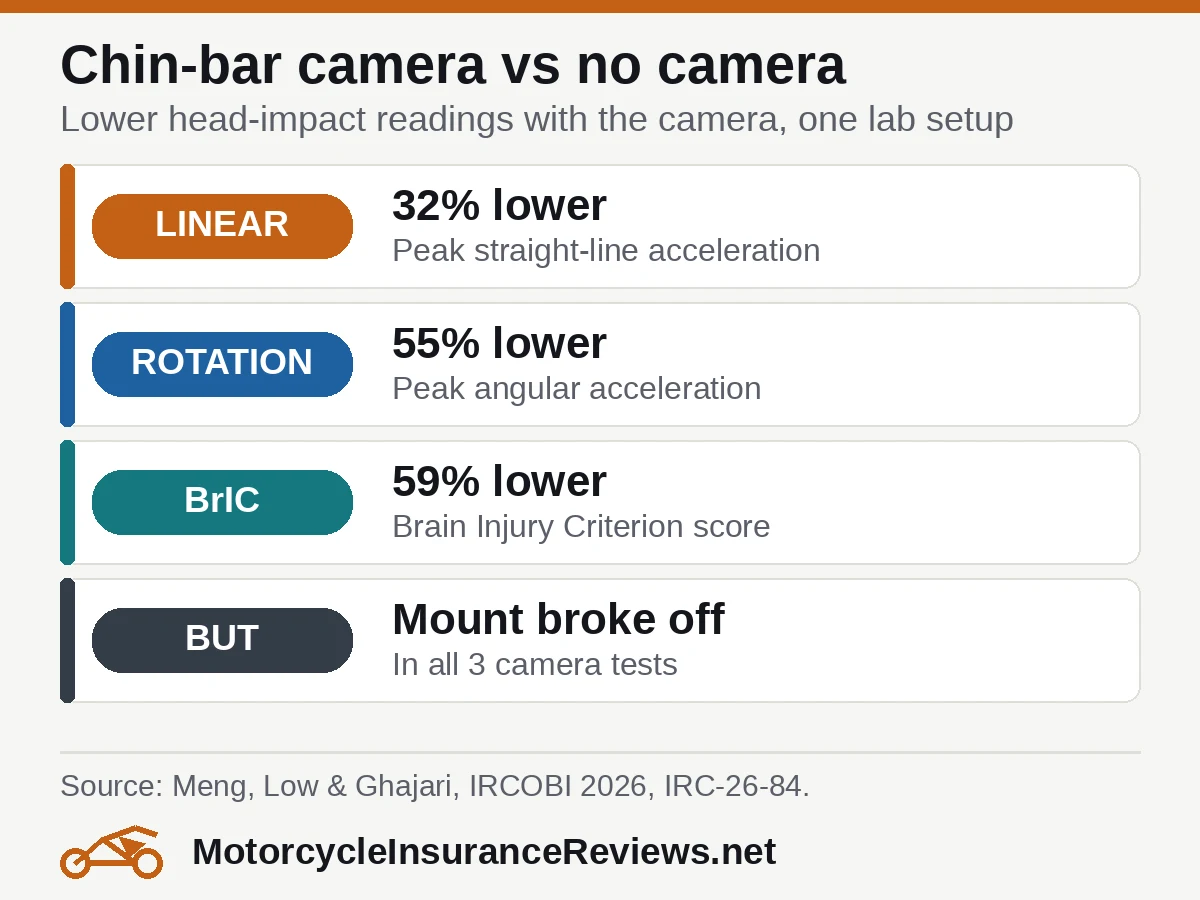
- The result: with the camera, peak linear acceleration was 32% lower, peak rotational acceleration 55% lower, and a brain-injury metric (BrIC) 59% lower.
- Why: the camera mount detached and the helmet's chin vent cover cracked in all three camera tests. The authors think that breakage let the helmet slide instead of twisting the head.
- The limits: one helmet, one mount type, one impact angle, three repeats per condition, and lab measurements rather than real injuries.
Why researchers looked at the chin
The researchers note that current helmet standards do little testing of facial impacts. Yet the face takes a big share of real crash impacts. The authors of this paper, Shiyang Meng of Autoliv Research in Sweden and Lucas Low and Mazdak Ghajari of Imperial College London, cite earlier work showing facial impacts account for nearly half of head impacts in motorcycle crashes.
Their starting hypothesis was the intuitive one: a camera, or any other bump sticking out of the chin bar, would make a facial impact worse.
How the test worked
The paper, "Does a Chin Bar-Mounted Action Camera Increase Head Injury Risk in Facial Impacts?" (IRC-26-84), is a two-page short communication. The team used an oblique chin-bar impact, a drop test designed to mimic a rider's face hitting something at an angle:
- Impact speed: 8.5 m/s, about 19 mph. That's the speed of the head hitting the anvil in the lab, not the speed the motorcycle was traveling.
- Anvil angle: 45 degrees.
- Head position: the headform rotated 90 degrees so the chin bar takes the hit.
Inside each helmet was the new EN 17950 test headform, which the authors say better matches a human head's shape, mass distribution and surface friction than older headforms.
Those settings come from a companion paper at the same conference (IRC-26-85, by Low and colleagues). That team reconstructed 30 real U.K. crashes involving facial impacts, ran 1,476 computer simulations varying speed, angle, rider height and posture, and grouped the results into representative test conditions. A chin-bar impact position they proposed represented about half of their reconstruction dataset. Because those 30 cases were selected for facial impacts, that figure describes the study set, not how often chin impacts happen in all crashes.
What the sensors showed
The team measured three things on the headform:
- Peak linear acceleration, the straight-line jolt to the head: 32% lower with the camera.
- Peak angular acceleration, how sharply the head was spun: 55% lower.
- BrIC (Brain Injury Criterion), a calculated score based on head rotation that's used to estimate brain-injury risk: 59% lower.
All three differences were statistically significant in this small sample, and results were consistent from test to test.
High-speed video gave the authors a possible explanation. With the camera fitted, the helmet slid more along the anvil and the head rotated less inside the helmet. The authors call this a "mechanical decoupling": the adhesive mount tearing loose and the chin vent cover fracturing changed how the helmet met the anvil, soaking up energy that would otherwise have reached the head.
What it doesn't tell you
This is where the caveats matter more than the headline numbers.
- One helmet, one mount. The authors say plainly that the findings "should not be generalised for all chin bar-mounted action cameras and accessories." A camera on a stronger mount that doesn't break away, or on a different helmet, could behave differently.
- One impact condition. A single angle and speed. Other angles, a camera hitting the ground first, or a mount that stays attached weren't tested.
- A stand-in camera. The camera was a mass- and shape-matched surrogate, not a real GoPro.
- Measurements, not injuries. Lower readings on a test headform aren't the same as fewer injuries for real riders. The study didn't follow any crashes.
- Six helmets. Three tests per condition is enough to show a consistent lab difference, not to settle the question.
The study also doesn't speak to whether a helmet's certification still applies once you stick something to it, whether your helmet maker approves of mounts, or where camera mounts are legal. Those depend on the helmet maker, your state and the standard involved.
What riders can take from it
If you already run a chin-mounted camera, this study offers some reassurance that the most common fear, a camera driving the impact straight into your head, didn't happen in this one setup. It doesn't show that a camera makes you safer, and the authors don't suggest adding one for protection.
What it does show is that how an accessory fails matters. Here, an adhesive mount that tore away and a vent cover that cracked seemed to help the helmet slide. A rigid, bolted mount might not do the same. If you mount a camera, follow your helmet maker's guidance on accessories, and replace a helmet after any crash impact even if it looks fine.
For the industry, the authors see a bigger use: they say the chin-bar test was repeatable enough to be considered for future helmet ratings and regulations, which could eventually test how helmets and accessories handle facial impacts.
References
- Meng S, Low L, Ghajari M. Does a Chin Bar-Mounted Action Camera Increase Head Injury Risk in Facial Impacts? IRCOBI Conference 2026, paper IRC-26-84 (short communication) — the full paper with the test setup, results, failure observations and the authors' limits on generalizing.
- Low L, Baker C, Dawber W, Meng S, Ghajari M. Facial Impact Conditions for Assessing Motorcycle Helmets, Informed by Reconstruction of Real-World Collisions. IRCOBI Conference 2026, paper IRC-26-85 — the companion study whose crash reconstructions informed the test conditions.
- IRCOBI 2026 conference proceedings (Munich, Sept. 9–11, 2026) — the proceedings index listing both papers and the conference dates.