
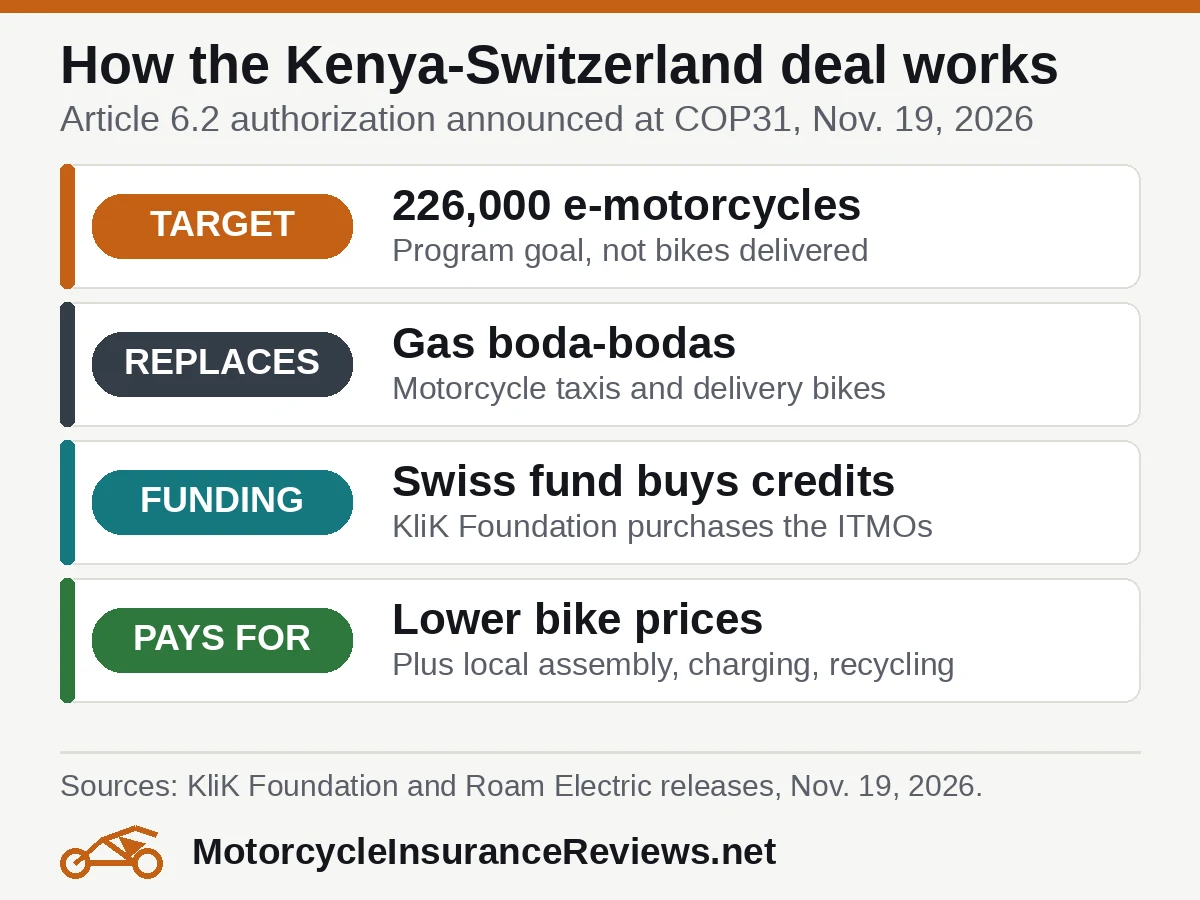
Kenya and Switzerland have signed off on a carbon-finance program that aims to put 226,000 locally built Roam electric motorcycles on Kenyan roads, mostly in place of gasoline motorcycle taxis and delivery bikes.
The approval was announced on Nov. 19, 2026 at the COP31 U.N. climate summit in Antalya, Turkey. According to KliK Foundation, the Swiss foundation that will buy the program's carbon reductions, it's the first authorization under the two countries' bilateral climate agreement. Kenyan electric-motorcycle maker Roam Electric, which owns and runs the program, published the same announcement.
Key points:
- The number: 226,000 is a deployment target for the program, not motorcycles already built or sold.
- The program: Roam's "E-Mobility Solutions in Kenya," authorized under Article 6.2 of the Paris Agreement.
- The money: KliK buys the resulting emissions reductions, and that revenue is meant to lower the bikes' purchase price.
- Where: Kenya only. Nothing here changes prices, incentives or availability in the U.S.
Boda-Bodas Are the Target
In Kenya, motorcycle taxis are called boda-bodas, and they're everywhere. They carry passengers and goods across cities and towns, and most run on gasoline.
The two announcements say Kenya's growing fleet of fuel-burning motorcycles is a major source of its transport emissions and dirty urban air. Kenya has made electric mobility a national priority, but adoption is still "extremely low," they say, because electric bikes cost more up front and charging is scarce.
The program is aimed squarely at that gap. Roam says its motorcycles are manufactured locally in Kenya and designed for how riders there work.
How Article 6.2 Turns Into Cheaper Bikes
Article 6.2 of the Paris Agreement lets countries cooperate and transfer authorized mitigation outcomes under agreed accounting rules. These are called internationally transferred mitigation outcomes, or ITMOs, and can count toward climate targets under those rules.
Here's how the pieces fit, according to KliK and Roam:
- Roam owns and carries out the program, supported by First Climate and Article Six Group.
- Kenya and Switzerland authorize it under their bilateral agreement.
- KliK Foundation buys the ITMOs the program generates.
- That carbon revenue helps pay for the program.
KliK says the ITMO money lowers the purchase price of the motorcycles and also funds local assembly, charging infrastructure and battery recycling.
Roam CEO Filip Lövström said in the release that "every kilometre ridden is measured, so the climate impact is real and verifiable." Roam says it measures riding distance. The announcements do not publish the full calculation for translating project activity into eligible emissions reductions.
What Riders There Are Promised
For riders, the two announcements list a lower purchase price, lower daily costs, predictable energy bills and a more stable income.
That's the pitch for riders who cover a lot of miles every day. Actual savings will depend on the final price, charging costs and battery life on the road, none of which the announcements quantify.
The program also says it's additional to Kenya's national climate pledge, meaning the cuts aren't ones Kenya was already counting on, and that it meets both Kenyan carbon-market rules and Swiss CO2 law.
What the Announcement Doesn't Say
A few things to keep straight:
- No delivery count. 226,000 is what the program enables over time, not current production or a confirmed order.
- No timeline per bike. The announcements don't say how many motorcycles reach riders each year.
- No price. Neither Roam nor KliK published the discounted purchase price.
- Kenya is the program’s market. The announcements give no U.S. sales plan or rider incentive.
Why it's still worth watching: at this scale, the program is a real-world test of whether international carbon finance can make electric motorcycles affordable for people who ride for a living. KliK says the full program documentation will be posted by the Swiss Federal Office for the Environment.
References
- KliK Foundation release: Kenya and Switzerland grant first-ever Article 6.2 authorisation for Roam electric motorcycle programme (Nov. 19, 2026) — the authorization at COP31, the 226,000-motorcycle target, KliK's purchase of ITMOs, what the carbon revenue funds and the program's additionality and eligibility.
- Roam Electric announcement of the Kenya-Switzerland Article 6.2 authorization (Nov. 19, 2026) — Roam's ownership of the program, local manufacturing, the boda-boda focus and the CEO's statement on measured riding.
- UN Climate Change overview of Article 6 — Explains the use of authorized transferred mitigation outcomes under agreed accounting rules.