Plenty of motorcycles are still out there with a recall nobody fixed. The bike changed hands, the letter went to an old address, or the owner just never got around to it. The National Highway Traffic Safety Administration (NHTSA) wants states to catch more of those at one moment almost every owner goes through: registration.
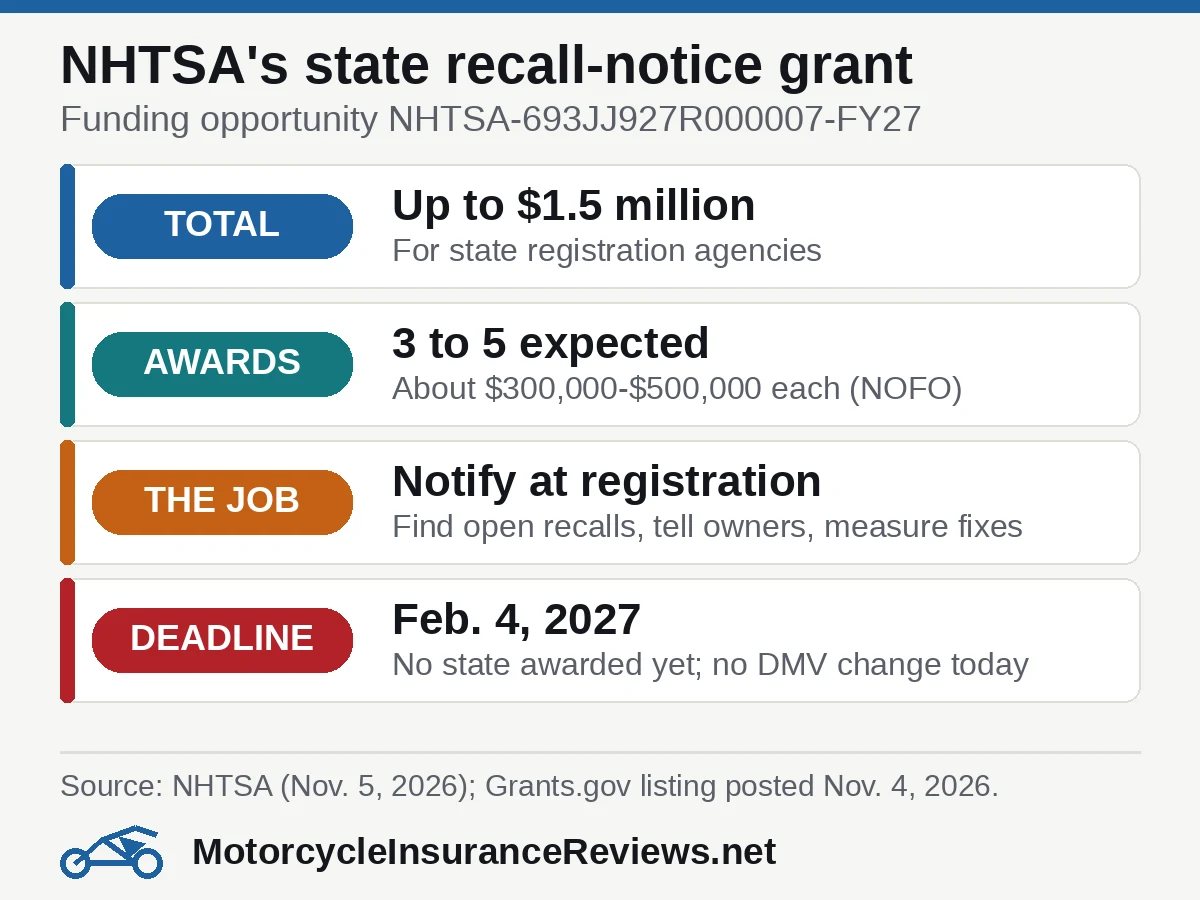
On Nov. 4, 2026, NHTSA posted a federal grant opportunity called the State Process for Informing Consumers of Recalls Program, and announced it publicly on Nov. 5. It makes up to $1.5 million available to state vehicle registration agencies to build systems that tell owners about open recalls when they register. Applications are due Feb. 4, 2027.
Key points:
- Who can apply: a state agency with authority to register motor vehicles for public roads, with the infrastructure and staff to run the program.
- How much: up to $1.5 million in total. NHTSA's funding notice anticipates three to five awards of roughly $300,000 to $500,000 each, depending on applications and funding.
- What states would build: a way to find open recalls on vehicles, notify each owner or lessee at registration, and measure whether the notices led to completed repairs.
- Deadline: Feb. 4, 2027.
- What it doesn't do yet: this announcement does not award funds or change how your state handles registration.
What the Program Asks States to Do
The federal listing spells out three jobs for a funded state:
- Develop a method for identifying open recalls on vehicles in the state's registration records.
- Inform each applicable owner and lessee of any open recall at the time of registration.
- Evaluate the results by analyzing completed recalls, and report to NHTSA on the processes and methods used.
NHTSA says it will review what states report and may share those methods, in part or in full, with other stakeholders for future use. In other words, the grants are as much about finding a model other states can copy as about the handful of states that get money. Awards are competitive, and there's no cost-sharing requirement.
Where Motorcycles Fit
Federal vehicle safety law defines a motor vehicle broadly: a vehicle driven by mechanical power and made mainly for use on public streets, roads and highways. Street-legal motorcycles fall inside that definition, and motorcycle makers run safety recalls through NHTSA just like carmakers.
But the grant notice is written about "motor vehicles" in general. Whether a funded state's notices would cover motorcycles depends on how that state designs its program and on what its registration data and recall matching can handle. The new grant announcement does not confirm motorcycle coverage in any program funded by this round.
If your state does build one, the benefit for riders is easy to picture. Motorcycles often pass through several owners, and recall letters go to whoever the maker or the state has on file. A notice on the renewal form reaches the person who actually has the bike today.
Why This Matters on a Used Bike
Recalls on motorcycles can involve the parts you least want to fail: brake lines and calipers, fuel pumps and fuel lines, wheels, steering stops, wiring that can stall the engine. An unfixed recall on a used bike is a real risk, and it's also an avoidable one, because the repair is normally done at no charge by an authorized dealer.
The trouble is that nobody makes you check. A private seller may not know about a recall, and the buyer may not think to ask.
Check Your Bike Now, No Grant Required
You don't have to wait for your state. NHTSA's recall lookup at NHTSA.gov/recalls lets you enter a 17-character VIN and see whether a vehicle has an unrepaired safety recall from the manufacturers that report to that tool, including motorcycle makers.
A few habits make it more useful:
- Check before you buy a used bike. Ask for the VIN, run it, and if something comes up, ask the seller whether it was repaired. A dealer service record is the best proof.
- Check after you buy. Then contact a dealer for that brand to schedule the fix and make sure the maker has your name and address.
- Check once or twice a year. New recalls are issued all the time, including on bikes that are several years old.
- Remember the gaps. The VIN lookup covers vehicles, not riding gear. Helmets, tires and aftermarket parts have their own recalls and are searched separately on NHTSA's site, usually by brand and model.
What Happens Next
State agencies have until Feb. 4, 2027 to apply. After that, NHTSA would choose recipients, and any funded state would still need to build and launch its notification system. Watch for award announcements in 2027, and check whether your state is on the list and whether its program includes motorcycles.
References
- NHTSA announcement: Investing in Improving Vehicle Recall Rates (Nov. 5, 2026) — the agency's public announcement of the state recall notification grant program, its amount and scope.
- Federal funding opportunity NHTSA-693JJ927R000007-FY27: State Process for Informing Consumers of Recalls Program — the official listing (posted Nov. 4, 2026) with the program objective, eligibility, $1.5 million in expected funding, the Feb. 4, 2027 closing date and the linked funding notice, which anticipates three to five awards of $300,000 to $500,000.
- 49 U.S.C. 30102: Definitions for federal motor vehicle safety law — the federal definition of "motor vehicle" (subsection (a)(7)).
- NHTSA recall lookup — the VIN search for unrepaired safety recalls and separate searches for equipment such as tires and helmets.