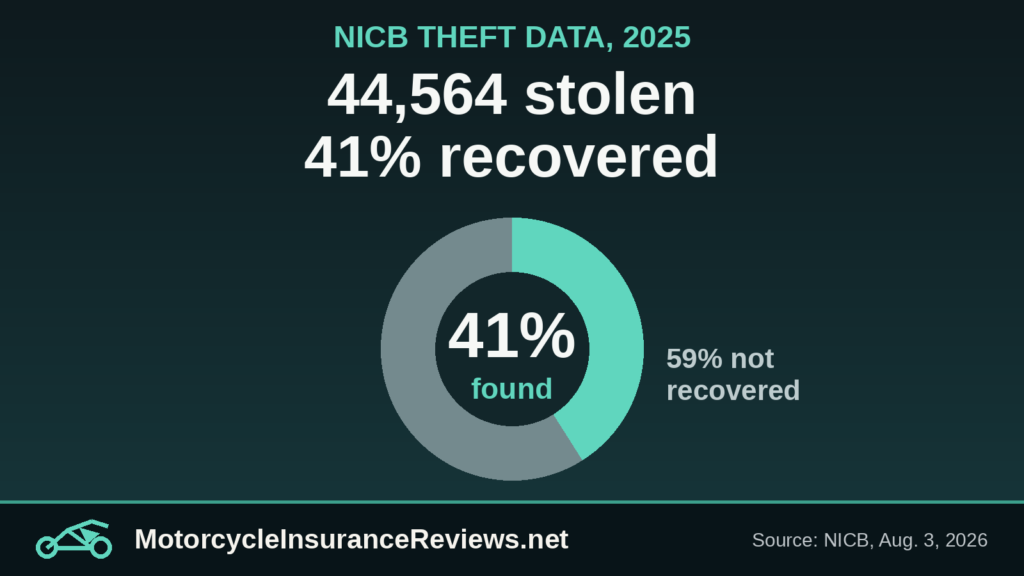
If someone steals your motorcycle, will you get it back? According to the latest national numbers, a little less than half the time. The National Insurance Crime Bureau (NICB) reports that 44,564 motorcycles were reported stolen in the United States in 2025, and 41% of them were eventually recovered.
That also means about 59 percent weren’t. NICB, a nonprofit funded by insurers, published the analysis on August 3, 2026. It covers theft reports from last year, not this year.
The figures are useful, but they’re easy to misread. One of the biggest numbers in the release isn’t about motorcycles alone, and the recovery rate says nothing about your own odds. Here’s what the data covers, what it doesn’t, and how to use it before the riding season ends.
The short version
- Motorcycles stolen in 2025: 44,564, reported to law enforcement.
- Recovered: 41%, according to NICB.
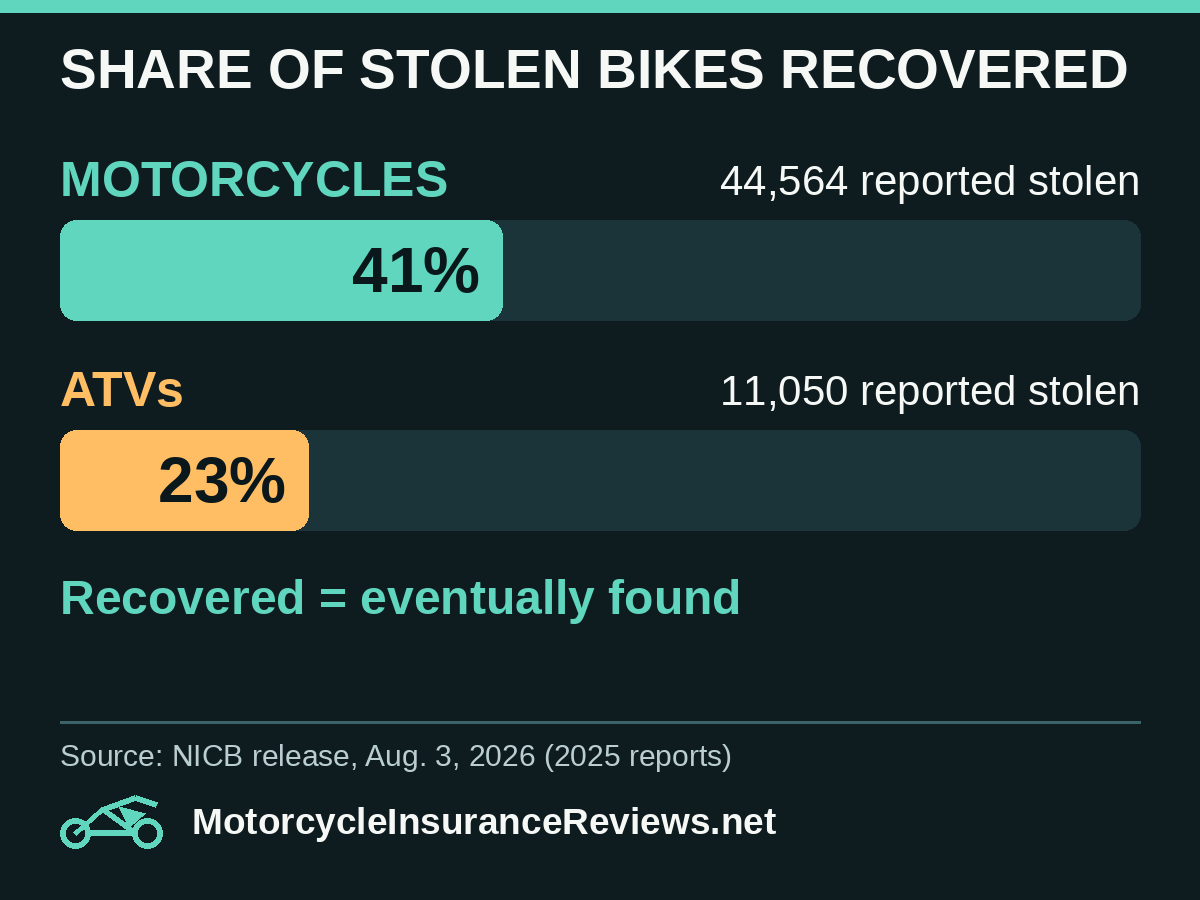
- ATVs for comparison: 11,050 stolen, with only 23% recovered, the lowest rate among the vehicle types NICB included.
- Prompt reports help: NICB says recovery chances improve with how quickly a theft is discovered and reported.
- Not covered: the release gives no motorcycle-only trend from 2024 and no state or brand breakdown.
Which numbers are about motorcycles, and which aren’t
The NICB release is titled “Recreational Vehicle Thefts Declined in 2025, but Most Remain Unrecovered.” That’s the first clue that it covers more than motorcycles. NICB counted motorcycles, ATVs, snowmobiles and watercraft together.
Here’s how the numbers split:
- Combined recreational vehicles: 58,957 reported stolen in 2025, which NICB says is a 20% decrease from 2024. About 63% remain unrecovered.
- Motorcycles only: 44,564 stolen, with 41% eventually recovered. These are the only motorcycle-specific figures in the release.
- ATVs only: 11,050 stolen, with 23% recovered.
The 20% drop and the 63% unrecovered rate apply to the whole group, not to motorcycles. NICB doesn’t say how much of the decline came from motorcycles, so nobody should read it as “motorcycle thefts fell 20 percent.” The release also doesn’t give separate counts for snowmobiles and watercraft, and it doesn’t say how long motorcycle recoveries took.
NICB does say motorcycles made up more than three-quarters of the combined thefts. That checks out, since 44,564 out of 58,957 is about 76 percent.
What “recovered” means, and what it doesn’t
Recovery here means the vehicle was eventually found. The release doesn’t say what condition the bikes were in, whether they were intact, whether parts were missing, or how long they were gone.
That matters. A recovered motorcycle can be a wrecked one. And a recovery doesn’t mean the owner’s problem is over, since the insurance claim, the repair and any missing parts can still be messy.
The data is also an analysis of reports, not an experiment. NICB didn’t test whether a particular lock, alarm or habit works, so don’t take a statistic here as proof that any one step helped.
Still, one finding in the release is practical. NICB says more than half of recreational vehicle recoveries happen within two weeks of the theft being reported. Again, that’s for the combined group, not motorcycles alone. It suggests that early action matters, not that waiting is hopeless.
How NICB says to protect a motorcycle
The release lists three precautions:
- Secure storage: keep vehicles in a locked garage or another secure, enclosed place whenever you can.
- Layered protection: use more than one anti-theft measure, including steering locks, chains and immobilizers.
- Good records: keep the VIN, other identifying information and current photos on file.
That third one is easy to skip and cheap to do. If you can hand police a VIN, plate and clear photos within minutes of discovering a theft, you’re in a much better spot than someone who has to dig for them.
If your bike is stolen: a quick checklist
NICB urges owners to report a theft to both law enforcement and their insurance company as soon as possible. Its reasoning is that prompt reporting lets identifying information reach police before thieves cover their tracks.
- Call police. Give them the VIN, plate number, make, model, color and any distinctive features.
- Call your insurer. Report the theft promptly and ask what the claim process requires.
- Share your photos. Current pictures help police and your insurer identify the bike.
- Keep a copy of the report number. You’ll likely need it for the claim.
Where insurance comes in
Theft is the kind of loss that comprehensive coverage is meant for. The Insurance Information Institute’s motorcycle insurance guide says comprehensive coverage pays for damage “caused by an event other than a collision, such as fire, theft or vandalism.” It adds that the insurer pays the damage minus your deductible, and usually only the book value of the bike.
That leads to a few things worth checking in your own policy:
- Do you have comprehensive coverage at all? Liability-only policies, which satisfy many states’ minimums, don’t cover your own bike. The III says most states require liability but that other coverage is usually optional.
- What’s your deductible? The insurer pays the loss minus the deductible.
- How is the bike valued? The III says payment is generally the bike’s book value, which may differ from what you paid or what you’ve invested in it.
- What about custom parts? The III warns that many policies cover only factory-standard parts or cap coverage on add-ons like chrome, custom paint, trailers and sidecars.
None of that comes from NICB, and the exact terms depend on your contract. If you aren’t sure, call your agent and ask.
Keep a “theft kit” ready
NICB’s third precaution, good records, is the one you can finish in an afternoon. A simple version is a note on your phone and a folder in cloud storage, kept somewhere you can reach even if the bike and its paperwork are gone. It could hold:
- the VIN, plate number, make, model, year and color;
- photos from each side, plus close-ups of anything distinctive, like custom paint, aftermarket parts, scratches or stickers;
- a copy of your insurance card and the policy’s phone number for claims;
- receipts for expensive add-ons, since the III notes custom parts can be capped or excluded on some policies.
None of this prevents a theft, and NICB doesn’t claim it does. What it does is shorten the time between discovering the bike is gone and getting accurate details into a police report and a claim.
A note for riders who store their bikes for winter
If you’re parking the bike for the season, the III describes something called a lay-up policy. It says that under a lay-up policy, all coverage except comprehensive is suspended during the winter months when the bike isn’t being used, which saves money. It adds that this is available mainly in northern states.
The reason it matters here is that comprehensive is the coverage that handles theft. If your bike sits in a shed or a rented storage unit for months, ask your insurer whether a lay-up arrangement is available and whether theft coverage stays active.
What we don’t know yet
- Motorcycle-only trends. The release gives a 20% decline for the combined group, not for motorcycles.
- The method. NICB’s release is a news summary. A full report and the methodology behind the counts weren’t included in it.
- Your odds. These numbers are national totals. They don’t tell you the chance your particular bike will be stolen.
- Where and how. There’s no breakdown by state, brand, or type of theft.
For riders, the takeaway is practical rather than scary. Keep your VIN and photos where you can find them, store the bike securely, layer your locks, and read your policy’s theft terms before you need them.
References
- NICB, “Recreational Vehicle Thefts Declined in 2025, but Most Remain Unrecovered” (August 3, 2026) — the 44,564 motorcycle theft count, 41% recovery, ATV figures, combined-group figures and NICB’s precautions.
- Insurance Information Institute (Triple-I), “Motorcycle insurance” — how comprehensive coverage treats theft, deductibles, book-value settlement, custom parts and lay-up policies.