
French helmet maker ROOF has shown its first adventure helmet, and it's built around an unusual idea: you don't pull it down over your head. The DJAGGER Venture opens at the back, lets your head slide in, then closes around you, with no chin strap to buckle.
ROOF announced the Venture on Nov. 3 in a statement that Objectif-Moto reproduced, ahead of its debut at EICMA in Milan on Nov. 5–8. It's a prototype. ROOF says the release date, price and colors will come later.
Key points:
- Rear entry: the Venture uses the patented rear-opening design of ROOF's road-going DJAGGER, in a carbon-fiber full-face shell.
- No chin strap: a collar that ROOF says is fitted once to the rider's head replaces the strap.
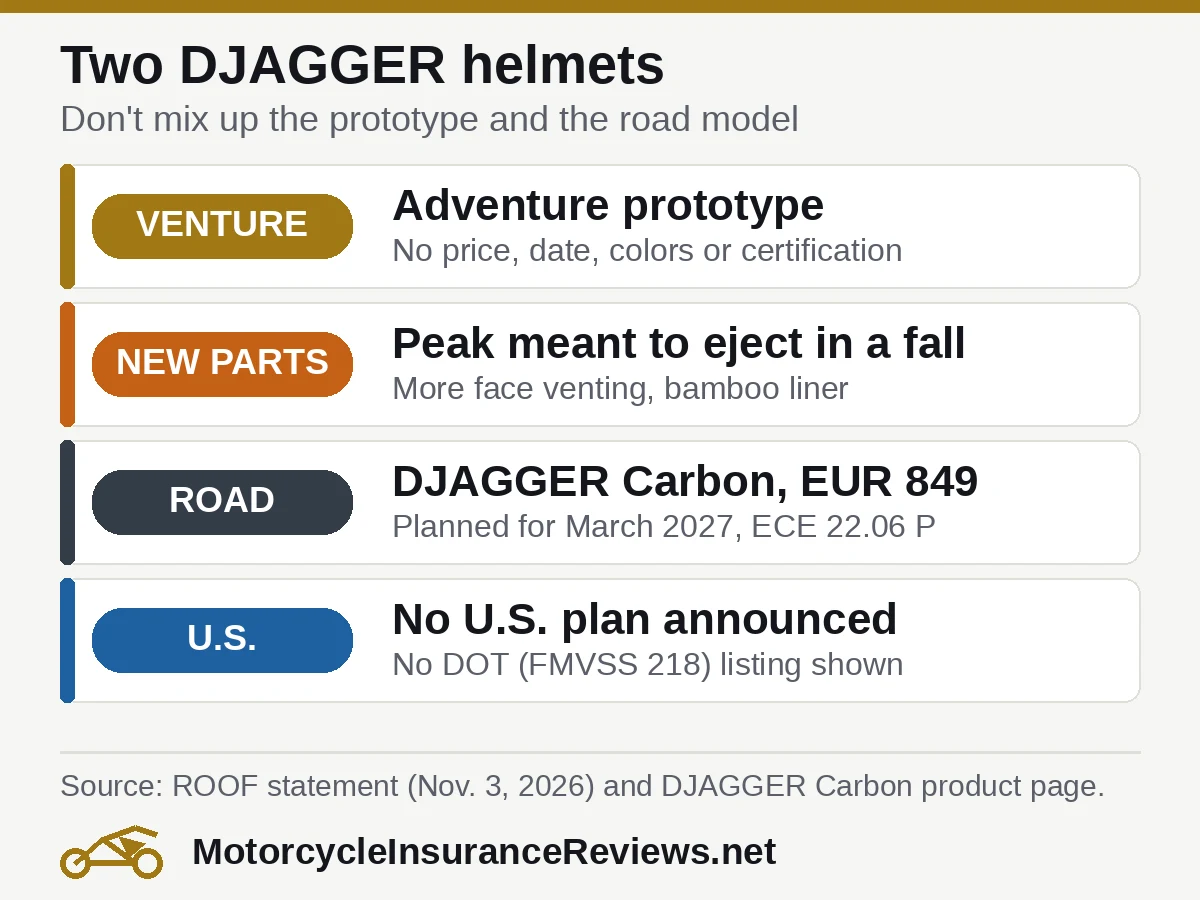
- Breakaway peak: ROOF says the adventure peak is designed to eject in a fall. Details are promised with the final version.
- Venting and liner: reworked vents for slow, hot off-road riding and a bamboo-fabric comfort liner.
- Not on sale: no price, date, colors or certification has been announced for the Venture.
How a Rear-Opening Helmet Works
A conventional full-face helmet goes on like a bucket. You spread the cheek pads, push it down past your ears and nose, then buckle a strap under your chin.
ROOF's DJAGGER design reverses that. Per the company's description:
- The back section of the helmet swings open.
- Your head slides in from behind, with no squeeze past the cheek pads.
- Closing the side panels pulls the rear shell shut around the back of your head in a single motion.
ROOF says you can do this with gloves and glasses on. On the road model, it says the underside of the helmet is far more enclosed than a normal full-face, which it credits for support and quieter riding. Those are the maker's claims. The cited materials provide no independent test results.
No Chin Strap, but a Collar
The chin strap is the part most riders will notice is missing. In its place, ROOF uses a patented collar that it says is adjusted once to the rider's head shape and then stays locked. You don't touch it again on later rides.
On an adventure trip, where you might pull your helmet off a dozen times a day for fuel, photos and food stops, ROOF pitches that as one less fiddly step each time.
Helmet standards include retention-system tests, and any certification applies to the model evaluated. ROOF lists ECE 22.06 certification for the road DJAGGER. It hasn't published any certification for the Venture prototype, so don't assume the road model's approval carries over.
The Adventure Parts: Peak, Vents and Liner
The Venture keeps the DJAGGER's mechanism and adds the pieces an adventure helmet needs:
- A peak that's meant to come off. Adventure-helmet peaks block sun and roost. ROOF says the Venture's peak has a new device that ejects it in a fall, intended to limit rotation of the helmet. It hasn't explained how the release works and says it will share details with the final version.
- More airflow at low speed. ROOF says the vents were reworked for a strong flow of air, especially across the face, for slow trail riding in heat and dust, without hurting noise insulation.
- A bamboo liner. The comfort lining is made from bamboo fabric, which ROOF describes as naturally antibacterial and cool against the skin.
- Face access. As on the road DJAGGER, ROOF says the front of the helmet separates and tilts up while the head stays in the rear shell, so the face can be reached quickly without moving the rider's neck.
All of these are design goals for a prototype. ROOF's announcement provides no test data for the breakaway peak or the venting.
The Road DJAGGER Comes First
It's easy to mix the two helmets up, so keep them separate.
The road-going DJAGGER Carbon has its own product page. ROOF lists it at €849 including tax for the Metallic White version, with commercial release planned for March 2027. That page also lists ECE 22.06 P certification, a photochromic visor, a glass-and-carbon composite shell, a six-density EPS liner and intercom compatibility.
The Venture has none of those details pinned down. It has no announced price, date, colors or certification. ROOF calls it the first step in a DJAGGER family it plans to extend "from the city to long-distance travel."
Will It Be Sold in the U.S.?
ROOF hasn't said. Neither announcement mentions U.S. availability, and ROOF's product page lists only the European ECE approval for the road DJAGGER.
That matters for American riders. Federal rules require motorcycle helmets sold for road use in the U.S. to meet FMVSS No. 218. Look for the manufacturer's DOT certification label on the exact model. ECE 22.06 is a separate UN standard. Check your state's helmet-use rules as well.
If ROOF does bring it over, a few things are worth checking before you buy:
- Fit: a helmet held in place by a collar instead of a strap needs a proper fitting, preferably at a dealer.
- Certification: confirm the exact standards on the helmet's label, not just the product page.
- Coverage: ask whether your policy covers a helmet, what limit or deductible applies, and whether you need to list it.
For now, the Venture is a prototype that shows where ROOF wants to take its rear-entry design. The final version, and the details ROOF has promised about the breakaway peak, will decide whether it's more than a clever show piece.
References
- ROOF's DJAGGER Venture announcement, reproduced by Objectif-Moto (Nov. 3, 2026) — ROOF's own statement (in French) on the prototype's rear opening, strapless collar, ejecting peak, venting, bamboo liner, face access and EICMA Hall 18 stand C52 display, Nov. 5–8.
- ROOF: DJAGGER Carbon Metallic White product page — the road model's €849 price, March 2027 availability, ECE 22.06 P certification and listed features.
- NHTSA: Choose the Right Motorcycle Helmet — the federal motorcycle helmet standard and how to identify a manufacturer’s DOT certification label.