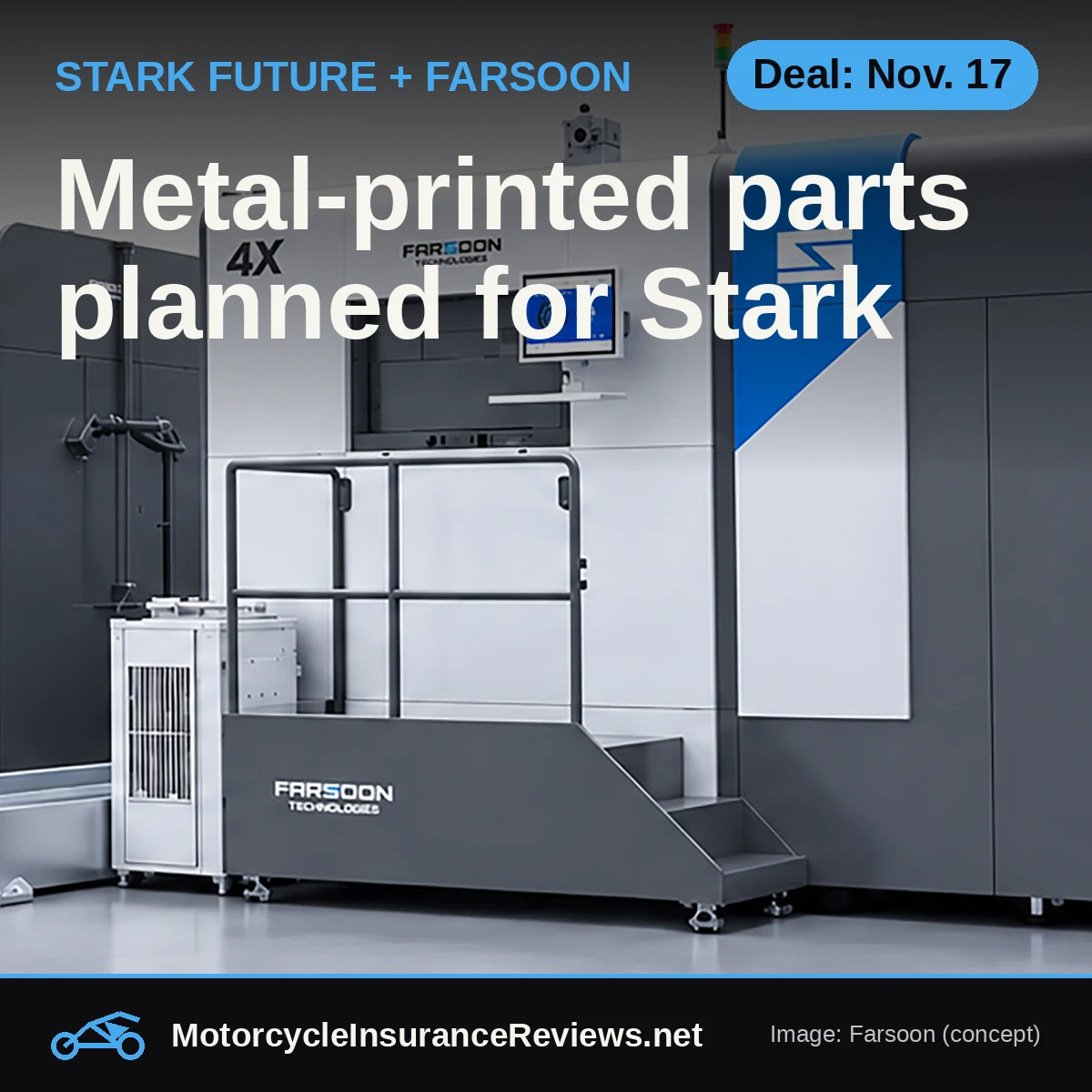
Stark Future, the Barcelona maker of the electric VARG dirt bikes, wants to 3D-print more of its motorcycle parts in metal, and at a much bigger scale. At the Formnext manufacturing trade show in Frankfurt on Nov. 17, 2026, Stark and Chinese printer maker Farsoon Technologies announced an agreement for Stark to buy multiple Farsoon FS4X metal 3D printers for a dedicated series-production line.
The goal, in Farsoon's words, is to make printing good enough, consistent enough and cheap enough to replace conventional manufacturing for selected metal components. Neither company said which parts, how many machines, how much it costs or when the line will run.
Key points:
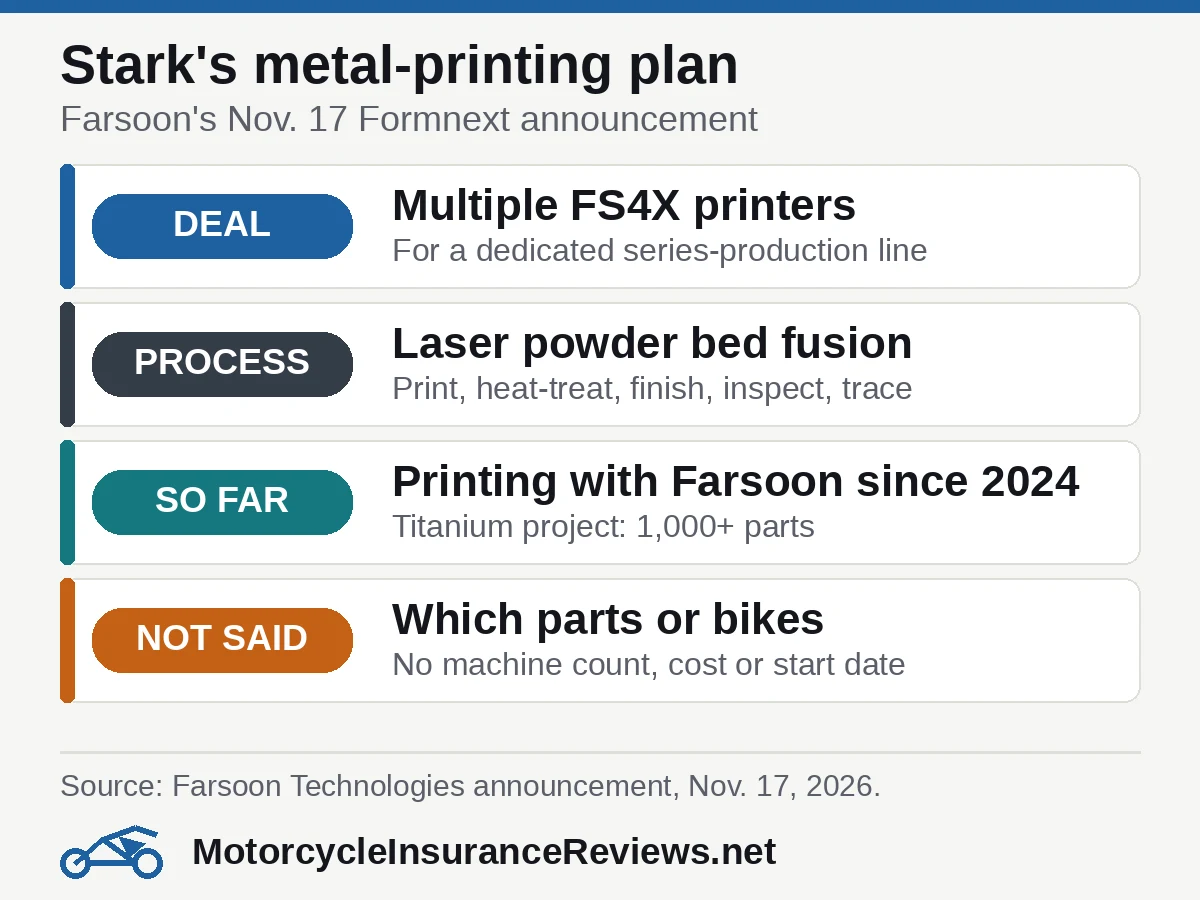
- The deal: Stark is buying multiple FS4X metal printers to build a high-volume production line. No count, price, site or start date was given.
- The process: laser powder bed fusion, where lasers melt thin layers of metal powder into a solid part.
- The scope: the companies are developing the whole workflow, from print settings through heat treatment, finishing, inspection and part traceability.
- The history: Stark started printing parts with Farsoon in 2024; a joint titanium project ran to more than 1,000 parts.
- What's missing: no list of parts or models, and no claim of new parts on bikes yet.
What Stark and Farsoon Actually Agreed
The announcement is a purchase and development agreement. Stark is buying the machines, and the two companies are building the production process around them together. That's different from a line that's already installed and turning out parts for customers' bikes, and neither company describes it that way.
Farsoon says the program "extends well beyond machine installation." The joint work covers:
- material and printing parameters, the recipe of laser power, speed and layer settings for each part;
- build preparation, meaning how parts are arranged and supported inside the printer;
- heat treatment and downstream finishing;
- quality inspection, full part traceability and production validation.
The stated aim is a "qualified manufacturing line ready for sustained serial output," with less scrap, rework and downtime.
Why Series Production Is the Hard Part
Metal 3D printing is common for prototypes and race parts, where a team needs one or a handful of something quickly. Building the same part thousands of times is a different job. Every print has to come out with the same strength and dimensions, whether it was made on Monday or three months later on a different machine.
That's why the agreement spends so much time on the steps after printing. A printed metal part usually needs heat treatment to relieve internal stresses and reach its intended strength, plus machining or finishing on surfaces that have to fit precisely. Inspection checks that each batch meets spec, and traceability records which machine, powder batch and settings made each part. If a problem turns up later, traceability is what lets a manufacturer pin it to specific parts instead of guessing.
Farsoon's FS4X is pitched at exactly this. The company describes it as a laser powder bed fusion platform "purpose-built around the demands of daily industrial series production," with multiple lasers working at once, stable build conditions and an open platform that lets the customer tune settings for its own parts. Farsoon's separate FS4X announcement lists configurations of four 2,000-watt or six 1,000-watt fiber lasers.
Why Stark Wants Printed Parts
Stark founder and CEO Anton Wass made the case in the announcement. Printing, he said, gives designers "freedom of geometry," which "minimizes the use of material, and helps us optimize flex, strength, fatigue and weight."
His most eye-catching line: "In many cases reducing weight with 50%." That's Stark's own claim about parts it has printed, not an independently tested figure, and Wass didn't say which parts it applies to. On a dirt bike, though, weight is everywhere: in the chassis, in how the suspension responds and in how tiring the bike is to wrestle through a long day.
This Builds on a 2024 Partnership
Stark and Farsoon have worked together since 2024, when Stark adopted Farsoon's large-format FS721M-H-8-CAMS printer to move key components for its electric motorcycles into serial production.
Farsoon points to a joint project called KLINGA, which it says "validated high-precision, repeatable titanium serial production across more than 1,000 parts." That's Farsoon's account of the result; neither company published inspection data. The new FS4X line is meant to take Stark from that first stage of serial printing to high-volume output.
What It Means for VARG Riders in the U.S.
Stark is a real factor in the U.S. electric dirt bike market. In a separate Nov. 16, 2026 release about its latest funding round, the company said the United States is its largest market by volume.
For now, though, this agreement changes nothing you can buy or ride. Stark hasn't said:
- which components will come off the new line;
- which VARG models, current or future, will use them;
- when production will start, or where the machines will go.
It also hasn't made claims about durability, safety certification, prices or spare-parts supply tied to printed parts, so don't assume any of those will change.
What's worth watching is how printed parts show up in practice. If Stark starts listing printed components on future bikes, the questions to ask are the same ones you'd ask about any part: is it covered by the warranty, can a dealer order a replacement, and how long does that take? For now, the useful signal is that Stark plans to build a dedicated line for selected metal parts and is investing in the inspection and traceability that series production needs.
References
- Farsoon Technologies: Stark Future and Farsoon Agree on Multiple FS4X Systems to Build a Series Production Line (Nov. 17, 2026) — Formnext announcement of the purchase agreement, the end-to-end production workflow, FS4X description, the 2024 partnership and KLINGA project, and statements from Stark's Anton Wass and Farsoon Europe's Oliver Huizhi Li.
- Stark Future: financing round announcement (Nov. 16, 2026) — Stark's statement that the United States is its largest market by volume.
- Farsoon: FS4X equipment announcement (Nov. 12, 2026) — manufacturer specifications for the laser configurations.