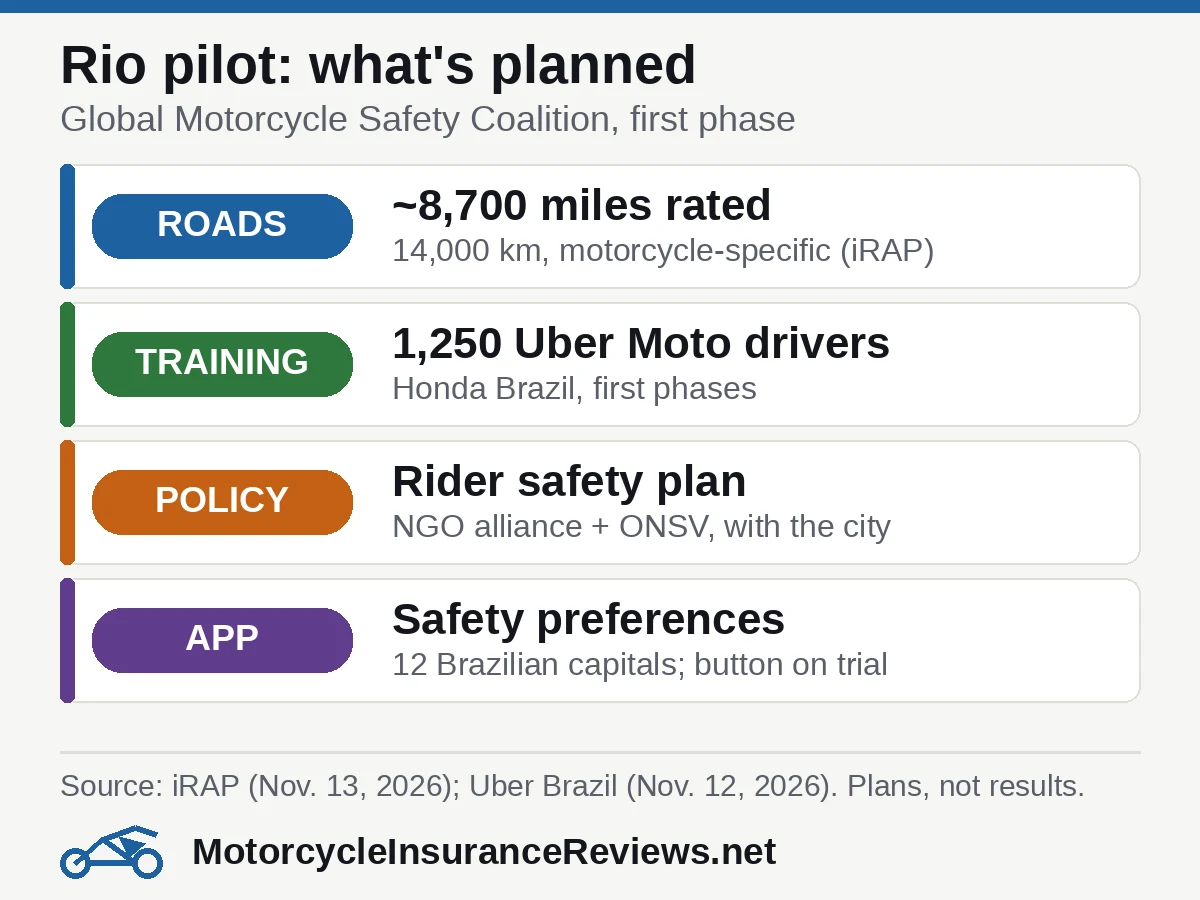
Uber has formed a Global Motorcycle Safety Coalition with the International Road Assessment Programme (iRAP), Honda Brazil, the FIA and the Global Alliance of NGOs for Road Safety. The first project is in Rio de Janeiro, where the partners plan to rate about 14,000 km (roughly 8,700 miles) of city roads specifically for motorcycle risk, and turn the findings into a motorcyclist safety plan for the city. Honda Brazil also aims to train 1,250 Uber Moto drivers across Brazil in the program's first phases.
Uber Brazil announced the coalition at a Rio event on Nov. 12, 2026; iRAP published its account on Nov. 13. The partners announced plans for the Rio pilot and have yet to report results or announce a U.S. project.
Key points:
- Road ratings: iRAP and its Brazilian program, BrazilRAP, will assess Rio's road network from a motorcyclist's point of view and recommend fixes.
- Training: Honda Brazil aims to train 1,250 Uber Moto drivers in Brazil in its first phases, with a focus on carrying passengers.
- City policy: the NGO alliance will combine street observations with iRAP's findings to push for safer speeds, intersections and infrastructure.
- App features: Uber is adding moto safety preferences in Brazil and testing a Bluetooth handlebar button.
- Not yet known: whether any of it lowers crashes. The partners haven't published targets for that.
Why Rating Roads for Motorcycles Matters
Most rider safety talk is about the rider: training, gear, attention. iRAP's work starts from the road. Its Star Ratings estimate how well a road's design protects people from death and serious injury, based on features such as lane width, intersections, roadside hazards, surface and speed.
The Rio assessment will calculate those ratings for motorcyclists specifically, find the highest-risk locations, and recommend infrastructure changes and speed management. iRAP's CEO, Greg Smith, lists the hazards it's looking for: loss of traction on poor surfaces, collisions with "unforgiving infrastructure," unexpected moves by other traffic and poor visibility in mixed traffic. The goal, he says, is roads that meet the global minimum 3-star infrastructure standard.
Any rider who has hit a polished manhole cover in the rain or met a guardrail post on a tight bend knows those risks. Rating them across a whole city, and publishing the results, is the useful part. iRAP says an interactive dashboard will make the findings easier to explore and could feed future motorcycle routing and rider information.
Training Built Around Carrying Passengers
Uber Moto, launched in 2016, is a motorcycle ride-hail service: a rider carries one passenger. Honda Brazil's program is built for that job. It will cover:
- Defensive riding and braking
- Intersections
- Motorcycle maintenance
- Protective equipment
Training will run at Honda's rider training facilities, at mobile events and online. Uber and Honda Brazil say they'll assess the program's impact before deciding whether to expand it. Separately, Uber will work with the FIA and its Brazilian auto clubs on in-person training, and with the FIA on how its Road Safety Index for companies can better account for motorcycle ride-hailing and delivery.
Turning the Data Into City Action
The Global Alliance of NGOs for Road Safety and its Brazilian partner, the Observatório Nacional de Segurança Viária (ONSV), will run a pilot called Deliver Safe Streets: Rio Motorcycle Safety Pilot. It pairs local street observations, which the groups call Mobility Snapshots, with iRAP's road findings. They'll work with city authorities on a dedicated motorcyclist road safety action plan and track whether commitments lead to change.
A public advocacy event is planned for Brazil's Maio Amarelo (Yellow May) road safety campaign in 2027. The coalition says lessons from Rio will guide work in other countries where motorcycles are central to daily travel, with more partners to come.
What Uber Is Changing in the App
Uber Brazil announced these alongside the coalition, and the details and timing are Uber's:
- Moto Safety Preferences: before booking, a passenger can ask for a smoother, calmer ride or say they have little experience riding pillion. Uber says this will reach 12 Brazilian state capitals, including Rio, in the coming weeks.
- Bluetooth handlebar button (trial): a thumb button paired with the driver's phone to accept or decline trips without touching the screen while riding. Uber calls this a test.
- Passenger matching options: a women-recommended driver option for female passengers in some cities, and automatic matching of first-time moto passengers with experienced drivers.
Uber's announcement did not report whether these features reduce crashes.
What It Means for U.S. Riders
Nothing changes here for now. The coalition hasn't announced any U.S. project, and it creates no new rule, insurance requirement or service for American riders.
What's worth watching is the method. A motorcycle-specific road rating that a city can act on is the kind of tool U.S. rider groups and state safety offices could point to. If the Rio dashboard and action plan are published, they'll show whether this approach produces real road changes, and how quickly.
References
- iRAP: Uber Partnership Launches Global Coalition to Advance Motorcycle Safety — the participant release naming the five partners and describing the 14,000 km Rio road assessment, Honda Brazil's 1,250-driver training target, FIA work, the NGO pilot and the 2027 Yellow May event.
- Uber Brazil: Uber anuncia pacote de segurança para viagens de moto no Brasil (Nov. 12, 2026, in Portuguese) — Uber's announcement of the coalition, the Moto Safety Preferences rollout to 12 capitals, passenger-matching options and the Bluetooth handlebar button trial.