Utah's Driver License Division has proposed a new administrative rule that writes down how it issues motorcycle learner permits and how a rider-training certificate can replace the Division's riding test. Rule R708-54, published in the Utah State Bulletin on Oct. 15, 2026 as filing 58259, also spells out a split that matters when you pick a bike for your test: the proposal would let the Division waive the engine-size (cc) restriction for approved course graduates. Riders who take the skills test at the Division would still be subject to the engine-size rules.
The rule is still a proposal. The Division is taking public comments through Nov. 16, 2026, and lists Nov. 23 only as the date it may make the rule effective, without confirming an effective date.
Key points:
- Why now: the Division says it reviewed Utah Code § 53-3-210.6, found that the statute requires a rule, and had none.
- Learner permit: valid for six months. Applicants need a valid class D or commercial license, must be at least 16 and must pass the motorcycle written exam.
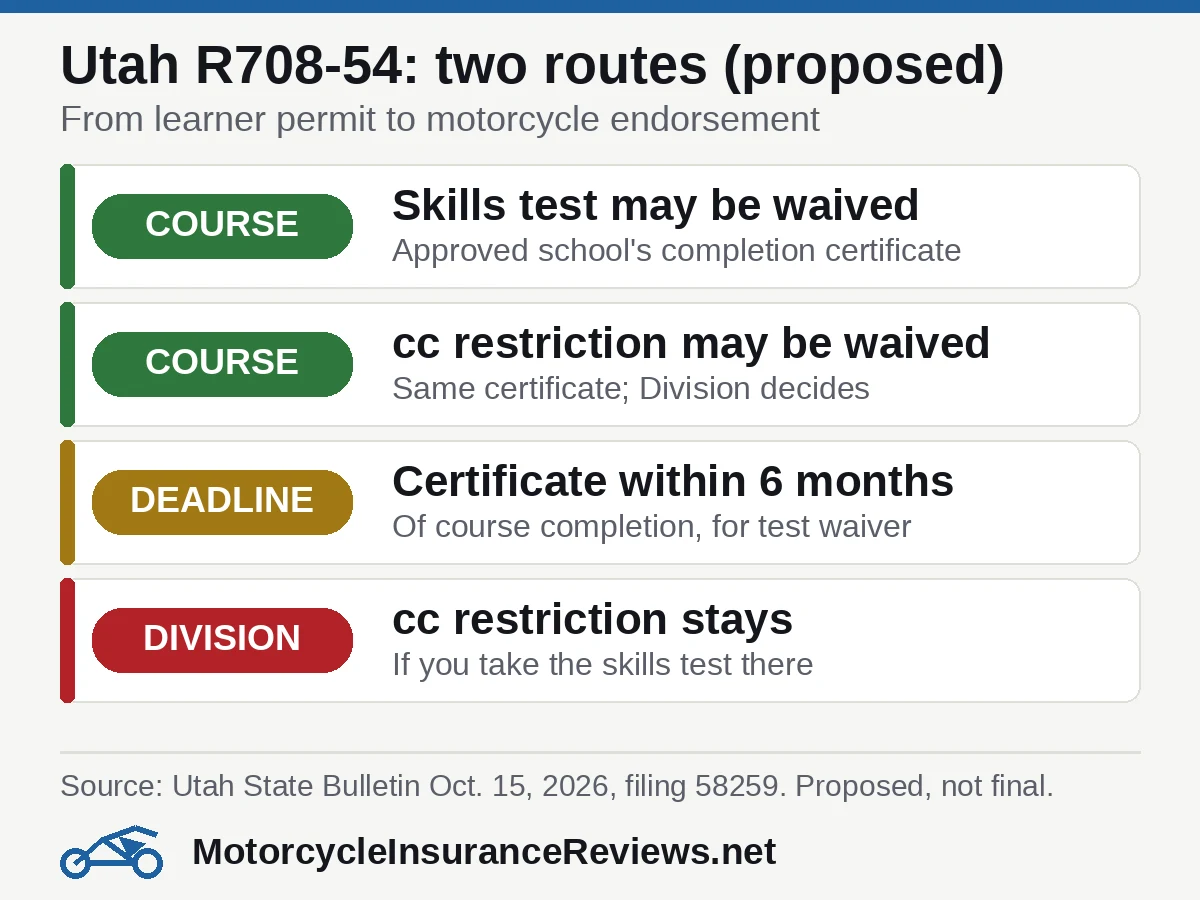
- Course route: the Division could waive the riding skills test and the cc restriction after receiving an approved school's completion certificate. To qualify for the skills-test waiver, submit the certificate within six months of finishing the course.
- Division-test route: no cc-restriction waiver.
- Riders under 19: course completion can waive the two-month learner-permit holding period.
- Cost: the Division puts the fiscal impact at $0 and says the rule outlines processes it already uses.
Two Ways to Earn a Utah Endorsement
The proposal describes two routes from a learner permit to a full motorcycle endorsement, and they don't end in the same place.
- Pass an approved rider-education course. The school issues a completion certificate. When the Division receives it, it may waive the practical skills portion of the endorsement application and the cubic-capacity restriction. The certificate has to reach the Division within six months of the course date for the skills-test waiver.
- Take the skills test with the Division. The proposed rule states it directly: the Division "may not waive the cubic capacity restriction" for a rider who completes the endorsement skills test there.
The rule defines cubic capacity simply as "the size of a motorcycle engine." It doesn't list the cc brackets themselves, and neither does the statute that authorizes it, so ask the Division which restriction would apply to the bike you plan to test on before you book.
What Changes on Paper
Most of this isn't new to the Division. It's moving out of an older rule.
A companion filing in the same bulletin (58258) would remove the certificate and waiver section from R708-30, the rule that governs motorcycle rider training schools. The Division says it removed the rider-education material so a separate rule could carry it.
Compare the cc language. The current R708-30 says a course graduate "will be restricted based on the cc size of the motorcycle tested on," and tells the instructor to write the engine size on the certificate. The proposed R708-54 instead says the Division may waive the cc restriction when it receives a completion certificate from an approved school, and saves the no-waiver line for riders who test at the Division.
The Division's fiscal statement says the proposal outlines existing processes. Its current motorcycle endorsement guidance still ties engine-size limits to the bike used for testing, including at an approved school. Ask the Division which restriction applies before choosing a bike for a course or test.
Other wording carries over. The certificate must show:
- the applicant's name
- the title of the course
- the date of completion
- an authorized signature from the school
The under-19 waiver of the two-month learner-permit holding period appears in both versions and is already allowed under Utah Code § 53-3-204(3).
The Learner Permit Rules Riders Already Live With
The proposal doesn't change the permit restrictions in the statute. Under § 53-3-210.6, a motorcycle learner permit lasts six months. During the first two months a permit holder may not ride:
- on a highway with a posted speed limit above 60 mph
- with any passenger
- between 10 p.m. and 6 a.m.
From the third through sixth month, those restrictions drop away. The statute gives an affirmative defense for riding to and from work, for agricultural work on a rancher's or farmer's assignment, and in an emergency. A violation is an infraction.
The statute accepts an original or provisional class D license, a commercial license or an out-of-state equivalent, plus a passed knowledge test. The proposed rule's own eligibility list names the class D or commercial license, sets the minimum age at 16 and requires the written exam.
Who Runs the Courses
Utah's Motorcycle Rider Education Program sits under the Division. State law (§ 53-3-903) requires a novice course, a course for experienced riders and an instructor course, and opens rider training to residents at least 15 years 6 months old who hold a valid learner permit or license or are eligible for a motorcycle learner permit. Learner permit holders must take the course on an approved closed course that meets national training standards. Approved schools may charge tuition and must issue completion certificates in the form the director sets.
That's the certificate R708-54 relies on. Keep the original, check that every required item is on it before you leave the range, and get it to the Division well inside the six-month window.
How to Comment Before Nov. 16
The notice accepts written or oral comments until Nov. 16, 2026. The Division lists three contacts for the filing:
- Kim Gibb, 801-556-8198, kgibb@utah.gov
- Tara Zamora, 801-964-4483, tarazamora@utah.gov
- Britani Flores, 801-884-8313, bflores@utah.gov
Mention R708-54, filing 58259 so the comment reaches the right file. The notice lists Nov. 23 as a possible effective date. Check for an official notice before treating the proposal as effective.
What It Doesn't Do
R708-54 doesn't create a new endorsement, change the permit's speed, passenger or night limits, or promise a waiver to anyone. Every waiver in the text is something the Division "may" grant. The filing says nothing about motorcycle insurance requirements.
For a rider starting out in Utah, an approved course can already replace the Division's riding test if you qualify. The proposed engine-size waiver would be a separate decision by the Division.
References
- Utah State Bulletin, Oct. 15, 2026: Proposed Rule R708-54, Motorcycle Rider Education Program (filing 58259) — the Driver License Division's notice, purpose, fiscal statement, Nov. 16 comment deadline, Nov. 23 anticipated date and full proposed rule text (printed pages 160–162).
- Utah State Bulletin, Oct. 15, 2026: Proposed amendment to R708-30, Motorcycle Rider Training Schools (filing 58258) — the companion filing that removes the current certificate and skills-test waiver section, including the existing cc-size language.
- Utah Code § 53-3-210.6, Motorcycle learner permit — six-month permit, eligibility, first-two-month restrictions, affirmative defenses and the Division's duty to make this rule.
- Utah Code § 53-3-903, Motorcycle Rider Education Program — required courses, enrollment age and permit conditions, school contracts, tuition and completion certificates. Section 53-3-907 covers the existing skills-test exemption.
- Utah Code § 53-3-204(3), Motorcycle endorsement eligibility — the existing under-19 permit holding period and training waiver.
- Utah Driver License Division: Motorcycle Endorsement — current guidance on course waivers and engine-size restrictions based on the test motorcycle.