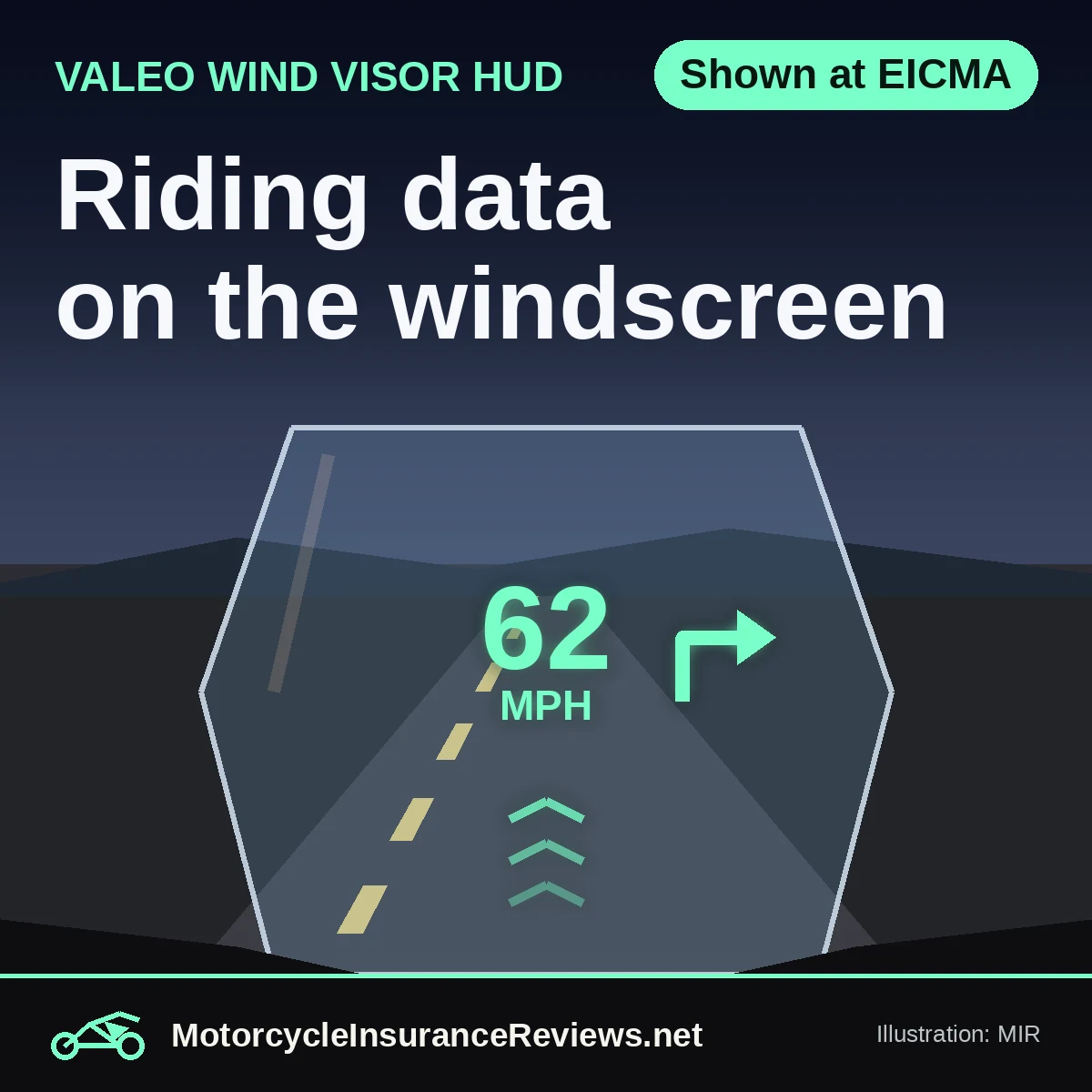
Every glance down at a motorcycle's dash is a moment you're not watching the road. French auto supplier Valeo wants to shorten those moments by putting the key numbers on the windscreen instead. At EICMA 2026 in Milan, Valeo showed the Wind Visor Head-Up Display (2W HUD), a system that projects riding information such as speed and trajectory guidance onto a motorcycle's windscreen, in the rider's forward view.
It's a supplier product aimed at motorcycle makers, not something you can buy and bolt on. Valeo announced it on Nov. 3, 2026, the opening day of the show, and hasn't named a motorcycle that will use it.
Key points:
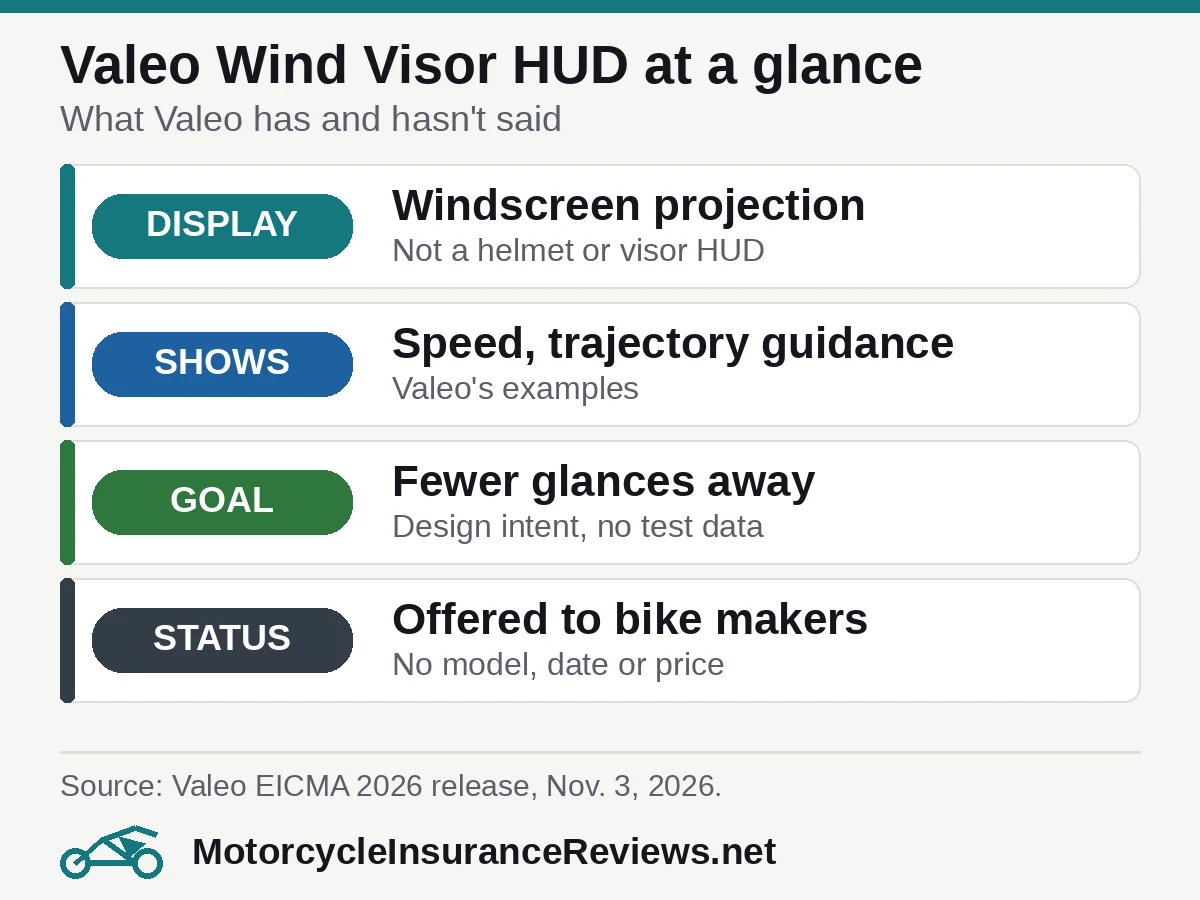
- What it is: a head-up display that uses the bike's windscreen as the display surface. It isn't a helmet-mounted or visor display.
- What it shows: Valeo names speed and trajectory guidance as examples of the information it projects.
- Why: Valeo says putting information in the forward field of view is designed to help reduce the need to look away from the road.
- Who it's for: motorcycle manufacturers. Valeo gave no production bike, launch date or price.
- Shown with: a Connected Cluster that combines the rider display and connectivity hardware into one unit.
Windscreen, not helmet
Some head-up displays for riders live in or on the helmet: a small projector clipped inside the chin bar, or a display built into a smart helmet. Valeo's approach is different. The display is part of the motorcycle, and the image appears on the windscreen in front of the rider.
That has a practical upside. The windscreen design would let riders use the display without a helmet-mounted device to buy, charge or pair. The trade-off is just as obvious: it only works on a motorcycle with a windscreen designed for it, and a bike maker has to choose to build it in.
Valeo's release doesn't explain how the image is kept readable as the rider moves their head, in bright sun, or through a wet or scratched screen. Those are the questions a production version will have to answer, and Valeo hasn't published test data on them.
The glance problem, in numbers
Valeo frames the HUD as a fix for visual distraction. The physics is simple. At 62 mph (100 km/h) you cover about 91 feet every second. A one-second glance at the dash means riding roughly 90 feet without looking ahead, and a two-second glance means about 180 feet (56 meters).
A head-up display aims to shrink that by putting the speed where your eyes already are. Valeo describes that as a design goal. It hasn't published any measurement showing how much the 2W HUD reduces glance time, or any crash data, so treat it as a promising idea rather than a proven safety gain.
The Connected Cluster
Valeo showed the HUD alongside a Connected Cluster, which it describes as combining the rider display and the connectivity backend into one smart unit. In plain terms, the dash screen and the hardware that links the bike to phones and online services sit in a single box instead of several.
Valeo pitches this mainly as a cost and packaging win for manufacturers: grouping the controls lets them integrate required and optional functions more simply. Riders would feel the result indirectly, through what features a given bike ends up offering and how cleanly they work.
Part of a bigger rider-safety push
The HUD was one piece of a larger Valeo display at EICMA. The company also showed Advanced Rider Assistance Systems, the motorcycle version of driver-assistance tech, built from radar, cameras and a compact processor. Valeo lists functions such as blind-spot detection, lane change assist, rear collision warning, forward collision warning, traffic sign recognition and adaptive cruise control.
Rounding out the stand were compact LED lighting modules, including adaptive high beams, and a small 48-volt electric motor and controller for scooters and light electric motorcycles, rated up to 10 kW.
Valeo's case for all of this rests on European crash data. Citing the European Transport Safety Council and the European Road Safety Observatory, it says powered two-wheeler riders account for roughly 20% of EU road deaths while making up less than 2% of traffic.
What it means for U.S. riders
For now, nothing you can buy. Valeo hasn't announced a motorcycle maker partner for the HUD, a model year, or any plans for the U.S. market. If a manufacturer adopts it, it would most likely arrive as a factory feature on a touring or adventure bike with a large screen, but that's an educated guess, not something Valeo has said.
It's still worth watching. Car buyers have had windshield head-up displays for years, and motorcycle electronics tend to follow cars a few years later. If a windscreen HUD does reach U.S. showrooms, ask what a replacement windscreen costs on a bike that has one. Valeo hasn't said whether the screen needs a special coating or treatment to show the image. If it does, a cracked screen could cost more than a plain piece of plastic, which matters when you weigh a repair against your comprehensive or collision deductible.
References
- Valeo: Valeo brings advanced safety and electrification technologies for two-wheelers to EICMA 2026 (Nov. 3, 2026) — the supplier's release describing the Wind Visor Head-Up Display, the Connected Cluster, its rider-assistance, lighting and 48V motor products, and the cited EU crash figures.