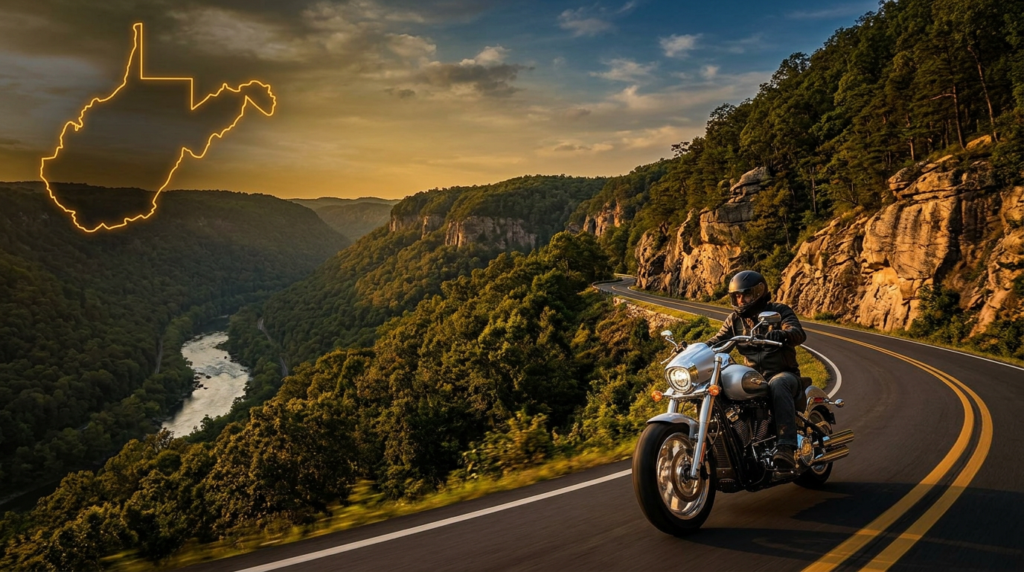
West Virginia motorcycle insurance at a glance
- Minimum liability: 25/50/25.[1]
- Uninsured motorist coverage: required at 25/50/25.[2][3]
- Underinsured motorist coverage: must be offered, but you can reject it.[2][3]
- Proof of insurance: required in the vehicle; electronic proof on a phone is valid.[5]
- WVOLV verification: used at registration, after citations/crashes, and for monthly checks.[4]
- First uninsured lapse: 30-day license suspension and registration revocation unless resolved in time under the statutory cure/payment process.[7]
- Helmet law: universal helmet law for operators and passengers, plus eye protection.[10]
- Lane splitting/filtering: no enacted authorization as of March 27, 2026; a bill to expressly prohibit it is still pending.[15][16]
- License requirement: motorcycle endorsement (F) or Class F motorcycle-only license.[17][19]
- Seasonal storage: do not simply let insurance lapse on a registered bike; DMV directs seasonal owners to file Form WV-4B before removing insurance.[4]
What West Virginia actually requires on a motorcycle policy
The legal baseline starts with W. Va. Code § 17D-4-2. That statute sets West Virginia’s minimum proof-of-financial-responsibility limits at $25,000 for bodily injury to one person, $50,000 for bodily injury to two or more people in one crash, and $25,000 for property damage.[1] Those are the liability limits most people recognize as 25/50/25.
But that is not the whole legal package in West Virginia. W. Va. Code § 33-6-31 requires an auto liability policy issued in the state to include uninsured motorist coverage at least equal to those minimum limits, and the West Virginia Offices of the Insurance Commissioner states the same requirement in its consumer material.[2][3] In other words, a legal West Virginia motorcycle policy is not merely liability-only in the narrow sense many riders assume. The state requires both liability coverage and UM coverage.
Underinsured motorist coverage, by contrast, is handled differently. West Virginia requires insurers to offer it, but not every rider has to buy it.[2][3] That distinction matters because a motorcycle crash can produce six-figure injury losses very quickly, and the state’s bare minimum liability limit on the at-fault side is still only $25,000 per injured person.
| Coverage type | Required in West Virginia? | Minimum or rule | Why it matters |
|---|---|---|---|
| Liability bodily injury | Yes | $25,000 per person / $50,000 per accident | Pays injury claims you cause to others. |
| Liability property damage | Yes | $25,000 per accident | Pays for property damage you cause to others. |
| Uninsured motorist bodily injury | Yes | 25/50 minimum | Helps if the at-fault driver has no insurance. |
| Uninsured motorist property damage | Yes | $25,000 minimum | Helps with property damage caused by an uninsured driver. |
| Underinsured motorist | Must be offered | Can be purchased up to the liability limits carried, subject to the statute | Closes the gap when the at-fault driver has insurance, but not enough of it. |
| Collision | No | Optional | Pays for your motorcycle after a crash or fall. |
| Comprehensive | No | Optional | Covers theft, fire, weather, animal strikes, and similar non-collision losses. |
| Medical payments | No | Optional | Helps with your own medical bills regardless of fault. |
The West Virginia Insurance Commissioner’s 2024 Auto Insurance Survey is useful here because it explicitly notes that state law mandates liability insurance and uninsured motorist coverage, while coverage such as comprehensive, collision, medical payments, and underinsured motorist coverage is optional.[30] That is the cleanest way to think about the state’s compulsory insurance structure.
In West Virginia, “full coverage” is not a real legal category
If you run a motorcycle insurance site, this is a point worth making clearly because it cuts through a lot of bad quote shopping. The West Virginia Offices of the Insurance Commissioner issued Bulletin 21-02 specifically to warn that “full coverage” auto insurance has no exact or standard definition.[36] In practice, buyers often use the phrase to mean liability plus comprehensive and collision, but the bulletin makes clear that optional coverages such as underinsured motorist, medical payments, towing and labor, rental reimbursement, or gap coverage may or may not be included.[36]
That warning is even more important for motorcycles than for passenger cars. A rider can ask for “full coverage,” get a policy with comp and collision, and still have no meaningful protection for custom parts, riding gear, towing from a remote county road, trip interruption, or medical bills. If your site wants to sound more authoritative than the average rate-comparison page, say it plainly: in West Virginia, riders should quote coverage by named limits and named optional coverages, not by the phrase “full coverage.”
Proof of insurance, WVOLV, and what West Virginia checks
West Virginia requires proof of insurance to be carried in the vehicle.[5] The proof can be the insurance card, the policy, a copy of the policy, a certificate of self-insurance if that applies, or an image displayed on a wireless communication device.[5] So yes, a digital insurance card on your phone is legally acceptable in West Virginia.
The enforcement system behind that proof requirement is what makes the state more aggressive than a casual reading of the law might suggest. According to the DMV’s consumer insurance page, West Virginia Online Verification (WVOLV) performs real-time insurance verification during vehicle registration, after insurance citations, after crashes, and in a monthly verification process covering registered vehicles.[4] That means keeping a valid card in your wallet is not enough if the policy itself has lapsed or been canceled.
West Virginia also gives police authority to inquire into insurance under defined circumstances. Under W. Va. Code § 17D-2A-6, an officer who investigates an offense or crash, or who lawfully stops a vehicle for another reason, shall inquire whether the owner or driver has insurance and may use the online verification system.[6] The same statute also says an officer may not stop a vehicle solely to ask about proof of insurance.[6] That is a narrow but useful distinction.
There is also an important difference between not having proof on hand and actually not being insured. If you were insured at the time of the stop but simply did not have proof, the code gives you a path to avoid the violation if you furnish proof within seven days showing that insurance was in effect at the time of the stop.[5] If you were not insured at all, that is when the suspension and revocation process becomes relevant.
Seasonal storage is a real West Virginia issue, and DMV has a process for it
This is one of the details generic state guides usually miss. West Virginia riders commonly store motorcycles in winter or during long off-road/off-season stretches. DMV’s insurance guidance says that if a vehicle is seasonal and you want to store it and remove insurance, you should submit a Seasonal Statement of Insurance (Form WV-4B) before storing the vehicle.[4] DMV states that during the storage dates entered on the form, the vehicle will not be electronically verified by DMV.[4]
That matters because simply canceling the policy on a registered bike without using the state’s seasonal procedure is a good way to get caught in WVOLV. DMV also warns that if the vehicle is out of use but still has a valid plate, the owner must maintain insurance or return the plate to DMV.[4] For a West Virginia motorcycle article, this is one of the most practical state-specific compliance points you can include.
What happens if you ride or register a motorcycle without insurance in West Virginia
First lapse
Under W. Va. Code § 17D-2A-7, a first offense can bring a 30-day suspension of the driver’s license and revocation of the vehicle registration until current proof of insurance is provided on all currently registered vehicles.[7] The code also contains an important escape hatch: if the owner complies with the statute and pays $200 before the suspension becomes effective, the 30-day suspension and registration revocation may not be imposed.[7]
Second or later lapse within five years
A second or subsequent offense within five years is more severe. The statute raises the suspension period to 90 days, along with revocation of the registration until current proof is provided.[7] This is where an avoidable insurance lapse can turn into a long transportation problem.
Reinstatement fees
DMV states that once a suspension is in effect, there is no driving permit available during the suspension period.[4] To reinstate, DMV lists a $50 driver’s license reinstatement fee and a $100 registration reinstatement fee, with an additional $50 if the State Police had to secure an order on the registration.[4][8]
Hearings and timing
The process is not entirely automatic. West Virginia law requires written notice by certified mail at least 30 days before the suspension effective date, and the owner has a limited window to request a hearing.[7] The hearing issues are narrow: identity and whether insurance was in effect at the relevant time.[7] The code also states that a citation more than one year old cannot be used to impose the suspension.[7]
False insurance information is a worse problem than a simple lapse
West Virginia requires registration applicants to certify, under penalty of false swearing, that liability insurance is in effect and will continue through the registration period.[9] Knowingly providing false information can trigger criminal exposure under the registration statute, and DMV separately warns that false or fraudulent insurance information can lead to a mandatory 90-day suspension, registration suspension, and possible prosecution carrying a fine of up to $1,000 and jail of up to one year.[4][9] The practical advice is simple: if the policy is gone, fix the problem. Do not try to solve it with an old card or a bad statement on registration paperwork.
Why the legal minimum is a thin shield on a motorcycle
West Virginia’s legal minimum is built to satisfy the state’s financial responsibility rules. It is not built to absorb the cost of a serious motorcycle crash.
Suppose a rider on U.S. Route 60 misjudges a left turn, collides with a newer pickup, and injures the driver. The state minimum liability policy can cover the other driver’s injuries only up to $25,000 and the property damage only up to $25,000.[1] In 2026 dollars, a single ER workup, imaging, follow-up care, and wage loss can threaten the bodily injury limit by themselves. A newer truck, SUV, or EV can threaten the property damage limit just as fast.
Now flip the scenario. Another driver hits you near Morgantown or Charleston and has no insurance. West Virginia’s required UM coverage helps, but if you kept it at the minimum, you still only have 25/50/25 in that situation unless you bought more.[2][3] If the other driver has insurance but carries only the state minimum, your losses can still outrun their policy quickly. That is exactly why UIM matters so much on motorcycles.
The state’s own consumer material makes the gap explicit in another way: comprehensive, collision, medical payments, and underinsured motorist coverage are not compulsory.[30] So a rider who buys only the minimum is leaving major parts of the risk map uncovered: damage to the bike, gear losses, deer strikes, theft, flood, hail, towing, and the rider’s own medical bills.
Coverage that makes sense for West Virginia riders
1. Higher liability limits
A practical upgrade from the statutory floor is often 100/300/100 or higher. West Virginia still requires insurers to offer optional UM coverage up to 100/300/50 and optional UIM up to not less than the liability limits you carry.[2][3] The exact best number depends on assets, riding habits, and budget, but the basic logic is easy: motorcycle crashes can create outsized injury exposure relative to the premium increase for better limits.
2. Uninsured and underinsured motorist coverage above the minimum
West Virginia already requires UM, which is good. The mistake is leaving it at the floor. If a distracted driver with no insurance clips you on a state route, you are relying on your own UM limits. If an at-fault driver carries only minimum liability, UIM can be the coverage that keeps the claim from collapsing into a personal financial disaster. For riders, matching UM/UIM to your liability limits is often the cleaner way to build a serious policy.
3. Collision coverage
Collision is what protects the bike when the crash is your fault, when fault is shared, or when no other driver is involved. On a motorcycle, that includes low-side and high-side crashes, guardrail hits, sliding on gravel, and losing the front end on wet pavement. If the bike is financed, the lender will usually require collision and comprehensive even though the state does not.[36]
4. Comprehensive coverage
Comprehensive matters in West Virginia more than in many flatter, lower-risk states. West Virginia’s Department of Transportation has publicly highlighted that the state leads the nation in deer-strike accidents according to insurance-based data.[37] The National Weather Service office serving Charleston also describes the region’s history of flooding, severe thunderstorms, tornadoes, and crippling winter storms, calling flooding the biggest overall weather threat in the region.[38] Those are textbook comprehensive losses, not collision losses.
5. Medical payments coverage
West Virginia does not require medical payments coverage.[30] That means if you want a first-party cushion for ambulance bills, ER treatment, deductibles, or follow-up care regardless of fault, you usually need to add it. On a bike, even a moderate-speed crash can create a large medical bill fast.
6. Custom parts, accessories, and gear coverage
Many motorcycle policies quietly cap accessories at a low default amount. That may not be enough for hard bags, backrests, upgraded suspension, exhaust work, crash bars, navigation mounts, comms equipment, or high-end riding gear. On a site like yours, this is where you can add real value by telling readers to confirm the accessory limit in writing instead of assuming “full coverage” includes it.
7. Roadside assistance and trip interruption
Motorcycle roadside coverage is worth scrutinizing because not every towing package handles a bike the same way. Ask whether the benefit is truly motorcycle-specific, what kind of transport is sent, how far towing is covered, and whether remote locations affect the service. For riders crossing the state or touring through the mountains, trip interruption coverage is often inexpensive relative to the cost of hotel nights, meals, and ground transport after a breakdown or covered loss.
8. Gap coverage
If you financed a newer bike with a long term and a small down payment, ask about gap. Motorcycle values can fall faster than loan balances, and an actual cash value total-loss settlement does not always pay off the note. Gap is not required by the state. It is a financing-protection question.
West Virginia helmet law and equipment rules riders actually need to know
West Virginia has a universal helmet law. Under W. Va. Code § 17C-15-44, every operator and passenger on a motorcycle or motor-driven cycle must wear a protective helmet meeting the statute’s referenced standards, and riders must also wear eye protection.[10] There is no general adult exemption for ordinary motorcycle riding.
The same statute also contains equipment and rider-position rules that many articles either ignore or get wrong. As of the current code, the operator must face forward and must either sit astride the permanent seat or stand astride the vehicle with both feet on the footpegs or pedals.[10] That wording matters because West Virginia amended this section in 2025. If you publish language saying the rider must only sit astride the seat, that is outdated.
Other current West Virginia motorcycle rules include the following:
- Eye protection: required.[10]
- Windshield/windscreen material: must be a safety glass or other shatter-resistant material.[10]
- Handlebar height: grips cannot be more than 15 inches above the uppermost part of the operator’s seat when the seat is not depressed.[10]
- Rearview mirror: required, with a clear view of the highway for at least 200 feet to the rear.[10]
- Passenger rules: you may carry a passenger only if the bike has a proper passenger seat and footrests or a sidecar; side-saddle riding is not permitted; a sidecar occupant must wear a safety belt.[10]
- Headlights: motorcycles, motor-driven cycles, and mopeds must display lighted headlamps at all times on the highway.[11]
- Headlamp count: at least one and not more than two.[12]
- Muffler: must be in good working order, with no cutout or bypass.[13]
- Turn signals: hand-and-arm signals are allowed unless they would not be visible to both front and rear, in which case a lamp or mechanical/electrical signal device is required.[14]
For insurance purposes, helmet and equipment rules matter for two reasons. First, violations can lead to citations and complicate post-crash narratives. Second, they can feed comparative-fault or damages arguments depending on the injuries and facts of the collision. In a tort-based claim environment, details like this are not cosmetic.
Is lane splitting legal in West Virginia?
West Virginia has no enacted authorization for motorcycle lane splitting or lane filtering as of March 27, 2026. The general lane rule in W. Va. Code § 17C-7-9 requires a vehicle to be driven as nearly as practicable entirely within a single lane and not moved from that lane until the driver has first ascertained that it can be done safely.[15] That is not an express motorcycle-specific ban, but it points against lane splitting as a practical matter.
There is also a current legislative marker worth noting. House Bill 4972, titled in part to expressly prohibit motorcycle lane splitting and lane filtering, was still listed as pending in House Judiciary in the 2026 regular session as of January 29, 2026.[16] The useful reader-facing answer is: do not assume lane splitting or stoplight filtering is allowed in West Virginia.
Motorcycle license and endorsement rules in West Virginia
To ride legally on public roads in West Virginia, you need either a motorcycle endorsement (F) added to a driver’s license or a Class F motorcycle-only license.[17][19] DMV states that the standard path starts with the written knowledge test for a motorcycle learner’s permit.[17]
The current permit rules are specific: the permit is valid for 180 days, riding is limited to daylight hours, no passenger may be carried, and the permit is not renewable.[17] After seven days, the rider may take the on-cycle skills test.[17] DMV also says that successful completion of an approved rider course waives the on-cycle test.[17]
For younger riders, West Virginia adds another gate: if you are under 18, DMV says you must complete Level II of the graduated driver’s license program before you are eligible for the motorcycle permit.[17]
West Virginia’s motorcycle safety program is also worth mentioning because it is both a licensing and pricing factor. DMV’s rider course page states that the approved courses cost $100, are the only approved rider training courses in the state, and generally run from April through October.[18] DMV also notes that graduates may be eligible for an insurance discount.[18] That is not a promise of a discount from every insurer, but it is a legitimate question to ask when comparing quotes.
Motorcycle, motor-driven cycle, moped, scooter, or e-bike? In West Virginia, the label matters
West Virginia’s definitions are not just academic. They affect registration, licensing, and insurance obligations.
| Vehicle type | West Virginia definition | Insurance / registration takeaway |
|---|---|---|
| Motorcycle | A motor vehicle with a seat or saddle designed to travel on not more than three wheels in contact with the ground.[20] | For on-road use, generally part of the title/registration/insurance framework.[23][24] |
| Motor-driven cycle | A motorcycle with more than 50cc but not more than 150cc, or not more than 5 brake horsepower.[21] | Treated within the motorcycle framework for practical road-use purposes. |
| Moped | A two- or three-wheeled vehicle with foot pedals, not more than two brake horsepower, not more than 50cc if combustion-powered, and a top speed of not more than 30 mph, among other statutory details.[22] | Important trap: many machines casually called “mopeds” do not qualify in West Virginia because they lack pedals. |
| Scooter | West Virginia does not create a stand-alone legal category called “scooter.” Most gas scooters fall into motorcycle, motor-driven cycle, or moped definitions depending on their specs.[20][21][22] | Classification controls the insurance and licensing answer. |
| Electric bicycle | A two- or three-wheeled vehicle with fully operable pedals and an electric motor of fewer than 750 watts, classified under the e-bike statute.[25] | E-bike owners/operators are not subject to registration, title, driver’s license, or financial responsibility requirements under the e-bike exemption statute.[26] |
For a motorcycle insurance page, the most useful state-specific warning is this: in West Virginia, a true moped must have foot pedals.[22] Many step-through gas machines that buyers casually call mopeds are actually motorcycles or motor-driven cycles for legal purposes. That can change whether insurance and a motorcycle endorsement are required.
How motorcycle claims work in West Virginia
West Virginia’s negligence system matters because it directly affects what an injured rider can recover after a crash. Under W. Va. Code § 55-7-13c, West Virginia uses a modified comparative-fault rule: a plaintiff can recover damages only if the plaintiff’s fault is not greater than the combined fault of all other responsible parties, and any recovery is reduced in proportion to the plaintiff’s share of fault.[27] In plain terms, once your fault is more than 50 percent, recovery is barred.
The same statute also provides that liability for compensatory damages is generally several only rather than joint and several, subject to statutory exceptions.[27] That matters in multi-vehicle crash litigation because each defendant is generally responsible only for that defendant’s allocated share.
Uninsured and underinsured motorist coverage are where many motorcycle claims become complicated. Under W. Va. Code § 33-6-31, West Virginia requires UM and requires insurers to offer UIM.[2] Under W. Va. Code § 33-6-31e, when a liability carrier offers its policy limits and asks for a release, the UIM carrier has 60 days to preserve subrogation rights by giving notice and paying an equal amount to the insured; if it does not, it is deemed to waive subrogation against the tortfeasor to that extent.[28] That is technical, but it is a core piece of how serious injury claims move in West Virginia.
West Virginia also gives consumers meaningful protections in physical-damage claims through the Insurance Commissioner’s claims settlement rule. Among other things:
- An insurer may suggest a repair shop, but it may not require you to use a particular shop.[29]
- If the insurer wants to inspect the damaged motorcycle before repairs, it generally has seven working days to inspect and make a good-faith settlement offer.[29]
- Valuation must be based on fair market values using current data from the area surrounding where the vehicle is garaged, with local market area given primary consideration.[29]
- If the insurer subrogates a collision loss, it must include your deductible in the demand and share any recovery proportionately, subject to the rule’s terms.[29]
- If the insurer-recommended repair shop fails to restore the vehicle properly, the insurer must cause the vehicle to be restored at no extra cost to you.[29]
Those are strong consumer-protection points for your site because they move beyond generic “file a claim promptly” advice and tell riders what the West Virginia framework actually requires.
Why West Virginia riders should think differently about risk
State guides get better when they stop pretending every state presents the same pattern of losses. West Virginia is a distinct case.
First, animal collisions are not a fringe risk. West Virginia’s transportation department has highlighted that the state leads the nation in deer-strike accidents in insurance-based reporting.[37] For a rider, that is not just a fender-bender statistic. It is a direct argument for comprehensive coverage and for carrying good medical and UM/UIM limits.
Second, weather exposure is not theoretical. The National Weather Service identifies flooding as the biggest overall weather threat in the Charleston forecast area and also notes the region’s history of severe thunderstorms, tornadoes, flash flooding, and crippling winter storms.[38] That affects theft and storage choices, storm-related losses, and whether dropping comprehensive during a storage season is really smart.
Third, territory matters. West Virginia’s 2024 Auto Insurance Survey says premium rates have historically been higher in southern West Virginia cities than in central and northern cities.[30] The survey also identifies driving record, geographic area, age, prior coverage, annual mileage, credit history, and the vehicle itself as rating factors.[30] That does not tell a rider what any one company will charge, but it does explain why two West Virginia riders with similar bikes can see materially different quotes.
What affects motorcycle insurance prices in West Virginia
West Virginia does not publish a motorcycle-only rating formula, and carriers underwrite motorcycles differently. But the state’s regulator materials still tell riders a lot about how premiums are built in practice. The 2024 Auto Insurance Survey identifies several factors that commonly affect personal auto premiums in West Virginia, including driving record, geography, age, prior coverage, annual mileage, credit usage history, and vehicle type.[30] Those same categories generally map well to motorcycle underwriting.
In real-world quote terms, expect these issues to matter:
- Rider experience and endorsement history: a newly endorsed rider usually presents more risk than a rider with years of clean motorcycle experience.
- Bike category: supersport, high-displacement naked bikes, and premium touring models generally rate differently than cruisers or smaller-displacement bikes.
- ZIP code and garaging location: the state recognizes geographic pricing differences, and some parts of West Virginia historically rate higher than others.[30]
- Use pattern: weekend recreation, commuting, and long-distance touring are different risk profiles.
- Prior insurance continuity: prior lapses can hurt both price and eligibility.
- Credit-based insurance score: West Virginia allows credit-based insurance scoring for rating or tiering, subject to regulatory limits.[30][31]
- Coverage design: higher limits, lower deductibles, comp/collision, MedPay, UIM, and accessory coverage all change price.
West Virginia’s Bulletin 20-12 adds a useful consumer detail: if an insurer uses credit information for rating or tiering, it must recheck insurance scores within 36 months in most circumstances, and a consumer may request re-underwriting or re-rating more often than once every 12 months.[31] The bulletin also notes that multiple insurance, mortgage, or auto-finance inquiries within a 30-day period do not adversely affect the insurance score.[31] So shoppers should not be afraid to gather multiple quotes.
How to compare West Virginia motorcycle quotes intelligently
- Quote by named limits, not by “full coverage.” West Virginia’s own bulletin says “full coverage” has no standard meaning.[36] Ask for the exact liability, UM, UIM, comp, collision, MedPay, and accessory limits.
- Get two quote sets. One should show the legal minimum. The other should show a serious protection package, often something like 100/300/100 liability with stronger UM/UIM and physical damage coverage.
- Keep deductibles constant. Comparing a $250 deductible quote to a $1,000 deductible quote is not real price comparison.
- Ask whether UIM was included or rejected. In West Virginia it must be offered, but it is not automatic unless you accept it.[2][3]
- Confirm accessory and gear treatment. Ask whether saddlebags, upgraded seats, exhaust, luggage systems, helmets, jackets, comms equipment, and other rider gear are covered and at what limits.
- Ask about seasonal storage correctly. If you plan to store the bike, ask both the insurer and DMV how the carrier handles storage pricing and how you should coordinate that with Form WV-4B.[4]
- Ask whether course completion gets a discount. West Virginia DMV says rider-course graduates may be eligible for insurance discounts.[18]
- Check the carrier, not just the premium. Use the West Virginia Insurance Commissioner’s company lookup, complaint resources, market conduct information, and legal orders pages before buying on price alone.[32][33][34][35]
Frequently asked questions
Do I need motorcycle insurance in West Virginia?
Yes. If the motorcycle is registered for highway use, West Virginia requires continuous financial responsibility, and in practical consumer terms that means a policy meeting the state’s minimum liability requirements with required uninsured motorist coverage.[1][2][4]
Is the state minimum enough for most riders?
Usually no. The minimum is designed to satisfy the legal floor, not to fully absorb serious injury exposure, bike damage, or medical losses. For most riders, it is the place to start quoting, not the place to stop.
Does West Virginia require uninsured motorist coverage on motorcycle policies?
Yes. A West Virginia policy must include uninsured motorist coverage at least equal to the minimum limits set by state law.[2][3]
Does West Virginia require underinsured motorist coverage?
It must be offered, but you do not have to buy it unless you want it or a specific policy/financing arrangement makes it relevant.[2][3]
Can I show proof of insurance on my phone?
Yes. West Virginia law allows proof of insurance to be shown as an image on a wireless communication device.[5]
What happens if I let coverage lapse?
A first lapse can lead to a 30-day license suspension and registration revocation unless you cure it in time under the statute. A second or subsequent lapse within five years can lead to a 90-day suspension.[7]
Can I just cancel insurance during the winter?
Not if the motorcycle remains registered and you ignore the DMV process. West Virginia directs seasonal owners to file Form WV-4B before storing the vehicle and removing insurance.[4]
Do I have to wear a helmet in West Virginia?
Yes. West Virginia requires helmets for operators and passengers on motorcycles and motor-driven cycles, along with eye protection.[10]
Is lane splitting legal in West Virginia?
There is no enacted authorization for it as of March 27, 2026, and West Virginia’s existing lane-use statute points against it in practice.[15][16]
Do scooters and mopeds need insurance in West Virginia?
That depends on how the vehicle is classified. Many gas scooters people call “mopeds” are not true mopeds under West Virginia law because a statutory moped must have pedals.[22] If the machine falls into the motorcycle or motor-driven cycle category and is used on public roads, the title/registration/insurance framework usually applies.[23][24]
Do e-bikes need motorcycle insurance in West Virginia?
No. West Virginia’s e-bike statute exempts e-bike owners and operators from registration, title, driver’s license, and financial responsibility requirements.[25][26]
Primary and official sources
- W. Va. Code § 17D-4-2 — Proof of financial responsibility; minimum liability limits
- W. Va. Code § 33-6-31 — Uninsured and underinsured motorist coverage
- West Virginia Offices of the Insurance Commissioner — Automobile Mandatory Limits
- West Virginia DMV — Consumer Insurance Information / WVOLV / seasonal insurance guidance
- W. Va. Code § 17D-2A-4 — Proof of insurance; electronic proof allowed
- W. Va. Code § 17D-2A-6 — Insurance inquiry during stops, offenses, and crash investigations
- W. Va. Code § 17D-2A-7 — Suspension and revocation for failure to maintain insurance
- W. Va. Code § 17A-9-7 — Registration reinstatement fee
- W. Va. Code § 17A-3-3 — Registration application insurance statement / false swearing issues
- W. Va. Code § 17C-15-44 — Motorcycle helmets, eye protection, equipment, rider/passenger rules
- W. Va. Code § 17C-15-2 — Headlamps required at all times for motorcycles, motor-driven cycles, and mopeds
- W. Va. Code § 17C-15-4 — Number of headlamps
- W. Va. Code § 17C-15-34 — Mufflers
- W. Va. Code § 17C-8-9 — Signal lamps and hand signals
- W. Va. Code § 17C-7-9 — Driving within a single lane
- West Virginia Legislature — 2026 status page showing HB 4972 (lane splitting / lane filtering bill) pending in House Judiciary
- West Virginia DMV — Motorcycle licensing, permit, endorsement, and testing information
- West Virginia DMV — Rider Courses / Motorcycle Safety Program
- W. Va. Code § 17B-2-7b — Separate motorcycle examination
- W. Va. Code § 17C-1-4 — Motorcycle definition
- W. Va. Code § 17C-1-5 — Motor-driven cycle definition
- W. Va. Code § 17C-1-5A — Moped definition
- W. Va. Code § 17A-1-1 — Registration/title chapter definitions, including motorcycle
- W. Va. Code § 17A-3-2 — Vehicles subject to registration and certificate of title
- W. Va. Code § 17C-1-70 — Electric bicycle definition
- W. Va. Code § 17C-11-8 — E-bike exemption from registration, title, license, and financial responsibility requirements
- W. Va. Code § 55-7-13c — Comparative fault / several liability
- W. Va. Code § 33-6-31e — UIM claim procedures and 60-day tender/subrogation rule
- West Virginia Insurance Commissioner Rule 114CSR14 — Unfair Claims Settlement Practices / auto physical damage claim standards
- West Virginia Offices of the Insurance Commissioner — 2024 Auto Insurance Survey
- West Virginia Offices of the Insurance Commissioner — Bulletin 20-12 (Credit scoring / re-rating)
- West Virginia Offices of the Insurance Commissioner — Consumer Services (Property & Casualty)
- West Virginia Offices of the Insurance Commissioner — Company Lookup / NAIC search
- West Virginia Offices of the Insurance Commissioner — Market Conduct
- West Virginia Offices of the Insurance Commissioner — Legal Orders
- West Virginia Offices of the Insurance Commissioner — Bulletin 21-02 (“Full Coverage” Automobile Insurance)
- West Virginia Department of Transportation — Deer-strike press release
- National Weather Service Charleston, WV — Hazard Risk Assessment