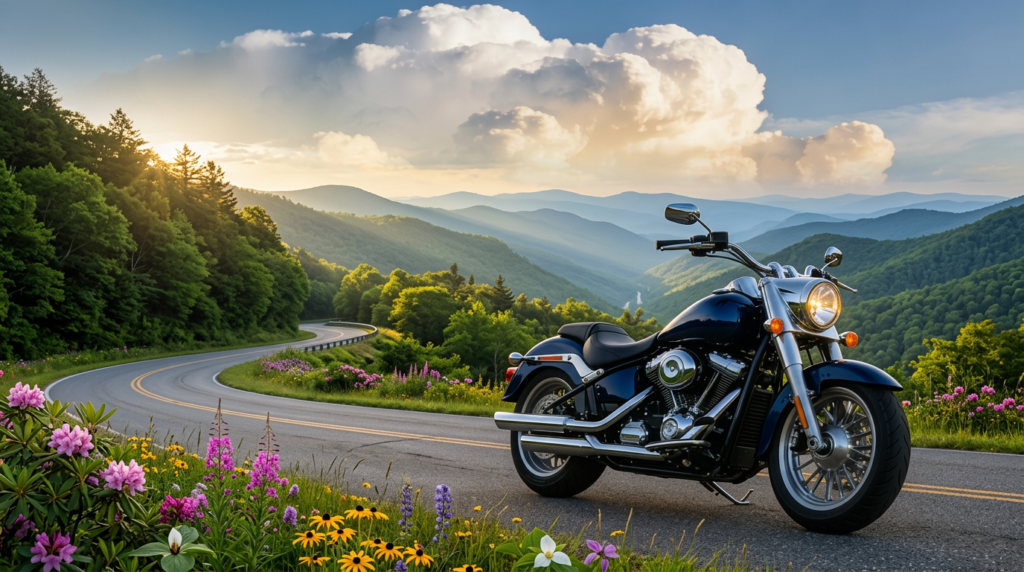
North Carolina motorcycle insurance at a glance:
UIM required after July 1, 2025
Helmet: Universal
Contributory negligence
NC licensed carrier only
North Carolina is not a state where a rider can buy the legal minimum, toss the ID card under the seat, and ignore the fine print. As of March 2026, a new or renewed North Carolina motorcycle policy is built around a 50/100/50 liability floor, and underinsured motorist coverage is now part of the baseline on policies issued or renewed on or after July 1, 2025. That matters, but it is only part of the story. North Carolina also requires continuous coverage from a carrier licensed in North Carolina, lets DMV move quickly when a lapse hits the system, applies contributory negligence in liability claims, and requires every motorcycle and moped rider to wear an FMVSS 218 helmet. Those rules change what you should buy, how a claim gets evaluated, and how expensive a mistake can become after a wreck.[1, 2, 3]
That state-specific context is not academic. NCDMV says motorcycles account for about 2 percent of registered vehicles in North Carolina but about 10 percent of roadway fatalities. For riders, that makes the difference between “legal” insurance and “useful” insurance very real.[1]
What Does “Continuous Coverage” Actually Mean?
North Carolina requires that your motorcycle stay insured by a carrier licensed in North Carolina as long as it has a valid registration. If your bike is registered, the insurance must be active—no gaps, no out-of-state policies. A lapse triggers DMV notifications and penalties automatically. That is why proof of insurance matters and why the DMV side of the equation changes what riders need to do.
| Issue | North Carolina Rule |
|---|---|
| Liability minimum | $50,000 bodily injury per person / $100,000 bodily injury per crash / $50,000 property damage on policies issued or renewed on or after July 1, 2025 |
| UM/UIM | Uninsured motorist coverage is required; underinsured motorist bodily injury coverage is required on policies issued or renewed on or after July 1, 2025 |
| Helmet law | Universal for motorcycles and mopeds; operator and every passenger must wear an FMVSS 218 helmet with the retention strap secured |
| Lane splitting / filtering | No statutory motorcycle exception authorizes it |
| Claims system | Fault-based, with contributory negligence as the core negligence rule |
| Proof of insurance | Paper or electronic proof is valid |
| Continuous coverage rule | Yes; North Carolina registration must be backed by continuous liability coverage from an insurer licensed in North Carolina |
Quick summary based on current NCDMV and NCDOI guidance plus the current statutes.[1, 2, 3]
The Legal Minimum After the 2025 Change
The headline number is simple: 50/100/50. The detail underneath it is where North Carolina gets technical. G.S. 20-279.21 now requires the policy to carry at least $50,000 for bodily injury to one person, $100,000 for bodily injury to two or more people in one crash, and $50,000 for property damage. NCDOI’s motorcycle page reflects the same minimums. If you are buying a new North Carolina motorcycle policy now, those are the starting numbers, not the “good” numbers.[2, 3]
North Carolina’s uninsured and underinsured motorist rules are more important than many riders realize. By statute, uninsured motorist bodily injury coverage defaults to the highest bodily injury liability limit on any vehicle on the policy unless the named insured elects different limits, and those limits cannot drop below the legal minimum. Uninsured motorist property damage defaults to the highest property damage liability limit on the policy, cannot be lower than the legal minimum, and has a first $100 exclusion. Underinsured motorist bodily injury coverage is required in addition to liability and UM on policies issued or renewed on or after July 1, 2025, and the UIM bodily injury limit must match the UM bodily injury limit you buy. North Carolina’s DOI also notes that UIM does not pay property damage.[2, 3]
| Coverage | Required in North Carolina? | What the Law Says |
|---|---|---|
| Bodily injury liability — one person | Yes | $50,000 minimum on policies issued or renewed on or after July 1, 2025 |
| Bodily injury liability — one crash | Yes | $100,000 minimum on policies issued or renewed on or after July 1, 2025 |
| Property damage liability | Yes | $50,000 minimum on policies issued or renewed on or after July 1, 2025 |
| Uninsured motorist bodily injury | Yes | Defaults to the highest bodily injury liability limit on the policy unless the named insured elects different limits; cannot be lower than the statutory minimum |
| Uninsured motorist property damage | Yes | Defaults to the highest property damage liability limit on the policy; cannot be lower than the statutory minimum; first $100 is excluded |
| Underinsured motorist bodily injury | Yes, on policies issued or renewed on or after July 1, 2025 | Defaults to the highest bodily injury liability limit on the policy unless the named insured elects otherwise; must equal the UM bodily injury limit purchased |
| Medical payments | No | Optional |
What Liability Does NOT Cover
If you remember only one thing from the minimums section, make it this: North Carolina’s legal minimum mainly protects other people from your liability. It does not automatically repair your bike, replace your luggage or custom parts, or pay your own injuries just because you were the one on two wheels.[2, 3]
Continuous Coverage, Proof of Insurance, and the DMV Side of the Problem
North Carolina cares about continuous coverage, not just whether you had insurance on the day you bought the bike. If your motorcycle has a valid North Carolina registration, it must stay insured by a company licensed to do business in North Carolina. NCDMV is explicit on a point that catches people moving into or out of the state: an out-of-state policy is not accepted for a North Carolina registration.[1, 3]
Proof of insurance can be shown in either physical or electronic form. G.S. 20-309 says acceptable electronic proof includes an image displayed on a phone or other device through the insurer’s app or website. At the same time, NCDOI’s motorcycle page still tells riders to keep a valid insurance card with the motorcycle or carry it as the operator. In practice, the safest setup is simple: keep the digital card on your phone and a paper copy in the bike’s storage or with your registration paperwork.[2, 3]
If DMV says your policy lapsed and the policy actually did not lapse, the fix is usually administrative, not legal. NCDMV instructs the owner to have the insurer electronically submit a Form FS-1 certificate of insurance. When DMV receives an FS-1 showing continuous coverage, it updates the record and clears the fines. That is a strong reason not to ignore a lapse notice just because you know you were insured. In North Carolina, the record matters until the insurer corrects it.[1]
One more practical detail: if you handle a lapse or civil penalty online, NCDMV uses the PayIt platform. The site currently discloses a $3 transaction fee plus a 1.85 percent card processing fee for online transactions, along with a separate $2 fee for online civil penalty payments. Those are small compared with a suspended registration, but they are still worth knowing before you click through.[1]
What Happens If You Ride Uninsured in North Carolina
North Carolina’s uninsured-driving consequences are not a single ticket. They are a stack of DMV, civil, and criminal problems that can hit at once. Under G.S. 20-311, once DMV receives evidence of a lapse, the agency notifies the owner and the owner has 10 days to respond. If the response shows there was a lapse but the owner now has insurance, the bike was not involved in a crash during the lapse, and the owner did not knowingly operate or allow operation without insurance, DMV can stop at a civil penalty. If the response shows no current financial responsibility, a crash during the lapse, or knowing uninsured operation, registration revocation enters the picture.[1, 3]
| North Carolina Lapse Consequence | What It Means |
|---|---|
| First lapse in a three-year period | $50 civil penalty |
| Second lapse in a three-year period | $100 civil penalty |
| Third or later lapse in a three-year period | $150 civil penalty |
| No current financial responsibility | Registration revocation for an indefinite period, ending when current financial responsibility is obtained or the vehicle is transferred |
| Crash during lapse or knowing uninsured operation | Registration revocation for 30 days |
| Failure to respond to DMV notice | Registration revocation continues until the owner proves no lapse, gets insurance, or transfers the vehicle |
| Re-registration after revocation | Proof of current financial responsibility, civil penalty, $50 restoration fee, and plate fee |
The criminal statute is separate. G.S. 20-313 makes it a Class 3 misdemeanor for an owner of a registered or required-to-be-registered vehicle to operate it, or allow it to be operated, without the financial responsibility North Carolina requires. If the registration is revoked, G.S. 20-311 also requires the owner to return the plate and registration card to DMV, and failure to do that is a Class 2 misdemeanor; the plate and card are subject to seizure by law enforcement. North Carolina also blocks renewal during revocation and can withhold registration renewal on other vehicles in that owner’s name for unpaid lapse penalties and fees.[3]
There are waiver rules for certain military deployments and for some owners who became residents of another state, but those are statutory exceptions, not an informal forgiveness program. The default rule is straightforward: if the bike stays registered in North Carolina, keep the insurance on it until the plate is surrendered.[1, 3]
What the Bare-Minimum Policy Pays for — and What It Does Not
Imagine a common North Carolina crash: you are riding through a Raleigh intersection or on a suburban arterial outside Charlotte, a collision happens, and the fault call eventually lands on you. Your liability coverage pays for the other person’s injuries and property damage up to the policy limit. That is what liability insurance is for. What it does not do is automatically pay to fix your motorcycle, replace your damaged bags or accessories, or cover your own emergency-room bill just because you are the insured rider.[2]
That gap matters more in North Carolina than riders sometimes expect because the state’s claims system is harsh on shared fault. If the other driver caused the wreck but you are found even partially responsible, North Carolina contributory negligence can wipe out your liability recovery altogether. In that kind of state, first-party coverages like collision, comprehensive, MedPay, and strong UM/UIM limits carry more practical value than they do in a pure comparative-negligence state where a reduced recovery would still be possible.[2, 3]
Coverage Add-ons That Matter More in North Carolina
Higher Liability Limits
The best first upgrade for most North Carolina riders is still higher liability. The legal floor is 50/100/50, but hospital bills, lost-income claims, and even a moderate vehicle-damage claim can exceed that faster than many people expect. If you want one easy pricing exercise, quote the bike at the legal minimum and again at 100/300/100. In a contributory-negligence state, you need strong protection on the days you are found to be the one who caused the loss.[2, 3]
Collision
Collision covers physical damage to your motorcycle after an impact with another vehicle or object. NCDOI explains that it pays the lesser of repair cost or actual cash value. If you commute on a bike, ride year-round, or simply own something expensive enough that you cannot self-insure the loss, collision is the coverage that turns a bad crash from a transportation disaster into an insurance claim.[2]
Comprehensive
Comprehensive matters in North Carolina for reasons that have nothing to do with another driver. NCDOI lists theft, hail, glass breakage, falling objects, fire, and contact with animals as classic other-than-collision losses. NOAA says North Carolina was affected by 121 billion-dollar weather and climate disasters from 1980 through 2024, including 31 tropical cyclone events and 54 severe storm events, and NCDOT’s flood warning system is built specifically to detect storm-related road problems across the state. For a state with barrier-island exposure, inland flash flooding, mountain weather, and summer storm seasons, comprehensive is not cosmetic coverage.[2, 5, 6]
More UM/UIM, Not Just the Default Amount
North Carolina requires UM, and now requires UIM on new and renewed policies, but the amount you buy still matters. UM bodily injury and UM property damage can be elected at limits above the floor, and UIM bodily injury must match the UM bodily injury limit you purchase. NCDOI also points out that UIM protects bodily injury only, not property damage. That means riders who want serious protection against underinsured drivers should look carefully at the UM/UIM line on the declarations page instead of assuming the statutory default is enough.[2, 3]
Medical Payments That Actually Follows the Bike
North Carolina’s Medical Payments coverage has an important catch. NCDOI says standard MedPay does not cover injuries sustained while occupying a motorized vehicle with fewer than four wheels. The fix, where offered, is the Miscellaneous Type Vehicle Endorsement, which can extend MedPay to motorcycles and other similar vehicles. If an agent tells you that your auto MedPay “already covers you,” ask the follow-up question that matters in North Carolina: Does it extend to the bike?[2]
Custom Parts, Permanently Installed Accessories, and Towing
North Carolina’s DOI specifically recognizes customizing equipment coverage, which increases limits for custom furnishings, custom equipment, and additional permanently installed electronic accessories. It also recognizes towing and labor cost coverage. That matters if your bike has hard luggage, upgraded lighting, electronics, a touring setup, or expensive aftermarket parts that would not be replaced correctly under a bare stock valuation. For a lot of riders, this is the difference between “the bike was covered” and “the bike I actually own was covered.”[2]
Helmet Law, Lane Splitting, and the Road Rules Riders Forget
North Carolina has a universal helmet law for motorcycles and mopeds. G.S. 20-140.4 requires the operator and every passenger to wear a helmet that complies with Federal Motor Vehicle Safety Standard 218, with the retention strap properly secured. NCDMV adds a practical warning that many riders miss: a novelty helmet with a separate or stick-on “DOT” sticker does not become compliant just because the sticker is on the shell.[1, 3]
The penalty is not enormous, but the legal details matter. A violation is an infraction, and the statute sets a $25.50 penalty plus court costs. Just as important for claims, G.S. 20-140.4 says a helmet-law violation is not negligence per se or contributory negligence per se in a civil action. That does not mean riding in violation never matters; it means the violation is not an automatic civil defeat by itself.[3]
Lane Splitting Is Not Authorized in North Carolina
North Carolina is not a lane-splitting state. The law gives motorcycles full use of a lane and says they cannot be operated more than two abreast in a single lane. The state motorcyclist handbook goes further and says cars and motorcycles need a full lane to operate safely and that lane sharing is usually prohibited. North Carolina does not create a statutory exception for stoplight filtering or riding between occupied lanes, so the safe read for riders is that lane splitting and filtering are off-limits here.[1, 3]
Other North Carolina-specific rules worth remembering are easy to overlook until a stop or a crash report brings them up. Motorcycle headlamps must be lighted at all times while the bike is operating on highways or public vehicular areas. The bike must have a rearview mirror that gives a clear, undistorted, unobstructed view of at least 200 feet to the rear. North Carolina’s directional-signal-equipment statute says it does not apply to motorcycles, which helps explain why the state’s motorcycle guidance still tells riders to use hand and turn signals at every lane change or turn. G.S. 20-140.4 also bars carrying more people than the motorcycle was designed to carry.[1, 3]
Licensing Rules That Affect Insurability
North Carolina uses a motorcycle learner permit and a motorcycle endorsement, not a separate stand-alone “Class M” license. To operate a motorcycle, you need either the permit or the endorsement attached to your provisional, regular, or commercial license. DMV says permit applicants must pass a motorcycle knowledge test, road-sign test, and vision test; endorsement applicants must pass the motorcycle knowledge test and an off-street skills test. Riders ages 16 to 18 need parental or guardian consent and a qualifying safety course. NCDMV also notes that motorcycle road tests are appointment-only at select offices, and NCMSEP says some insurers give students a discount and that successful course completion produces a DMV waiver card for the skills portion of the test.[1, 3, 4]
Motorcycles vs. Mopeds vs. Scooters vs. E-Bikes in North Carolina
North Carolina’s insurance rules follow the statute, not the sales label. A machine marketed as a “scooter” may still be treated as a motorcycle, and a true moped is handled differently from both motorcycles and electric assisted bicycles.[1, 3]
| Vehicle Type | North Carolina Definition | Insurance Required? | License Required? |
|---|---|---|---|
| Motorcycle | Vehicle with a saddle for the rider and not more than three wheels in contact with the ground; includes autocycles, motor scooters, and motor-driven bicycles, but excludes mopeds and electric assisted bicycles | Yes | Yes — motorcycle learner permit or motorcycle endorsement |
| Moped | Two or three wheels, no external shifting device, motor of 50cc or less, and top speed no greater than 30 mph | Yes — registered mopeds are inside North Carolina’s financial-responsibility system | No regular driver license or motorcycle endorsement required, but operator must be at least 16 |
| Scooter | Not a separate legal category by itself; if it meets the motorcycle definition, motorcycle rules apply; if it fits the moped definition, moped rules apply | Usually yes | Depends on which definition it meets |
| Electric assisted bicycle | Bicycle with operable pedals, a seat or saddle, an electric motor of no more than 750 watts, and motor-only top speed of no more than 20 mph | No motorcycle liability requirement under the motor-vehicle insurance statutes | No motorcycle permit or endorsement |
Important Moped Note: North Carolina’s statutes clearly place registered mopeds inside the financial-responsibility framework, but agency pages are not perfectly harmonized after the 2025 limit change. The general NCDMV insurance page and the current statutes reflect the post-July 1, 2025 50/100/50 framework, while the moped registration page still shows older limit wording. If you are buying insurance for a moped right now, verify the required limit with the carrier and NCDMV rather than relying on an older page in isolation.[1, 3]
How North Carolina’s Insurance System Changes Motorcycle Claims
Fault Decides the Liability Claim, and Contributory Negligence Is the Pressure Point
North Carolina handles these claims as a fault-based system. NCDOI explains that the adjuster investigates the wreck to determine who was negligent or at fault. The problem for riders is the next sentence on the same page: North Carolina’s contributory negligence law bars a driver from collecting damages if the driver is determined to be partially at fault. That is a much tougher rule than modified comparative negligence. In practical terms, a small allegation about speed, lane position, or reaction time can become the entire case.[2]
UM/UIM Is Mandatory Now, but the Fine Print Still Matters
North Carolina’s UIM changes in 2025 were not cosmetic. NCDOI says UIM is included in all new or renewed policies on or after July 1, 2025, and the reform also changed how an “underinsured” vehicle is evaluated, how setoffs work, and when separate policies can be combined. The statute now says UIM coverage applies from the first dollar beyond the exhausted liability limits, cannot be reduced by a setoff or credit against other coverage except workers’ compensation, and can be combined across separate or additional nonfleet private-passenger policies by taking the highest available UIM limit under each policy. What North Carolina still does not allow is combining multiple vehicle UIM limits inside the same policy.[2, 3]
There is another North Carolina wrinkle that surprises riders after a serious crash: your own insured motorcycle is not automatically treated as an “underinsured motor vehicle” under the owner’s policy on that bike. The statute says that, for an owner’s policy insuring the vehicle, the vehicle is not an underinsured motor vehicle unless the owner’s UIM limits are greater than that policy’s bodily injury liability limits, and then only to the extent of the excess. That is one reason why carrying identical low liability and UIM limits can produce a much smaller recovery than riders expect.[3]
NCDOI also gives a warning riders should treat as mandatory: if you or your legal representative settle a bodily injury or property damage claim without the company’s written consent, the company may deny UM/UIM coverage. If a North Carolina motorcycle wreck is serious enough that UM/UIM might matter, do not sign away the claim casually just to get the liability check moving.[2]
Repair Fights and Total-Loss Rules Are Also State-Specific
North Carolina’s DOI gives riders two practical repair rules worth knowing before the adjuster calls. First, an insurer cannot require the use of after-market parts unless the part is equal to the original in fit, quality, performance, and warranty, and any modifications made necessary by those parts must be included in the estimate. Second, if repair cost equals or exceeds 75 percent of the vehicle’s pre-accident actual cash value, the insurer must consider the vehicle a total loss. Those rules do not remove every valuation fight, but they tell you where North Carolina starts.[2]
What Moves Motorcycle Premiums in North Carolina
North Carolina’s rating environment changed in 2025, but your personal quote still turns on the usual risk factors plus a few state-specific ones. NCDOI’s June 2025 rate-case settlement included an average statewide 16.3 percent decrease in motorcycle liability rates on new and renewed policies on and after October 1, 2025, but average statewide is not the same thing as your individual premium. Here is what usually moves the number.[2, 3, 4]
| Pricing Factor | Why It Matters in North Carolina |
|---|---|
| Driving experience | NCDOI lists driving experience as a rating factor, and for drivers first licensed on or after July 1, 2025 the inexperienced-operator surcharge can apply for up to eight years |
| Driving record and at-fault crashes | North Carolina’s Safe Driver Incentive Plan ties premium surcharges to moving violations and at-fault accidents |
| Bike type, value, and performance | A fully faired sport bike, a touring bike, and a smaller standard do not present the same repair cost or theft profile |
| Where you live and garage the bike | NCDOI specifically says location affects premium; dense urban storage and high-theft areas usually price differently from rural garaging |
Sources and References
- North Carolina Department of Motor Vehicles —
Official DMV Website;
Motorcycle Licensing;
Financial Responsibility - North Carolina Department of Insurance —
Official DOI Website;
Motorcycle Insurance Information - North Carolina General Statutes (G.S.) —
G.S. 20-279.21;
G.S. 20-309;
G.S. 20-311;
G.S. 20-313;
G.S. 20-140.4;
G.S. 20-146.1;
G.S. 20-125.1;
G.S. 20-126;
G.S. 20-129;
G.S. 20-4.01;
G.S. 20-7;
G.S. 58-36-90;
Chapter 58, Article 37 - North Carolina Motorcycle Safety Education Program —
Frequently Asked Questions - NOAA National Centers for Environmental Information —
North Carolina Billion-Dollar Weather and Climate Disasters Summary - N.C. Department of Transportation —
Flood Warning System
This article is written for March 2026. If you update it later, re-check the official sources above before changing limits, no-fault language, or registration-related insurance rules.
Last verified: April 23, 2026. Related update: Is Lane Splitting Legal in North Carolina?.