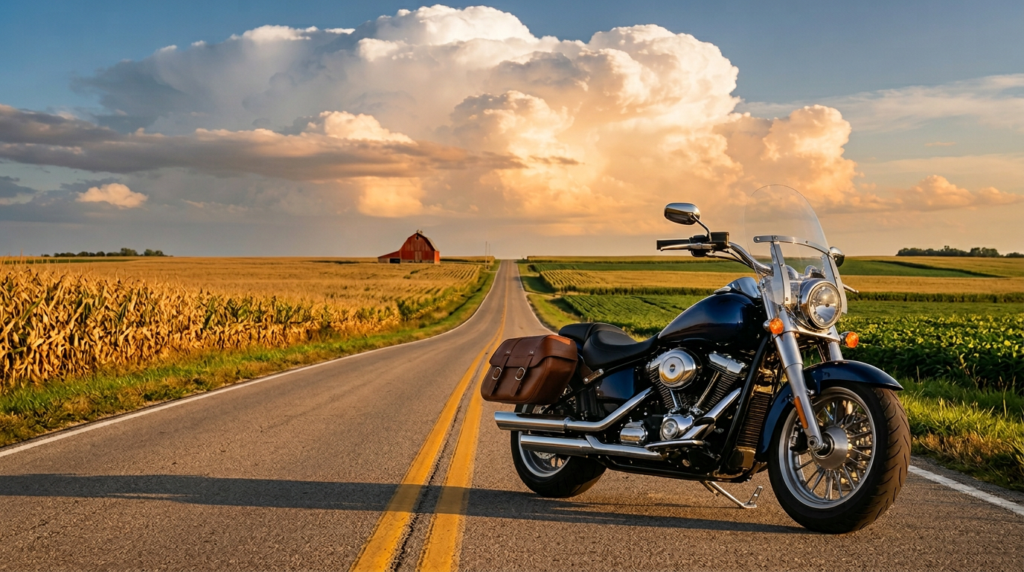
Iowa motorcycle insurance at a glance:
UM/UIM: Included by default
Helmet: Not required
Lane splitting: Illegal
No-fault: Not applicable
Iowa still lets riders satisfy the law with 20/40/15 liability limits. That keeps you legal. It does not fix your bike, pay your own ER bill, replace your helmet and jacket, or cover lost income after a bad crash on I-80, U.S. 30, or a county road outside Cedar Rapids. Iowa also has a quirk many riders miss: uninsured and underinsured motorist bodily injury coverage is built into motor vehicle liability policies unless the named insured rejects it in writing, so the default baseline is slightly stronger than the liability floor alone. It is still a thin baseline for a motorcycle claim.[1, 2]
Iowa’s legal minimum is simple: 20/40/15, with UM/UIM added by default unless you reject it
The hard minimum comes from Iowa Code section 321A.21. A qualifying motor vehicle liability policy must provide at least $20,000 for bodily injury or death to one person in one accident, $40,000 for bodily injury or death to two or more people in one accident, and $15,000 for property damage in one accident. Iowa’s Insurance Division publishes the same figures and plainly warns consumers that many drivers need more than those minimums.[1, 3]
Iowa does not impose a general no-fault/PIP package for ordinary motorcycle claims, and it does not require MedPay. What Iowa does require by default is bodily injury protection against uninsured, hit-and-run, and underinsured motorists. Under Iowa Code section 516A.1, those coverages must be included in a motor vehicle liability policy with bodily injury limits at least equal to Iowa’s statutory minimum unless the named insured rejects all or part of them in writing on a separate document. For riders, that means UM/UIM is the starting point on many Iowa policies, but it is still waivable.[2]
| Coverage | Iowa minimum | Required? | How Iowa treats it |
|---|---|---|---|
| Bodily injury liability | $20,000 per person / $40,000 per accident | Yes | Required by Iowa Code section 321A.21. |
| Property damage liability | $15,000 per accident | Yes | Required by Iowa Code section 321A.21. |
| Uninsured motorist bodily injury / hit-and-run bodily injury | At least Iowa’s bodily injury minimums | Default unless rejected in writing | Included by section 516A.1 unless the named insured rejects it. |
| Underinsured motorist bodily injury | At least Iowa’s bodily injury minimums | Default unless rejected in writing | Included by section 516A.1 unless the named insured rejects it. |
| PIP / no-fault benefits | None | No | Iowa does not require a general no-fault/PIP package for motorcycle liability policies. |
| MedPay | None | No | Optional if offered by the carrier. |
That table is the legal floor. It is not a recommendation.
On a modern bike, one ambulance ride, one damaged SUV, or one lawsuit involving multiple injured people can blow through 20/40/15 quickly.[1, 3]
Proof of insurance in Iowa: your phone works, but the state still expects you to have the card ready
Iowa Code section 321.20B requires two things at once: the motorcycle must actually be covered, and the rider must have proof for that vehicle in the vehicle. Iowa expressly allows paper or electronic proof. The statute says acceptable electronic formats include an image displayed on a cell phone or other portable electronic device with a screen and touch input or a miniature keyboard, so a digital ID card on your phone is valid in Iowa.[4]
The public-facing rule is still the proof card itself. Iowa’s statute spells out the card requirement and what officers can do if you cannot produce it. It does not tell riders to rely on a named roadside insurance-verification database in the way some other states publicize electronic verification systems. In practice, the safe move is to carry both: a paper card on the bike and an electronic copy on your phone.[4]
If you are stopped and cannot show proof, the officer has options. Under section 321.20B, the officer may issue a warning, issue a citation, issue a citation and remove the plate and registration receipt, or issue a citation, remove the plate and registration receipt, and impound the motorcycle. If the officer removes the plate without impounding the bike, the statute allows up to 48 hours to remove the motorcycle from Iowa highways, and the citation has to stay with the bike during that limited drive-out period.[4]
Iowa also distinguishes between “I didn’t have proof with me” and “I was actually uninsured.” If liability coverage really was in force at the time of the stop and you produce proof to the clerk of court before the court date, the citation is dismissed. If plates were removed, the county treasurer still assesses a $15 administrative fee before issuing new plates and registration. If you were not actually insured, dismissal is off the table; you are into fines, fees, and possibly towing and storage charges.[4]
Riding uninsured in Iowa gets expensive quickly, and the accident rules make it worse
The scheduled fine for violating Iowa Code section 321.20B is $325. If the proof-of-financial-responsibility charge is tied to a motor vehicle accident and the person is charged and found guilty, the scheduled fine jumps to $645. Those numbers come from Iowa Code section 805.8A, not from an insurer brochure or a secondary summary.[5]
- A no-insurance citation can lead to a $325 scheduled fine.[5]
- If the violation is charged in connection with a motor vehicle accident, the scheduled fine is $645.[5]
- An officer can remove your plate and registration receipt on the spot.[4]
- An officer can impound the motorcycle, which then adds towing and storage costs before you get it back.[4]
- If the case goes before a court and you are found guilty, the court may impose the fine or order unpaid community service instead.[4]
- If plates were removed, the county treasurer charges a $15 administrative fee before new plates and registration are issued.[4]
Iowa’s accident-related financial responsibility rules are the part many riders never read until after the crash. Iowa DOT says you must report an accident to the DOT within 72 hours if it causes injury, death, or property damage over $1,500, unless law enforcement investigated and filed the report. The same Iowa DOT page says that if you cause injury or property damage exceeding $1,500 to the other party, you must show proof of insurance or your license will be suspended. If you own the bike and cannot show proof, you can also lose registration privileges.[7]
Repeat-offense treatment in Iowa is less about a neat published “second offense” ladder and more about compounding consequences. Iowa’s scheduled-fine statute gives one standard amount for section 321.20B and one higher amount when the charge is tied to an accident. The real escalation is practical: another citation, another chance to lose plates, another impoundment, another tow bill, and, if a suspension or revocation is imposed, proof of future financial responsibility from day one for two years.[5, 6]
If the Iowa DOT starts an accident-based suspension, the agency says you can prevent it by providing one of several items: proof you had insurance at the time of the accident, a security deposit, a release, an agreement to pay the other party, or proof you sold the vehicle before the crash. If the suspension already happened, Iowa DOT says you reinstate by satisfying one of those options, scheduling a DMV appointment, and paying a $20 reinstatement fee plus a $10 duplicate-license fee. If more than a year has passed since you held a valid license, the DOT says you must also pass a knowledge test and a driving test before reinstatement.[7]
That future-proof requirement usually means an SR-22 filing through an Iowa-authorized insurer. Iowa DOT’s proof-after-suspension page says the filing obligation starts on the first day of the suspension or revocation and lasts for two years. It also says you can only drive and register vehicles, including motorcycles, that are listed on the SR-22, and that motorcycles are covered under a separate policy. That separate-policy point matters if you assume your car filing automatically handles the bike. It does not.[6]
What Iowa’s minimum coverage actually does, and what it leaves hanging in the air
Use a simple Iowa scenario. You are riding in the Des Moines metro, a driver turns left in front of you, and the crash turns into a fault fight about speed, visibility, and reaction time. If the other driver proves you caused the wreck, your minimum liability policy pays for the other side’s injuries and property damage, up to 20/40/15. It does not repair your motorcycle. It does not replace your helmet, jacket, gloves, or comms unit. It does not pay your own ER bill, physical therapy, or missed work unless you bought additional first-party protection.[1, 15]
Even if the other driver mostly caused the crash, Iowa’s comparative fault rule still matters. Under Iowa Code section 668.3, your recovery is reduced by your percentage of fault, and you recover nothing if your fault is greater than the combined fault of the defendants and released parties. So the minimum policy is weak in two different ways: low liability limits for the damage you cause, and no built-in protection for your own losses when fault is disputed.[15]
Real Iowa risk factors to consider:
Animal collisions: Iowa DOT reported 8,023 crashes between vehicles and animals on Iowa roads in 2023, with five deaths and 23 serious injuries.
Severe weather: NOAA’s Iowa disaster summary says the state was affected by 86 billion-dollar weather and climate disasters from 1980 through 2024, including 57 severe storm events.
Put those two facts together and you get the real-world case for better coverage: deer, hail, wind, and high-severity injury are not edge cases here.[21, 22]
Coverage options that make sense for Iowa riders
Higher liability limits
A practical Iowa step-up is 100/300/100. That gives you more room if you seriously injure someone or total a newer vehicle, and it protects assets much better than 20/40/15. Iowa’s Insurance Division says many drivers need more than the statutory minimum, and motorcycles are exactly the kind of risk where one bad claim can make that obvious fast.[3]
Collision
Collision pays for your motorcycle after a crash with another vehicle or object, regardless of fault, subject to the deductible. In Iowa, that matters because fault arguments affect what you can recover from someone else. When comparative fault cuts your third-party claim, collision is what gets your bike repaired or totaled without waiting for everyone to finish blaming each other.[15]
Comprehensive
For Iowa riders, comprehensive is not a luxury add-on for spotless garage queens. It is the coverage that responds to deer strikes, theft, vandalism, fire, hail, and wind damage. Iowa DOT’s 2023 animal-crash count and NOAA’s severe-storm history make this one of the easiest coverages to justify on any financed, newer, or higher-value bike.[21, 22]
Uninsured and underinsured motorist bodily injury
Because Iowa law includes UM and UIM bodily injury coverage in liability policies unless you reject them in writing, many riders already have this protection and do not realize it. Keep it unless you have a very deliberate reason not to. Iowa’s minimum liability limits are low, and section 516A.2 allows policy terms and anti-stacking provisions that can limit how multiple policies interact, so the exact wording of your own policy matters more than riders often think.[2, 16]
MedPay or other supplemental medical coverage
Iowa does not give motorcycle riders a mandatory no-fault PIP bucket to lean on after a wreck. MedPay helps close that gap by paying some immediate medical expenses regardless of fault. On a bike, that can mean ambulance, imaging, ER treatment, and follow-up care start getting addressed before the liability fight is finished.[1, 15]
Custom parts, accessories, and riding gear coverage
Stock valuation is a poor fit for many Iowa motorcycles. Saddlebags, crash bars, upgraded seats, taller windscreens, GPS and phone mounts, heated-gear connections, custom paint, and hard luggage all add value that can disappear after a crash or theft. So can the gear you were wearing. If your bike is anything other than factory-standard, look closely at accessory and riding-gear limits instead of assuming “comprehensive and collision” covers everything attached to or carried on the bike.
Motorcycle-specific roadside assistance
Iowa is a state of long stretches between towns once you leave the metro areas, and a generic auto-club add-on is not always built for motorcycles. Ask whether the program specifically covers bikes, whether the tow vehicle is a flatbed or motorcycle trailer, and whether the plan covers fuel delivery, flats, dead batteries, and winching. A roadside program that treats a touring bike like a compact sedan is not a roadside program worth paying for.
Trip interruption
If you use Iowa as a base for longer runs into Minnesota, Wisconsin, Nebraska, South Dakota, or Missouri, trip interruption can be cheap protection. It helps with lodging, food, and transportation if the motorcycle is disabled far from home. Riders who do long weekends out of Des Moines, Cedar Falls, Davenport, or Sioux City tend to appreciate this one after the first breakdown rather than before it.
Gap insurance
If the loan balance is higher than the bike’s actual cash value, a total loss can leave you paying for a motorcycle you no longer own. Gap coverage fills that difference. On a newer financed bike bought with a small down payment, it is a much more useful add-on than flashy optional endorsements that do not change the total-loss math.
Laid-up or seasonal coverage
Iowa has a real riding season, and carriers know it. Iowa DOT’s rider-education page says training around the state is generally available from early April through mid-October, which lines up with how many riders actually use their bikes. Iowa DOT’s motorcycle fatality-by-month data also show 2023 deaths concentrated in April through October, with zero fatalities in January, February, March, and November. That is why storage or laid-up options matter in Iowa: you may want comprehensive protection year-round while dialing back other coverages during the parked months.[9, 24]
Iowa’s helmet law: no statewide street requirement, but the insurance angle does not disappear
Iowa DOT says Iowa law does not require helmets for motorcycles or autocycles. There is no statewide age-based highway helmet rule and no extra-medical-coverage requirement to ride bareheaded the way some states structure helmet exemptions. For street riding, Iowa is a no-helmet-requirement state.[8]
That is the legal rule. The insurance and claim-value analysis is a separate question. Iowa DOT still recommends helmets for operator and passenger protection, and in any serious injury claim a carrier or defense lawyer may argue that avoidable head injuries increased the damages. Riding without a helmet may be lawful in Iowa, but lawful does not mean neutral in a contested bodily-injury case.[8, 15]
Lane splitting is illegal in Iowa, and these are the other motorcycle rules worth knowing
- Lane splitting: Illegal. Iowa Code section 321.275 says a motorcycle or motorized bicycle may not be operated between lanes of traffic or between adjacent lines or rows of vehicles.[10]
- Lane filtering at a stop: Also illegal under the same statutory language. Iowa does not carve out a separate stoplight-filtering exception.[10]
- Two abreast: Allowed, but no more than two motorcycles or motorized bicycles abreast in one lane.[10]
- Full lane use: Other motorists cannot lawfully deprive a motorcycle operator of the full use of a lane.[10]
- Passengers: A passenger is legal only if the bike is designed for more than one person, the passenger has a proper seat, and footrests are provided unless the passenger is in a sidecar or enclosed cab.[10]
- Seating position: Rider and passenger must sit astride the seat, facing forward, with one leg on either side.[10]
- Headlight on: A 1977-or-later motorcycle must display at least one lighted headlamp on the highway.[10]
- Hands on the bars: No package, bundle, or article that prevents the operator from keeping both hands on the handlebars.[10]
- Mirror rule: Iowa requires a mirror giving a view of the highway for at least 200 feet to the rear.[11]
- Exhaust/noise: Every motor vehicle must have a muffler in good working order, and muffler cutouts or bypass devices are not allowed on the highway.[12]
- Motorized bicycles: No passenger, and when operated on a highway they need a Day-Glo triangular safety flag extending at least five feet above the ground.[10]
Licensing in Iowa: the insurance-relevant version, not the full DMV rabbit hole
For insurance purposes, the key point is that Iowa treats motorcycles as a Class M issue. You can either add a motorcycle endorsement to an existing driver’s license or obtain a motorcycle-only Class M license. Iowa DOT says the normal path requires a motorcycle knowledge test, a motorcycle skills test, and a vision screening, although the skills test may be waived if you successfully complete an Iowa-approved motorcycle education course. Iowa also issues a motorcycle instruction permit for one four-year term with no renewal, and the permit requires the rider to be accompanied by a licensed motorcycle operator within sight and hearing distance in a different vehicle. If the applicant is under 18, Iowa DOT says a motorcycle rider education course must be completed before the motorcycle license is issued.[8, 9]
Motorcycles, scooters, mopeds, e-bikes, and autocycles do not all live in the same legal bucket
| Vehicle Type | Iowa definition | Insurance required? | License required? |
|---|---|---|---|
| Motorcycle | A motor vehicle with a saddle or seat for the rider, designed to travel on not more than three wheels; includes a motor scooter; excludes an autocycle, low-speed electric bicycle, and motorized bicycle. | Yes | Yes — motorcycle endorsement or Class M motorcycle-only license |
| Scooter / motor scooter | If it fits Iowa’s motorcycle definition, Iowa treats it as a motorcycle. | Yes | Yes — motorcycle endorsement or Class M |
| Moped / motorized bicycle | A motor vehicle with a saddle or seat, not more than three wheels, and not capable of more than 39 mph on level ground unassisted by human power. Iowa’s moped manual also treats it as a single-operator vehicle with no passengers. | Yes | Yes — moped license or another valid driver’s license |
| Low-speed electric bicycle | A pedal-equipped two- or three-wheel device with an electric motor under 750 watts that fits Iowa’s class 1, 2, or 3 e-bike definitions. | No | No driver’s license or permit required |
| Autocycle | A three-wheeled motor vehicle with two front wheels, one rear wheel, a steering wheel instead of handlebars, no straddle seat, and foot pedals that control the vehicle. | Yes | No motorcycle endorsement required; any license valid for a noncommercial passenger vehicle can operate it |
Important distinction:
The most common Iowa mix-up is between mopeds and e-bikes. Iowa’s official moped manual says mopeds must be registered and that operators must carry proof of insurance. By contrast, Iowa Code section 321.235B says low-speed electric bicycles are not subject to licensure, registration, titling, inspection, proof of financial liability coverage, or possession of a driver’s license or permit. They are not close legal substitutes for each other, even if the sales pitch makes them sound similar.[25, 13, 14, 8]
Iowa motorcycle claims run through fault rules, not a no-fault shortcut
In practice, Iowa operates as an at-fault tort state for motorcycle claims. The state requires liability coverage, not a separate no-fault PIP system for routine motorcycle injury claims, and fault allocation is handled under Iowa’s comparative-fault statute. If another driver causes the wreck, you usually pursue that driver’s liability coverage or sue. If you cause the wreck, your liability coverage protects the other side up to your limits.[1, 15]
Iowa uses modified comparative fault. Section 668.3 says your fault does not bar recovery unless your percentage of fault is greater than the combined fault of the defendants and released parties, but any damages allowed are reduced in proportion to your fault. Put that into motorcycle math and the rule is easy to see: if you are 20% at fault on a $50,000 claim, your recoverable damages drop to $40,000; if you are 51% at fault, the claim is barred.[15]
There is one more Iowa-specific claims wrinkle worth knowing before you buy a policy. Iowa Code section 516A.2 says UM/UIM forms may include limitations, offsets, and anti-stacking language designed to avoid duplication of benefits, and it expressly states that enforcing anti-stacking provisions in a motor vehicle insurance policy does not frustrate the protection required by section 516A.1. So if you own multiple vehicles or multiple policies exist in the household, do not assume you can automatically combine every UM/UIM limit after a bad crash. Read the policy wording.[16]
What actually changes your motorcycle premium in Iowa
- Rider age: younger operators usually pay more because they bring less experience and more claims volatility.
- Riding experience: a rider with several clean Iowa riding seasons is a different underwriting risk than a first-year owner.
- Bike type and displacement: a supersport, a touring rig, and a small dual-sport do not price the same.
- Driving record: speeding tickets, serious moving violations, and at-fault crashes move premiums up fast.
- Annual mileage: Iowa’s Insurance Division says some insurers offer lower premiums for people who drive fewer miles, and pay-as-you-drive programs can benefit low-mileage operators.[18]
- Garaging location: where the bike is kept overnight affects theft, weather exposure, and expected claim frequency.
- Claims history: prior collision, comprehensive, or liability claims change what a carrier expects next.
- Training: Iowa-approved education can affect underwriting and, depending on carrier, discounts. At minimum, it can waive the state skills test.[8, 9]
- Credit-based insurance scoring: Iowa allows insurers to use credit information in personal insurance, including motorcycle insurance, but section 515.103 imposes guardrails and bans factors such as income, gender, address, ZIP code, ethnicity, religion, marital status, race, or nationality from the insurance score itself.[17]
- Limits and deductibles: higher liability limits and lower deductibles cost more, but they also change the value of the policy in a real loss.
- Bundling and payment method: Iowa’s Insurance Division specifically notes that some insurers discount bundled policies and that paying the premium in one lump sum annually may reduce cost.[18]
- Continuous coverage: Iowa’s Insurance Division also notes that maintaining continuous auto insurance coverage can lead to lower premiums over time, and carriers often treat lapses as a warning sign.[18]
Iowa-specific takeaway:
Credit information is not banned, low-mileage savings are possible, and the state’s own consumer guidance points riders toward bundling, deductible discipline, and pay-in-full discounts before it points them toward gimmicks.[17, 18]
How to compare Iowa motorcycle quotes without fooling yourself
- Quote two tiers, not one. Get one quote at Iowa’s legal minimum and another at a realistic upgrade such as 100/300/100. That shows you the real price gap between “legal” and “actually useful.”[1]
- Hold deductibles constant. A quote is not truly cheaper if the only reason is that the collision deductible quietly moved from $500 to $1,000.
- Ask about winter lay-up. Iowa’s training season generally runs from early April through mid-October, and the DOT’s fatality-by-month data show how seasonal the exposure is. Ask whether parked-month discounts keep comprehensive in force while dialing back other coverages.[9, 24]
- Ask how parts are settled. Find out whether the carrier uses OEM parts, aftermarket parts, or actual-cash-value sourcing after a loss, especially if your bike has fairings, bags, or expensive trim pieces.
- Confirm roadside assistance is motorcycle-specific. Ask what equipment the vendor uses and whether the plan covers a motorcycle trailer or flatbed.
- Check financial strength. AM Best is the usual shortcut, but the larger point is simple: a bargain policy is not a bargain if the carrier handles claims poorly.
- Push on discounts that actually move the number. Ask about training, multi-policy, low-mileage, pay-in-full, and continuous-coverage discounts. Iowa’s Insurance Division specifically calls out several of those items in its consumer guidance.[18]
- Use Iowa’s own complaint and data pages. Before you bind coverage, check the Iowa Insurance Division’s complaint page and data resources. Those are the official Iowa places to start if you want to look beyond the carrier’s marketing copy.[19, 20]
Frequently asked questions about Iowa motorcycle insurance
Do I need motorcycle insurance in Iowa?
Yes. Iowa Code section 321.20B says you may not drive a motor vehicle on Iowa highways unless financial liability coverage is in effect and you have proof for that vehicle in the vehicle. For motorcycles, that means at least Iowa’s liability minimums, with UM/UIM bodily injury coverage generally included unless rejected in writing.[4, 1, 2]
Is Iowa’s state minimum enough?
Usually not. The 20/40/15 floor is there to satisfy the law, not to make a rider financially whole after a serious collision. Iowa’s Insurance Division says many drivers need more than the minimum, and that is even more true once you factor in motorcycle injury severity and the value of newer vehicles and property you could damage.[3]
Does Iowa’s no-fault or PIP system apply to motorcycles?
Iowa does not impose a general no-fault/PIP package for routine motorcycle claims. In practice, motorcycle claims run through liability coverage, fault allocation, and Iowa’s comparative-fault statute instead of through a mandatory PIP benefit bucket.[1, 15]
What happens if I ride without insurance in Iowa?
You can be cited for violating section 321.20B, face a $325 scheduled fine, lose your plate and registration receipt, or have the bike impounded. If the charge is tied to a motor vehicle accident, the scheduled fine increases to $645. If a suspension or revocation follows, Iowa DOT requires proof of future financial responsibility from the first day for two years, usually through an SR-22 filing.[4, 5, 6]
Do mopeds and scooters need insurance in Iowa?
Scooters usually do if they fit Iowa’s motorcycle definition, because Iowa defines “motorcycle” to include a motor scooter. Mopeds do too. Iowa’s official moped manual says operators must carry proof of insurance at all times and that mopeds must be registered.[13, 25]
Does a motorcycle safety course lower my insurance rate in Iowa?
Sometimes, but it is not guaranteed by Iowa law. Iowa DOT says successful completion of an Iowa-approved motorcycle education course can waive the licensing skills test. Any premium discount is carrier-specific, so you have to ask the insurer directly and compare the quote both ways.[8, 9]
What if my motorcycle is financed or leased?
Your lender will usually require more than Iowa’s legal minimum. Expect a requirement for collision and comprehensive, and think hard about gap coverage if the loan balance is higher than the bike’s cash value. Iowa’s liability floor keeps you legal with the state; it does not satisfy every lender’s contract.[1]
Does Iowa require uninsured motorist coverage on motorcycle policies?
Iowa law requires UM, hit-and-run, and UIM bodily injury coverage to be included in motor vehicle liability policies unless the named insured rejects all or part of that coverage in writing. So the practical answer is yes by default, but it can be waived.[2]
Can I show proof of insurance on my phone in Iowa?
Yes. Section 321.20B expressly allows proof of financial liability coverage to be produced in electronic format, including an image displayed on a cellphone or other qualifying portable electronic device.[4]
Is lane splitting legal in Iowa?
No. Iowa Code section 321.275 says a motorcycle may not be operated between lanes of traffic or between adjacent lines or rows of vehicles. That same language also makes stoplight filtering illegal in Iowa.[10]
Do I have to wear a helmet in Iowa?
No statewide street helmet requirement applies to motorcycles in Iowa. Iowa DOT says Iowa law does not require helmets for motorcycles or autocycles, though it still recommends helmet use for protection.[8]
Do low-speed e-bikes need insurance in Iowa?
No. Iowa Code section 321.235B says low-speed electric bicycles are not subject to licensure, registration, titling, inspection, proof of financial liability coverage, or possession of a driver’s license or permit. That is a completely different legal category from a motorcycle, scooter, or moped.[14]
Official sources and direct links
- Iowa Legislature — Iowa Code section 321A.21, “Motor vehicle liability policy” defined
- Iowa Legislature — Iowa Code section 516A.1, Coverage included in every liability policy — rejection by insured
- Iowa Insurance Division — Auto Insurance
- Iowa Legislature — Iowa Code section 321.20B, Financial liability coverage — proof required — violations — penalties — exceptions
- Iowa Legislature — Iowa Code section 805.8A, Citations in lieu of arrest
- Iowa Department of Transportation — Proof of Insurance After a Suspension (SR-22)
- Iowa Department of Transportation — Suspension Due to an Accident
- Iowa Department of Transportation — Get a Motorcycle, Moped, or Autocycle License
- Iowa Department of Transportation — Motorcycle & Moped Education
- Iowa Legislature — Iowa Code section 321.275, Operation of motorcycles and motorized bicycles
- Iowa Legislature — Iowa Code section 321.437, Mirrors
- Iowa Legislature — Iowa Code section 321.436, Mufflers, prevention of noise
- Iowa Legislature — Iowa Code section 321.1, definitions including motorcycle, motor scooter, motorized bicycle, and low-speed electric bicycle
- Iowa Legislature — Iowa Code section 321.235B, Low-speed electric bicycles — labels — operation
- Iowa Legislature — Iowa Code section 668.3, Comparative fault — effect — payment method
- Iowa Legislature — Iowa Code section 516A.2, Construction — minimum coverage — stacking
- Iowa Legislature — Iowa Code section 515.103, use of credit information in personal insurance
- Iowa Insurance Division — Consumer Connection: Saving Money on Your Auto Insurance
- Iowa Insurance Division — How Do I File a Complaint?
- Iowa Insurance Division — Data
- Iowa Department of Transportation — “Roadside Chat – Dear Iowa, eyes up, phone down. – Your deer”
- NOAA National Centers for Environmental Information — Iowa Summary, Billion-Dollar Weather and Climate Disasters
- Iowa Department of Transportation — DMV Statistics & Research
- Iowa Department of Transportation — Motorcycle Fatalities in Iowa by Month, 2009–2023 (PDF)
- Iowa Department of Transportation — Iowa Moped Operator Manual (PDF)
This article is written for March 2026. If you update it later, re-check the official sources above before changing limits, no-fault language, or registration-related insurance rules.