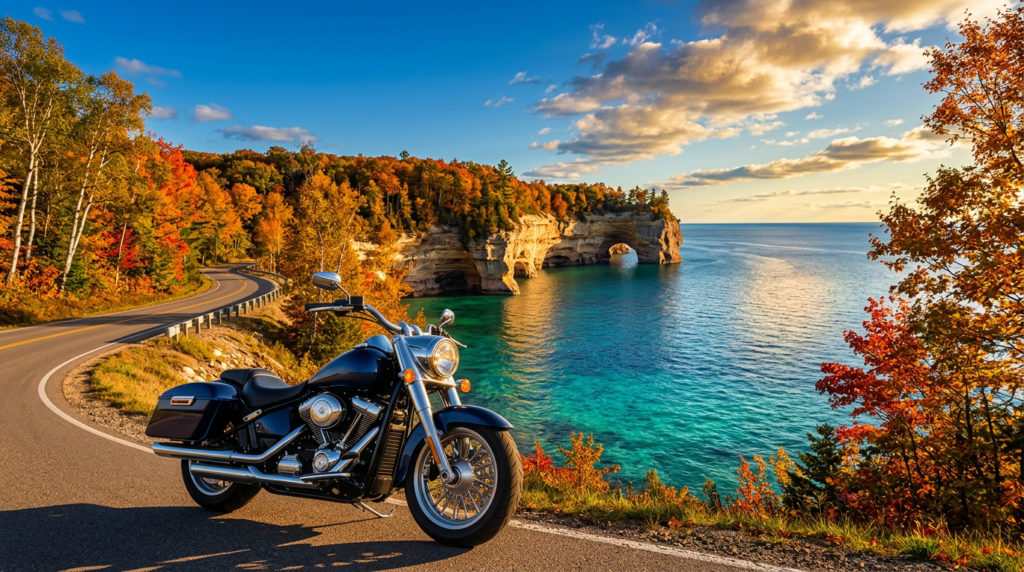
Michigan motorcycle insurance at a glance:
Default: 250/500
No Standard PIP
Helmet Requirement
Michigan riders deal with one of the strangest insurance setups in the country. You absolutely need motorcycle liability coverage to ride legally here, but your bike policy is not the same thing as Michigan no-fault car insurance. That means a rider can be legal, paid up, and still misunderstand what the policy will actually cover after a crash. Add Michigan’s default bodily-injury limits, the helmet-law medical-benefit requirement, the Secretary of State’s insurance-verification system, and the way PIP can still appear when a motorcycle collides with a motor vehicle, and you get a state where the fine print matters more than most people think.[1, 2, 3, 4, 6, 7]
If you ride in Metro Detroit, Grand Rapids, or northern Michigan, the useful question is not just “What is the minimum?” It is “What does the policy actually pay after a left-turn crash, a deer hit, or a bike-only slide?” This guide answers that with live links to the statutes and agency pages that control the rules.[1, 10, 22, 23]
Michigan’s legal minimums are only the first layer
Under Michigan law, the owner or registrant of a motorcycle has to maintain liability security that conforms to the state’s bodily-injury and property-damage rules. DIFS’s motorcycle guide summarizes the current minimum motorcycle liability floor as $50,000 for bodily injury or death to one person, $100,000 per accident if multiple people are hurt or killed, and $10,000 for property damage. The controlling statute is MCL 500.3103, which says motorcycle liability security has to conform to MCL 500.3009(1).[1, 2]
Here is the part many riders miss: Michigan’s liability framework does not default to the bare 50/100 level. DIFS’s bodily-injury guidance and the state-approved selection form say policies are generally issued at $250,000 per person / $500,000 per accident unless the insured signs the state form choosing lower limits. In other words, 50/100 is the lowest limit you may intentionally select, not the automatic default. That matters because some Michigan quotes look cheap only because the rider already signed down without fully appreciating what they gave up.[3, 4]
Also crucial: a Michigan motorcycle policy does not include the standard Personal Injury Protection package people associate with Michigan no-fault auto insurance. Motorcycles are specifically excluded from the no-fault definition of “motor vehicle” for that purpose. Instead, the insurer must offer first-party medical benefits in $5,000 increments. Those optional medical benefits matter far more in Michigan than they do in many states, because they are the motorcycle-side substitute when no auto PIP is available and because they are built directly into Michigan’s helmet-law exception.[1, 2]
Coverage Breakdown: What’s Actually Required
| Coverage | Required? | Michigan Minimum/Rule | What It Does |
|---|---|---|---|
| Bodily injury liability | Yes | $50,000 per person / $100,000 per accident (lowest selectable floor); default generally $250,000 / $500,000 | Pays injury claims made by others when you are legally responsible |
| Property damage liability | Yes | $10,000 | Pays property-damage liability claims from motorcycle use |
| Standard no-fault PIP | No | Not included in motorcycle policy | Michigan’s biggest quirk: bike policy is not standard no-fault auto |
| First-party medical benefits | Insurer must offer | $5,000 increments; at least $20,000 required for helmetless riding | Helps pay your medical expenses when no other coverage available |
| Uninsured/underinsured motorist | No | Not in required minimums | Optional, but smart add-on in Michigan |
| Collision/comprehensive | No | Optional | Protects bike against crash, theft, fire, weather, deer strikes |
The short version is this: in Michigan, “state minimum” mainly means liability for damage you cause to somebody else. It does not mean a full no-fault package for you, your bike, your gear, or your wages. That is the mistake to avoid when you compare quotes here.[1, 2, 3, 4]
Proof of insurance in Michigan: roadside rules, phone screens, and EIV
Michigan expects riders to be able to show proof of insurance. Under MCL 257.328, a certificate of insurance can be produced in paper or electronic form, and the statute expressly allows an officer to view an electronic copy. Secretary of State guidance separately tells Michigan motorists to keep the insurance certificate in the vehicle or carry it while driving; on the same page, SOS notes that motorcycles need Michigan insurance coverage even though it does not have to be standard no-fault insurance.[5, 6]
For plate renewals, Michigan uses the Electronic Insurance Verification (EIV) system. SOS says some insurers verify coverage through EIV, which updates Secretary of State records and can eliminate the need to mail or upload separate proof at renewal. The catch is that auto insurers are required to participate, while insurers are only encouraged to report motorcycles. If your motorcycle insurer does not participate, you may still need to renew by mail or in person and provide proof directly.[6, 7]
There is an important difference between not having proof with you and actually being uninsured. A failure to produce proof at the roadside is handled under the Vehicle Code proof-of-insurance rule. By contrast, if the bike is truly uninsured, MCL 500.3102 makes operation a misdemeanor, and the failure to produce proof creates a rebuttable presumption that the required security was not in effect. SOS also warns that failing to present insurance while driving can trigger license suspension, plate cancellation, and vehicle impoundment consequences, so this is not a paperwork issue worth treating casually.[2, 5, 6]
Michigan law offers some relief if you were actually insured and later produce valid proof before the appearance date, but that cure provision does not help a rider who was uninsured in the first place.[5]
What happens if you ride uninsured in Michigan
Uninsured Operation = Criminal Offense
Riding without insurance is not a simple traffic ticket in Michigan — it’s a misdemeanor carrying serious consequences.
Michigan treats uninsured motorcycle operation as a criminal offense, not a cheap administrative inconvenience. Under MCL 500.3102(2), an owner or registrant who operates, or permits operation of, an uninsured motorcycle on a public highway is guilty of a misdemeanor. The statute allows a fine of $200 to $500, up to one year in jail, or both, and DIFS says the court may also suspend the rider’s license for 30 days or until valid proof of insurance is produced.[2, 17]
False proof makes things worse. Michigan law says a person who supplies false information to the Secretary of State or issues or uses an altered, fraudulent, or counterfeit certificate of insurance can face up to one year in jail, a fine up to $1,000, or both. And if you are an out-of-state rider who operates in Michigan for more than an aggregate of 30 days in a calendar year, the same chapter says you must maintain the required security here as well.[2]
Getting back on the road is not automatic. SOS says the standard driver’s-license reinstatement fee is $125, and riders dealing with an unpaid crash judgment may also need to satisfy the judgment or file a partial-payment agreement plus proof of financial-responsibility insurance before a restricted license is possible.[18, 19]
What the minimum policy really covers in a Michigan crash
Picture a common Michigan wreck. You are riding near Grand Rapids, a car turns left across your lane, and you dump the bike trying to avoid the bumper. The minimum liability part of your motorcycle policy is there to pay other people’s injury or property claims if you are legally at fault. It is not there to rebuild your bike, replace your helmet and jacket, or automatically pay your own medical bills the way many people assume “Michigan no-fault” works.[1, 2]
The gap gets even sharper in a deer strike or single-bike crash. If no motor vehicle is involved, DIFS says the injured motorcyclist turns to a health plan or to the first-party medical benefits purchased with the motorcycle policy. No standard motorcycle PIP appears just because the crash happened in Michigan.[1]
That matters because Michigan is rough on motorcycles in very state-specific ways. The Office of Highway Safety Planning says Michigan had more than 58,000 vehicle-deer crashes in 2024, and Michigan Traffic Crash Facts reports 291 motorcycles involved in deer-related crashes and seven motorcyclist deaths that year. III’s current state table also estimates that 22.3% of Michigan motorists were uninsured in 2023. In a state with that mix of deer exposure, uninsured drivers, and a short riding season, minimum-only coverage is unusually thin.[22, 23, 24]
There is one Michigan-specific safety valve. If the crash involves an insured motor vehicle, the injured motorcyclist can claim PIP benefits from the motor-vehicle side, subject to Michigan’s priority rules and the applicable auto policy’s selected PIP limit; if no PIP is available in priority, the rider may seek up to $250,000 through the Michigan Assigned Claims Plan. That helps in bike-versus-car crashes. It does nothing for the deer strike or bike-only crash that never touches a motor vehicle.[1, 14]
Coverage upgrades that make sense for Michigan riders
Higher liability limits
If you signed down to 50/100, rerun the quote at a stronger tier such as 100/300/100 and at Michigan’s default 250/500 level. Severe injury claims get expensive fast, and Michigan already assumes higher limits unless you choose lower ones on the approved form.[3, 4]
Collision
Collision pays for the motorcycle after an impact regardless of fault. In Michigan, it matters because many rider losses involve disputed fault, a deer-avoidance crash, or no second driver worth pursuing.[15, 16]
Comprehensive
Michigan makes comprehensive easy to justify: deer, theft, fire, storm damage, and winter-storage losses are real. SOS also says storage-only comprehensive policies are not part of EIV road-use verification, so winter storage coverage is not the same thing as spring-ready insurance.[7, 22, 23]
Uninsured and underinsured motorist coverage
UM/UIM is not part of Michigan’s required motorcycle minimums, but it is exactly the sort of coverage that earns its keep here. III’s current state table puts Michigan’s estimated uninsured-driver rate at 22.3% for 2023, which is hard to ignore if you ride in traffic regularly.[24]
First-party medical benefits or other supplemental medical coverage
On a Michigan motorcycle policy, this is the line many riders underbuy. The law only requires insurers to offer first-party medical benefits in $5,000 increments, and at least $20,000 becomes a legal requirement for operators who want to ride without a helmet.[1, 2, 12]
Custom parts, accessories, and riding-gear coverage
Hard bags, heated gear, comms, upgraded seats, windscreens, and crash protection add up quickly. Ask what accessory cap is built into the policy before you assume the bike is insured for what is actually bolted to it.
Motorcycle-specific roadside assistance
Buy roadside assistance that explicitly covers motorcycles, not a generic auto-club add-on. Michigan riders routinely end up far from home on two-lane roads where a bad tow can create a second loss.[22, 23]
Trip interruption
This matters more in Michigan than it first appears. If a covered loss strands you in St. Ignace, Munising, or Petoskey, hotel and meal reimbursement can pay for itself quickly.
Gap insurance
If the motorcycle is financed, gap coverage protects you from still owing money after a total loss that pays only actual cash value.
Seasonal lay-up or storage coverage
Ask whether the carrier offers real lay-up coverage and what stays active while the bike is parked. Letting the policy lapse entirely is the wrong way to save money if you still want theft, fire, or weather protection.[6, 7]
Michigan’s helmet law is conditional, and insurance is written into the rule
Michigan is not a universal-helmet state, but it is not a free-choice helmet state either. Under MCL 257.658(5), a motorcycle operator may ride without a helmet only if the operator is at least 21, carries at least $20,000 in first-party medical benefits, and has either held a motorcycle endorsement for at least two years or passed an approved motorcycle safety course. A passenger may ride without a helmet only if the passenger is at least 21 and at least $20,000 in first-party medical benefits is in effect in addition to the insurance required of the operator, unless the passenger has qualifying coverage of their own.[1, 10, 12]
Insurance Tied to Helmet Exception
The helmet exception is not just an age or experience rule — it’s a medical-benefits rule. Michigan has effectively tied the legal right to ride helmetless to proof of baseline first-party medical coverage.
That insurance hook is what makes Michigan different. The helmet exception is not just an age rule or an experience rule; it is a medical-benefits rule. Michigan has effectively tied the legal right to ride helmetless to proof that somebody has at least a baseline layer of first-party medical coverage in place.[1, 10, 12]
And the financial stakes are not abstract. In March 2026, Michigan Medicine reported University of Michigan research finding that Michigan’s 2012 repeal of universal motorcycle helmet use was associated with a 26% increase in average inpatient crash costs, roughly $5,785 more per crash patient in inflation-adjusted terms. Even if a carrier does not explicitly ask whether you plan to ride helmetless, the state’s own legal framework already treats that choice as something that requires extra medical protection.[25]
Lane splitting is still illegal here, and the smaller road rules matter
Michigan’s current motorcycle traffic rule is straightforward: the bike gets the full lane, but it does not get California-style lane splitting. MCL 257.660 still says a person operating a motorcycle “shall not pass between lines of traffic,” and there is no separate stoplight filtering exception in current law as of March 2026.[11]
- Lane splitting: Illegal. Michigan’s current statute still bars passing between lines of traffic.[11]
- Lane filtering at stops: Not separately legalized. The same current statute is why riders should treat stop-and-go filtering as prohibited.[11]
- Lane position: A motorcycle is entitled to full use of a lane, and motorcycles may not ride more than two abreast in one lane.[11]
- Expressways and limited-access highways: The motorcycle needs at least a 125 cc engine to use them.[10]
- Eye protection: If you are riding faster than 35 mph without a windshield, you need transparent goggles, eyeglasses, or a face shield that protects against debris.[10]
- Passengers: The motorcycle cannot carry more people than it was designed and equipped to carry, and passengers need proper seats and footrests or pegs.[10, 12]
- Handlebars: Michigan caps handlebar height at 30 inches from the lowest point of the undepressed saddle to the top of the grips.[10]
- Packages and cargo: You may not carry anything that prevents keeping both hands on the handlebars.[10]
- Lighting and equipment: Michigan requires the motorcycle to be properly equipped with lights, reflectors, brakes, horn, muffler, mirrors, and legal tires under the Vehicle Code equipment provisions.[10]
- Noise: The operator guide lists motorcycle sound limits of 82 dB on streets posted 35 mph or less and 86 dB on higher-speed streets.[10]
The licensing detail insurers care about is the CY endorsement
To legally operate a motorcycle on public roads in Michigan, you need a CY motorcycle endorsement on your license. Michigan gives riders two main paths: complete an approved Michigan Rider Education Program (MI-REP) course, or obtain a Temporary Instruction Permit (TIP), practice for up to 180 days under Michigan’s restrictions, and then pass a Rider Skills Test. The endorsement fee is $16; TIP riders cannot ride at night or carry passengers and must stay under the constant visual supervision of a licensed motorcyclist who is at least 18; and riders under 18 must complete the motorcycle safety course. MI-REP’s own FAQ also says successful completion may qualify the rider for an insurance discount with some insurers.[8, 21]
Motorcycles, mopeds, scooters, and e-bikes are not interchangeable in Michigan
Michigan does not let dealers, riders, or marketplace listings define these vehicles by vibe. The legal classification follows the statute and Secretary of State rules, and insurance eligibility follows the classification. That is why a “scooter” with the wrong performance specs can quietly become a motorcycle for endorsement and insurance purposes.[1, 9, 13]
| Vehicle Type | Michigan Definition | Insurance Required? | License/Endorsement Required? |
|---|---|---|---|
| Motorcycle | Seat-or-saddle vehicle with not more than three wheels; motor exceeding 50 cc; machines capable of more than 30 mph treated as motorcycles rather than mopeds | Yes. Michigan motorcycle liability coverage required.[1, 2] | Yes. CY motorcycle endorsement for public-road operation.[8, 9] |
| Moped | Engine displacement not exceeding 100 cc, no manual gearshift, top speed 30 mph or less on level surface | Not as a motorcycle. If exceeds moped definition, becomes motorcycle and must be insured as one.[9] | Moped license or standard/enhanced/chauffeur’s license, or qualifying GDL privilege.[8, 9] |
| Scooter | Not a separate legal category. Treated as either a moped or motorcycle depending on size and performance | Depends on whether it qualifies as moped or motorcycle.[9] | Depends on whether it qualifies as moped or motorcycle.[9] |
| E-bike | Electric bicycle under Michigan law; class-based rules apply; Class 3 may not be operated by person under 14 | No motorcycle insurance requirement.[13] | No motorcycle endorsement; Class 3 age limits apply.[13] |
How Michigan’s insurance system changes a motorcycle claim
Michigan is a no-fault state for automobiles, but motorcycle insurance works beside that system instead of inside it. The motorcycle policy itself does not carry standard PIP. So the claim path depends heavily on what the bike hit. If the motorcycle is involved in a crash with an insured motor vehicle, DIFS says the injured rider is entitled to PIP benefits from the insurer of the motor vehicle, and the amount available is tied to the selected PIP limit on that auto policy. That is a very Michigan result: your bike policy does not carry auto-style PIP, but a car’s policy can still pull you back into the no-fault system after a motorcycle-versus-car crash.[1, 14]
If no PIP is available in the statutory priority chain, the rider may seek up to $250,000 in PIP benefits from the Michigan Assigned Claims Plan. If no motor vehicle is involved at all, DIFS says the injured motorcyclist generally turns to a health plan or the first-party medical benefits purchased on the motorcycle policy. This is why a Michigan deer strike, a solo lowside, and a bike-versus-car collision can feel like three completely different insurance events even though they all happened in the same state.[1, 14]
Fault still matters after that. Under MCL 600.2959, a court reduces damages by the plaintiff’s percentage of comparative fault. And under MCL 500.3135, noneconomic damages are assessed on comparative fault principles but are barred entirely if the claimant is more than 50% at fault. So a rider who was speeding, making an unsafe pass, or doing something the defense can frame as the majority cause of the crash may see a pain-and-suffering claim cut down or wiped out even when the injuries are severe.[15, 16]
Michigan has another quirk that surprises riders at billing time: motorcycle insurers are still assessed by the Michigan Catastrophic Claims Association (MCCA). DIFS explains why. Even though motorcycle policies do not include standard PIP, motorcyclists can still receive PIP medical benefits when they are injured in accidents involving motor vehicles, so the system still charges motorcycle insurers an MCCA assessment that is typically passed through to the policyholder.[17]
What drives motorcycle insurance cost in Michigan
- Rider age and years licensed: Younger or newly endorsed riders usually pay more, especially on performance bikes
- Bike type and engine size: A supersport, big ADV bike, or high-value touring model prices differently from a smaller standard or cruiser
- Experience and CY endorsement history: Michigan’s endorsement structure gives insurers a clean signal about how long you have been legally riding.[8, 21]
- Safety-course completion: MI-REP says course completion may qualify you for an insurance discount with some insurers.[21]
- Driving record and claims history: Tickets, at-fault claims, and prior losses all move the number
- ZIP code and garaging location: Metro Detroit pricing pressures are not the same as those in Traverse City, Alpena, or the U.P.
- Annual mileage and use pattern: Daily commuting, pleasure-only use, and long seasonal touring do not price the same
- Coverage structure: First-party medical limits, collision and comprehensive deductibles, UM/UIM, and accessory coverage can change the quote fast
- Storage situation: Locked garage, winter lay-up, and theft exposure all matter in a state with a long off-season
- Bundling and payment method: Multi-policy and paid-in-full discounts are still worth checking on every Michigan quote
How to compare Michigan motorcycle quotes without getting fooled by the paperwork
- Quote at more than one liability tier. Run the numbers at the legal floor, at a stronger tier such as 100/300/100, and at the default 250/500 level so you can see the real premium gap rather than guessing.[3, 4]
- Hold deductibles constant. A “cheaper” Michigan quote is often just a higher collision or comprehensive deductible wearing a discount costume
- Ask exactly how much first-party medical coverage is on the motorcycle policy. In Michigan, that line matters more than riders expect because the bike policy is not standard PIP.[1, 2]
- If you plan to ride without a helmet, verify the legal medical-benefit threshold. The operator needs at least $20,000 in first-party medical benefits, and passengers have their own rule.[1, 10, 12]
- Ask how the carrier handles aftermarket parts, OEM parts, and accessory caps. That matters on bikes with luggage, electronics, protection parts, and comfort upgrades
- Confirm any winter storage option in writing. A comprehensive-only storage setup can protect the parked bike, but SOS’s EIV FAQ makes clear that storage-only policies are not the same thing as active road-use insurance.[7]
- Check financial strength and discounts. Look at AM Best or comparable strength ratings, ask about bundle and paid-in-full discounts, and ask whether MI-REP completion helps on the rate.[21]
- Check complaint history before you bind. Michigan publishes complaint statistics through DIFS, and it is one of the better ways to spot carriers that look great in a quote engine and miserable in the claims department.[20]
Frequently asked questions about Michigan motorcycle insurance
Do I need motorcycle insurance in Michigan?
Yes. Michigan requires motorcycle liability coverage, and DIFS summarizes the current minimum as 50/100/10. The part riders often miss is that this is motorcycle liability coverage, not the standard no-fault auto package people usually mean when they say “Michigan insurance.”[1, 2]
Is the state minimum enough?
Usually not. Minimum liability mostly protects other people from damage you cause; it does very little for your own bike, gear, or medical exposure in a bike-only crash. In Michigan, deer risk, uninsured drivers, and the lack of standard motorcycle PIP make minimum-only coverage thinner than it looks.[1, 22, 23, 24]
Does Michigan’s no-fault / PIP law apply to motorcycles?
Not the same way it applies to cars. A motorcycle policy does not include standard PIP, but a motorcyclist injured in a crash involving an insured motor vehicle can still receive PIP benefits from the motor-vehicle side under Michigan’s priority rules.[1, 14]
What happens if I ride without insurance in Michigan?
Under MCL 500.3102, it is a misdemeanor punishable by a $200 to $500 fine, up to one year in jail, or both. DIFS also says the court may suspend your license for 30 days or until you provide valid proof of insurance.[2, 17]
Do mopeds and scooters need insurance in Michigan?
A true moped does not follow the same rules as a motorcycle. But a “scooter” is not its own legal category in Michigan; if it exceeds the moped definition, it becomes a motorcycle and then the insurance and CY endorsement rules apply.[9]
Does a motorcycle safety course lower my insurance rate?
Sometimes. Michigan’s MI-REP FAQ says successful completion may qualify you for an insurance discount with some insurers, but you should ask each carrier to price that discount explicitly.[21]
What if my bike is financed or leased?
The state only requires liability coverage, but lenders usually require collision and comprehensive too. Gap coverage is also worth checking if the loan balance is higher than the bike’s actual cash value.
Does Michigan require uninsured or underinsured motorist coverage on motorcycle policies?
No. Michigan’s required motorcycle minimums do not include UM/UIM. But with an estimated 22.3% uninsured-driver rate in 2023, many riders should price it before they dismiss it.[1, 24]
Can I legally ride without a helmet in Michigan?
Yes, but only if you meet Michigan’s conditions. The operator must be at least 21, carry at least $20,000 in first-party medical benefits, and either have held a motorcycle endorsement for at least two years or have passed an approved motorcycle safety course; helmetless passengers have their own $20,000 rule as well.[1, 10, 12]
Is lane splitting or lane filtering legal in Michigan?
No. Michigan’s current statute says a person operating a motorcycle shall not pass between lines of traffic, and there is no separate stoplight-filtering exception in force as of March 2026.[11]
Why does my motorcycle insurer mention the MCCA even though my bike policy has no standard PIP?
Because Michigan motorcyclists can still receive PIP medical benefits when they are injured in crashes involving motor vehicles. DIFS says motorcycle insurers are assessed by the MCCA for that reason, and the cost is typically passed through to the policyholder.[17]
Official Michigan sources and where to verify this yourself
The inline numbered citations above are live links to the statutes, agency pages, and supporting data used throughout the article. For a quick verification stack, start with these official Michigan sources:
- Michigan Department of Insurance and Financial Services — Riding a Motorcycle in Michigan / motorcycle insurance quick facts
- Michigan Legislature — Insurance Code Chapter 31 (including MCL 500.3102 and 500.3103)
- Michigan Department of State / Secretary of State — Motorcycle endorsement and Motorcycle riders
- Michigan Department of State / Secretary of State — License plates and tabs and Electronic Insurance Verification (EIV) FAQ
- Michigan Legislature — MCL 257.658 (helmet law) and MCL 257.660 (lane use and lane splitting ban)
- Michigan Department of Insurance and Financial Services — Complaint statistics
This article is written for March 2026. If you update it later, re-check the official sources above before changing limits, no-fault language, or registration-related insurance rules.
Sources and References
- Michigan Department of Insurance and Financial Services — Riding a Motorcycle in Michigan
- Michigan Legislature — Insurance Code Chapter 31 (MCL 500.3102, 500.3103)
- Michigan Department of Insurance and Financial Services — Choosing bodily injury coverage
- Michigan Department of Insurance and Financial Services — Choice of BI Liability Coverage Limits Form
- Michigan Legislature — MCL 257.328 (proof of insurance)
- Michigan Department of State — License plates and tabs
- Michigan Department of State — Electronic Insurance Verification (EIV) FAQ
- Michigan Department of State — Motorcycle endorsement
- Michigan Department of State — Motorcycle riders
- Michigan Department of State Police — Michigan Motorcyclist Laws Guide for Operators
- Michigan Legislature — MCL 257.660 (lane use and lane splitting)
- Michigan Legislature — MCL 257.658 (helmet law)
- Michigan Legislature — MCL 257.662A (electric bicycles)
- Michigan Legislature — MCL 500.3114 (PIP priority for motorcyclists)
- Michigan Legislature — MCL 600.2959 (comparative fault)
- Michigan Legislature — MCL 500.3135 (noneconomic damages and comparative fault)
- Michigan Department of Insurance and Financial Services — Frequently Asked Questions
- Michigan Department of State — License reinstatement fee
- Michigan Department of State — Financial responsibility and restricted licenses FAQ
- Michigan Department of Insurance and Financial Services — Complaint statistics
- Michigan Department of State — Michigan Motorcycle Rider Education Program (MI-REP) FAQ
- Michigan Department of State Police — Vehicle-deer crashes
- Michigan Traffic Crash Facts — Deer-related crashes (2024)
- Insurance Information Institute — Michigan insurance statistics
- Michigan Medicine — Motorcycle helmet repeal and hospital cost impact study
Last verified: April 23, 2026. Related update: Michigan Helmet Law Repeal Raised Hospital Costs.