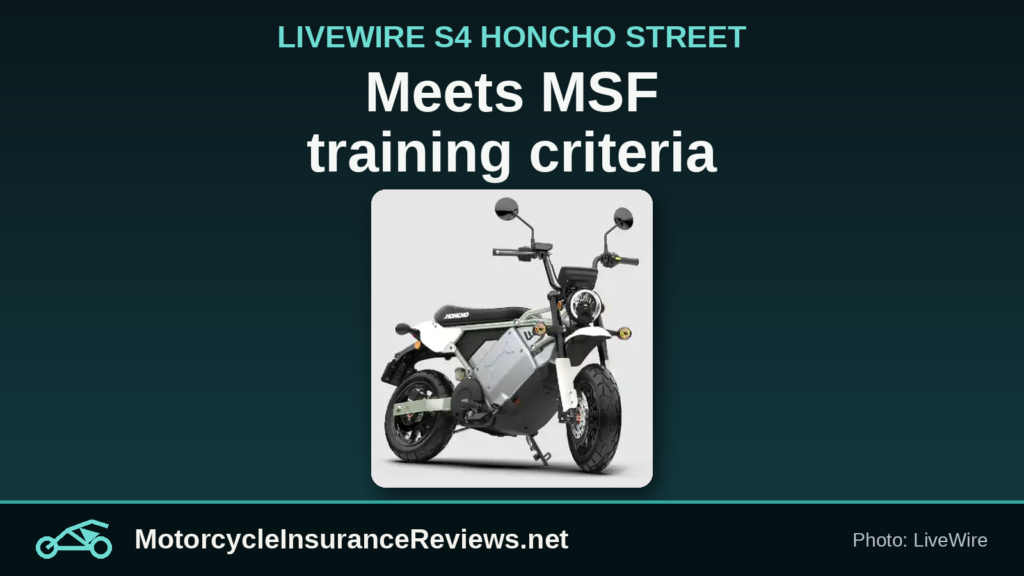
Learning to ride usually means juggling a clutch, a shifter, a throttle and two brakes all at once. LiveWire thinks an electric motorcycle with none of the first two could make that first day easier, and on October 2, 2026 it said the S4 Honcho Street meets the Motorcycle Safety Foundation’s criteria for use in rider-training programs.
That’s a real announcement, but it’s narrower than the headline sounds. It doesn’t mean your local MSF-based course now teaches on Honchos, or that you can skip a license test. Here’s what LiveWire said, what it didn’t, and how to find out whether you can actually learn on one.
The short version
- The announcement: LiveWire (NYSE: LVWR) says the S4 Honcho Street meets the MSF’s criteria for rider-training use and “will join the training lineup.”
- The MSF part: Corey Eastman, the MSF’s Director of Rider Education Expansion, says the Honcho will join the MSF RiderCoach Tour training demo fleet.
- The bike: 266 lb curb weight, a seat height under 30 inches, an electric powertrain with no clutch or shifting.
- Training speed settings: profiles capped at 18 mph and 28 mph, which LiveWire compares to first- and second-gear learning conditions.
- Range claim: up to 73 miles at 20 mph, with swappable batteries.
- What isn’t announced: specific classes, schools, schedules, tuition or any change to your state’s licensing rules.
What “meets MSF criteria” means
LiveWire says the Honcho Street “meets all three primary MSF qualification criteria, including power output, weight, and seat height.” The release doesn’t print those thresholds. So the accurate statement is that LiveWire says it meets them, and that MSF’s own representative described the bike as joining a demo fleet for the RiderCoach Tour.
That’s an important distinction. A demo fleet gives MSF coaches a chance to try the bike in several training exercises. Eastman’s quote says the move broadens “the range of options available to training providers as they consider motorcycles for their programs.” Considering is not the same as adopting. The announcement doesn’t claim that any training provider has bought a Honcho, scheduled a class on one or will.
The bike, in the numbers LiveWire gave
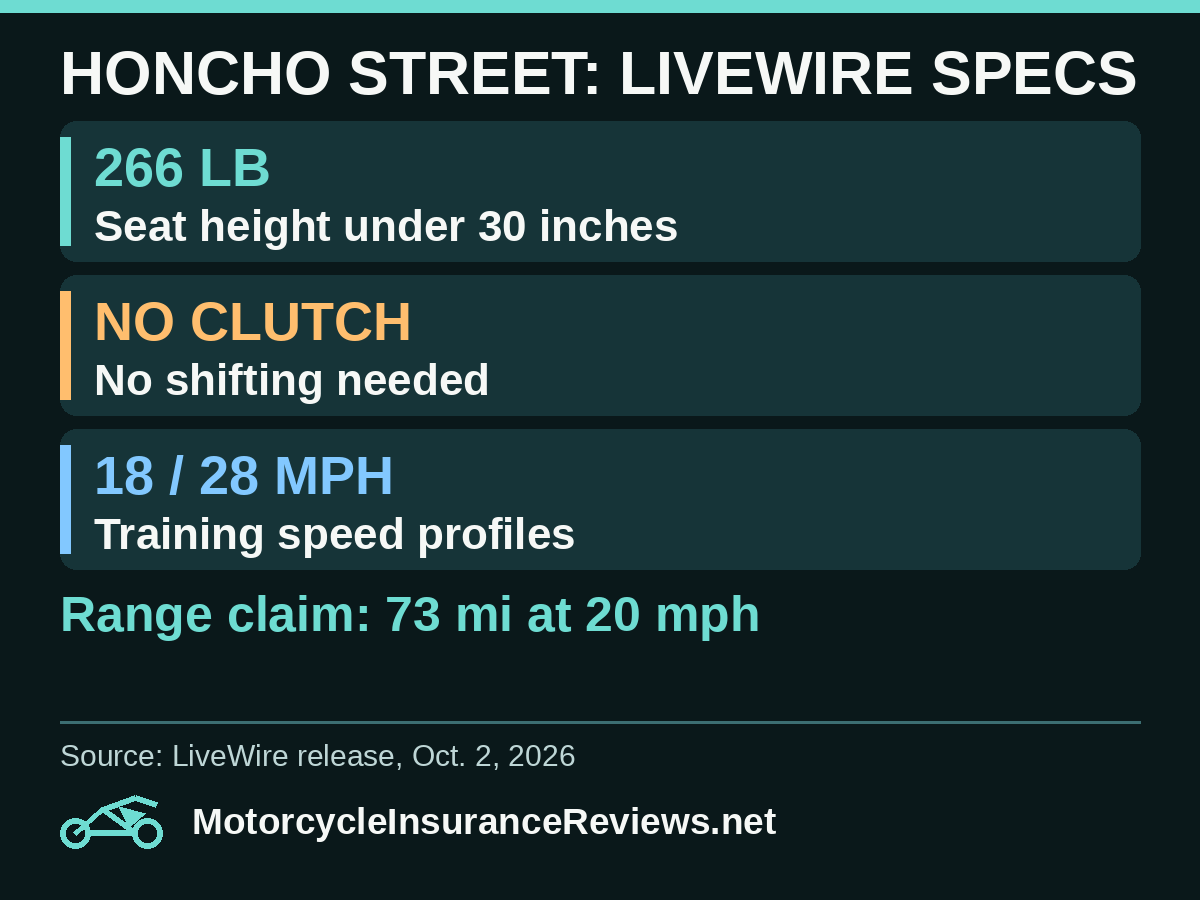
- Weight: 266 pounds. LiveWire says that helps with the low-speed maneuvers that make up much of an entry-level course.
- Seat height: under 30 inches.
- Controls: a fully electric powertrain with no clutch lever and no shifting.
- Speed profiles: “tuned top speed profiles equivalent to first- and second-gear learning environments: 18 mph and 28 mph.”
- Range: “up to 73 miles of range at 20 mph,” with swappable batteries LiveWire says support full-day training sessions.
- Operator extras: simple charging, a vehicle protection kit and fleet management for training operators.
LiveWire’s own S4 Honcho product page, checked October 4, adds context the release leaves out. It lists the Street at $5,499 with a “coming soon” label (the Trail is $4,999 and “available now”), a 59 mph top speed, a 53-mile range under World Motorcycle Test Cycle standards, and a 29-inch laden seat height for the Street. The page lists 30 inches for the Trail. Ask a provider about the actual bike and rider fit.
Read the speed and range numbers carefully. The 18 and 28 mph figures are training settings, not the bike’s normal top speed. And the 73-mile figure is a manufacturer’s claim at a steady 20 mph, a pace that suits a parking-lot course and nothing like highway riding. The release doesn’t give a highway range or say how many hours a training day needs.
Why a clutch-free bike matters for new riders
LiveWire’s pitch is that riders coming from e-bikes and electric scooters may find a motorcycle without a clutch more familiar. Jon Bekefy, LiveWire’s Head of Commercial, says it “removes traditional barriers to entry.” The company argues that with throttle, clutch and shifting all in play at once, new riders can spend their first hours managing the machine rather than learning the road skills.
That reasoning is plausible, and it’s LiveWire’s. The release cites no study, no crash data and no measured improvement in how quickly students learn or how safely they ride. It is a company’s expectation that a simpler bike will help. Whether it does in practice is something training providers will find out, if they adopt it.
What it means for getting your license
Here’s where to be careful. This announcement is about a training motorcycle. It isn’t about licensing. The release doesn’t say anything about:
- State licensing rules. Whether a skills test or course taken on an electric, clutch-free bike earns the same motorcycle endorsement as one taken on a conventional bike is a state-by-state question. Check with your DMV or motor vehicle agency, and with the course provider.
- Restrictions. Some states or providers might place conditions on a license earned on a bike without a clutch. The release says none of this, so don’t assume either way.
- Insurance. Nothing in the announcement mentions insurance discounts for completing a course on the Honcho. If you’re asking whether a course lowers your premium, ask your insurer which courses it recognizes.
How to find out if you can learn on one
- Ask your local training provider whether it has the S4 Honcho or plans to. As of the announcement, there’s no list.
- Look for MSF RiderCoach Tour dates. MSF says the Honcho joins the touring demo fleet, which means coaches will try it, but the release doesn’t give tour stops.
- Check LiveWire’s dealer locator (livewire.com/locations) if you want to see a Honcho in person. LiveWire gives that page for dealership locations.
- Confirm what the course counts toward. Ask whether finishing it satisfies your state’s license requirements, and on which type of bike.
What we don’t know
- Which training providers will use the Honcho, and when.
- MSF’s exact qualification thresholds. LiveWire names the criteria (power output, weight, seat height) but not the numbers.
- Whether the Honcho Street’s “tuned” speed profiles are selectable by providers or fixed. The release describes them but not how they’re set.
- Real-world range in a training day. The 73-mile figure is a claim at 20 mph.
- How a license earned on this bike is treated by your state.
- When the Street ships. LiveWire’s page says “coming soon.” Training-provider pricing isn’t stated.
- Any effect on crash rates or learning outcomes. No data is cited.
One further note on sourcing: the announcement was issued by LiveWire through Business Wire, and the reading here relies on a full copy of that release. The article reports LiveWire’s statements and the MSF quote it contains, and MIR has not independently confirmed the MSF arrangement.
Bottom line
LiveWire says the S4 Honcho Street meets MSF’s rider-training criteria and will join MSF’s RiderCoach Tour demo fleet. That’s a useful step toward electric training bikes, but not yet a place to sign up for a class on one. If a clutch-free training bike appeals to you, ask local providers about it and check your state’s licensing rules before you count on it.
References
- LiveWire, “S4 Honcho Meets Criteria for Motorcycle Safety Foundation Rider Training Programs” (Business Wire issuer release, October 2, 2026; full copy on Yahoo Finance) — MSF criteria statement, Corey Eastman quote, weight, seat height, 18 and 28 mph profiles and 73-mile claim at 20 mph.
- LiveWire, S4 Honcho product page (checked October 4, 2026) — Street $5,499 and “coming soon,” 59 mph top speed, 53-mile range, 73 miles at 20 mph sustained.