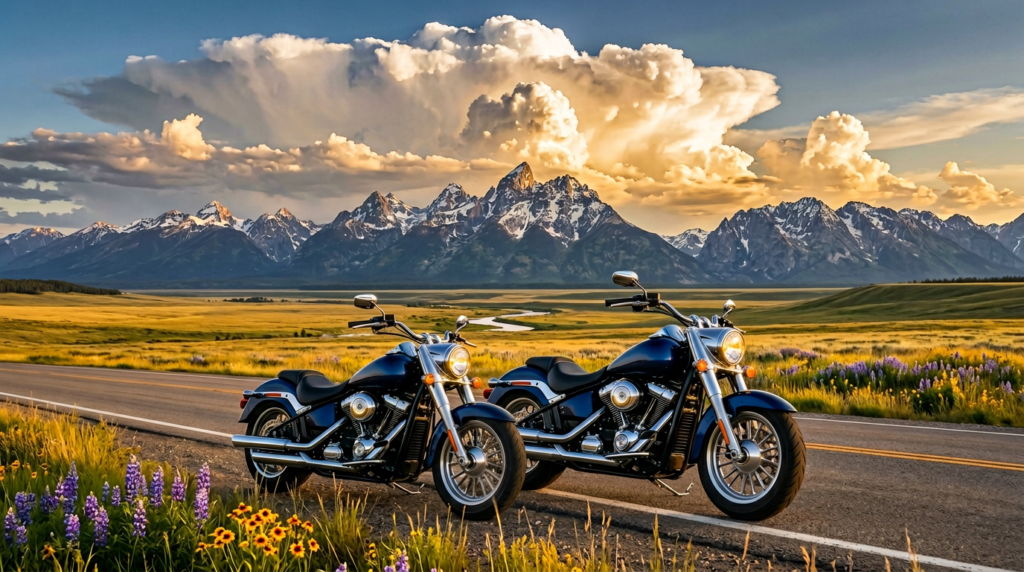
Montana motorcycle insurance at a glance:
UM + UMPD Included by Default
Not Full Coverage
Montana still lets a rider satisfy the law with 25/50/20. That keeps you legal. It does not repair your bike after a deer strike, pay your ER bill after a left-turn crash, or replace the luggage and gear that turned a stock motorcycle into a real Montana machine. Montana also has a rule many riders miss: uninsured motorist bodily injury coverage is built into the policy unless you reject it in writing.1, 3, 25, 28
This guide is for riders who want the practical version. You will see the exact minimum limits, how MTIVS lets officers verify coverage in real time, what happens on a second or third no-insurance conviction, how Montana’s partial helmet law works, why lane filtering is legal here but only on a short leash, and which coverage upgrades make the most sense on Montana roads.4, 5, 7, 8, 9, 28
Montana’s legal floor: 25/50/20, with uninsured motorist bodily injury included unless you opt out
Montana’s compulsory motorcycle insurance starts with liability coverage. Under Montana Code Annotated section 61-6-103, the minimum limits are $25,000 for bodily injury or death to one person in one accident, $50,000 for bodily injury or death to two or more people in one accident, and $20,000 for property damage in one accident. Section 61-6-301 makes it unlawful to operate a registered motor vehicle on roads open to the public without continuously providing at least that level of coverage, unless another statutory exception applies.1, 2
Montana also requires a motor vehicle liability policy to include uninsured motorist bodily injury coverage in those same 25/50 limits unless the named insured rejects it in writing. Many riders think of the minimum as only 25/50/20 liability. In Montana, the base policy normally also carries UM bodily injury unless you sign it away.[3]
What Montana does not do in these compulsory-insurance statutes is require a statewide motorcycle PIP or no-fault benefit, MedPay minimum, or UIM minimum as part of the legal floor. The required package is liability-based, with default UM bodily injury unless rejected. UIM, MedPay, collision, comprehensive, and accessory coverage are quote choices rather than part of the mandatory minimum.1, 3, 27
| Coverage | Montana minimum | Required to ride legally? | How Montana treats it |
|---|---|---|---|
| Bodily injury liability | $25,000 per person / $50,000 per accident | Yes | Set by MCA 61-6-103. |
| Property damage liability | $20,000 per accident | Yes | Set by MCA 61-6-103. |
| Uninsured motorist bodily injury | Same 25/50 bodily injury limits unless rejected | Included by default | MCA 33-23-201 requires it unless the named insured rejects it in writing. |
| PIP / no-fault benefits | No statewide motorcycle minimum in the compulsory-insurance statutes | No | Not part of Montana’s mandatory motorcycle-insurance floor. |
| Underinsured motorist (UIM) | No statewide minimum | No | Available by policy choice, not required by the minimum-limit statutes. |
| MedPay | No statewide minimum | No | Available by policy choice, not required by the minimum-limit statutes. |
Key Takeaway: Montana’s minimum is built to protect other people from losses you cause. It is not built to make a rider financially whole after a serious crash.1, 3, 25
Proof of insurance in Montana: paper card, phone screen, and a live database behind the stop
Montana lets you prove coverage with either a paper insurance card or an electronic document displayed on a phone or other device. Under section 61-6-302, the owner or operator has to show proof on demand to law enforcement, a justice of the peace, or a municipal judge. Montana also uses a statewide electronic verification system.4, 21
The system is the Montana Insurance Verification System, or MTIVS. State law directed the Department of Justice and the Commissioner of Securities and Insurance to establish it, and MVD says it uses registration and insurer records to provide up-to-the-minute liability verification. MVD also says the Montana Highway Patrol has used electronic verification during traffic stops since 2012.5, 21
Montana distinguishes between not having proof in hand and actually being uninsured. If you cannot show proof during the stop, you can still avoid a conviction under section 61-6-302 if MTIVS later shows valid insurance at the time or, if the system is unavailable, you later produce valid proof. If the bike was truly uninsured, the penalty statute is next.4, 7
Critical: Section 61-6-309 adds one more wrinkle: during a traffic stop or accident investigation, the MTIVS response generally supersedes the insurance card or phone display, subject to limited exceptions such as binders that have not yet been entered into the system. A valid-looking card does not win the argument if the state database says the coverage is gone.[6]
What happens if you ride uninsured in Montana
Montana’s penalty structure moves past fines and into registration and license consequences. Under section 61-6-304:
- First conviction: Fine of $250 to $500
- Second conviction: Fine of $350
- Third or subsequent conviction: Fine of $500, up to 10 days in county jail, or both[7]
On a second or subsequent conviction, the court must order the surrender of the vehicle’s plates and registration receipt, and the Department of Justice suspends the registration. The owner can then receive only a restricted registration receipt for 90 days after a second conviction or 180 days after a third or later conviction, and the statute limits that registration to employment purposes only. On a fourth or subsequent conviction, the court must also order surrender of the rider’s driver’s license, and the department suspends it until proof of compliance is filed and the person is otherwise eligible again. Montana counts prior no-insurance convictions within a five-year lookback period.[7]
MVD’s reinstatement guidance fills in the practical steps. After a second or later conviction, the state says you need to follow the court’s instructions, send proof of liability insurance to the Records and Driver Control Unit in Helena, purchase restricted registration and plates through the county treasurer, and then return after the 90-day or 180-day restriction period to remove the restriction.[22]
What Montana’s minimum policy actually covers — and what it leaves sitting on your side of the ledger
Picture a common Montana crash. You are riding through Billings or Bozeman, a driver turns left across your lane, and the impact sends you over the bars. Or you are out near dawn and a deer steps into the lane with no time to stop. Your 25/50/20 liability coverage does one job: it pays for the other person’s injuries and property damage when you are legally responsible, up to the policy limits. It does not automatically repair your motorcycle, replace your helmet and riding gear, or pay your own medical bills.1, 25
Montana’s Wildlife Reality: The Montana Department of Transportation says 13% of reported crashes in the state are wildlife-related, that collisions climb in spring and fall around dawn and dusk, that Montana ranks second nationally for the likelihood of a wildlife collision, and that MDT crews pick up more than 6,000 carcasses statewide each year. For a rider with liability only, a deer strike can mean a destroyed bike and no first-party coverage for the loss.[28]
Coverage upgrades that make real sense in Montana
Higher liability limits
A realistic step up from Montana’s minimum is 100/300/100. One multiple-injury crash or one new truck can run past 25/50/20 much faster than riders think, especially with property damage capped at only $20,000 under the minimum law.[1]
Collision coverage
Collision pays for damage to your bike when you hit another vehicle or object or overturn. If you low-side on gravel, slide into a guardrail, or hit a car that changes lanes into you, collision is the coverage that speaks for your motorcycle while liability is still being argued.[25]
Comprehensive coverage
In Montana, comprehensive is not filler. It is the coverage for animal strikes, theft, fire, and other non-collision losses. Given MDT’s wildlife numbers, comprehensive is one of the most rational upgrades a Montana rider can buy.25, 28
UM and UIM
Montana already includes uninsured motorist bodily injury coverage unless the named insured rejects it in writing. Keep it. UIM matters when the other driver has insurance, but not enough insurance, which is a real issue in a state where the liability floor is still 25/50/20.1, 3, 27
MedPay or supplemental medical coverage
Montana’s compulsory-insurance laws do not give motorcycle riders a built-in no-fault medical cushion. MedPay or another supplemental medical option can help with the ambulance, deductible, and first treatment bills while fault is still being fought out.1, 25, 27
Custom parts, luggage, and riding-gear coverage
Montana riders often add real utility to a bike: panniers, racks, GPS mounts, better lighting, upgraded suspension, heated gear, and tools. Those items add value that a bare actual-cash-value settlement may not fully capture unless the policy handles accessories clearly.[25]
Motorcycle-specific roadside assistance
Roadside assistance is only useful if it is built for motorcycles. Ask whether the plan includes a motorcycle-capable tow, whether there is a mileage cap, and whether it covers a non-collision disablement. “Roadside included” is not enough detail.[24]
Trip interruption
Montana riders do actual distance, not just short urban hops. Trip interruption can pay for lodging, meals, and transportation after a covered loss away from home, so the mileage trigger and dollar cap are worth checking before you treat it as real protection.[24]
Gap coverage
If the motorcycle is financed and the loan balance is still high, a total loss can leave the rider owing more than the bike’s actual cash value. Gap coverage is the clean fix for that difference.[25]
Laid-up or storage coverage
Montana’s riding season is not year-round for most riders, and MVD says motorcycle skills tests are offered only from April through November, weather permitting. Montana also permanently registers street-legal motorcycles. That makes storage coverage an important quote question: ask exactly what stays in force during lay-up and how the carrier expects you to handle the state’s continuous-insurance rule before the first spring ride.2, 23, 24
Helmet law in Montana: partial requirement, not a universal one
Montana is a partial-helmet-law state. Under section 61-9-417, operators and passengers under age 18 on a motorcycle, moped, motorized scooter, or quadricycle must wear protective headgear that meets Montana’s standard. A fully enclosed autocycle with a windshield, nonremovable doors, and a roof is exempt. The penalty for violating the helmet rule is $5 under section 61-9-518, and riders 18 and older are not subject to a statewide helmet requirement.8, 29
The insurance angle is more subtle than the fine. Montana law does not create a special adult helmet-coverage condition, but Montana does use comparative negligence. If an adult legally rides without a helmet and then suffers a head injury, the defense still has room to argue about avoidable harm and damage reduction.8, 19, 25
Lane filtering is legal in Montana — but only under narrow conditions
Montana is one of the few states that expressly allows lane filtering by statute. Section 61-8-392 lets a two-wheeled motorcycle pass a stopped or slow-moving vehicle in the same lane only when:
- The lanes are wide enough to permit safe passing
- The motorcycle is traveling no more than 20 mph while overtaking
- The vehicle being passed is stopped or moving no more than 10 mph
- Conditions are otherwise reasonable and prudent
That is a tightly defined filtering rule, not general lane splitting through moving traffic.9, 30
Other Montana motorcycle operation rules:
- Lights on: Montana requires motorcycles to operate with lights on at all times on a public roadway, with narrow exceptions.[10]
- Passenger rules: You can carry a passenger only if the motorcycle is designed for more than one person, and the passenger cannot interfere with operation or obstruct the rider’s view.[10]
- Hands on the bars: A rider may not carry a package or bundle that prevents keeping both hands on the handlebars.[10]
- Lane rights: Motorcycles are entitled to full use of a lane, and no more than two may ride abreast in a single lane.[10]
- Mirror rule: At least one mirror must provide a rear view of at least 200 feet.[11]
- Headlamps: A motorcycle must have at least one and not more than two headlamps.[12]
- Turn-signal distance: In an urban district, a signal must begin at least 100 feet before the turn; elsewhere the minimum is 300 feet.[15]
- Mufflers and noise: The bike must have a muffler in good working order with no cutout or bypass, and motorcycles manufactured after 1987 are subject to a 70 dB(A) limit measured at 50 feet.13, 14
License and endorsement basics that matter for insurance eligibility
Montana uses a motorcycle endorsement rather than a separate motorcycle-only license class for most riders. MVD says a rider needs a Montana driver’s license with a motorcycle endorsement to operate a motorcycle or motor scooter, and the state requires both a written test and a driving test unless a Montana-approved MSF Basic Rider Course is used to waive the driving test. MVD also notes that skills tests are offered only from April through November, weather permitting. Section 61-5-102 adds that an autocycle or a three-wheeled motorcycle does not require the motorcycle endorsement.16, 23
Motorcycle, moped, scooter, or e-bike? Montana’s definitions matter
Montana does not use these words loosely. The legal definitions change both insurance and licensing answers. One example matters a lot on quote forms: Montana’s statutory definition of a motorized scooter says it is a vehicle without a seat. A seated step-through machine that people casually call a scooter may actually be a motorcycle under Montana law.17, 18
| Vehicle type | Montana definition | Insurance required? | License required? |
|---|---|---|---|
| Motorcycle | A motor vehicle with a seat or saddle, designed to travel on not more than three wheels in contact with the ground; includes an autocycle; excludes bicycles, mopeds, and motorized scooters. | Yes. Montana’s compulsory-insurance law applies to registered motor vehicles, and motorcycles fall inside that definition. | Yes. A Montana driver’s license with a motorcycle endorsement is generally required, except for autocycles and three-wheeled motorcycles. |
| Moped | Two or three wheels, foot pedals, no more than 2 brake horsepower, no more than 30 mph on level ground without human help, and direct or automatic drive without clutching or shifting after engagement. | Not in the same way as a motorcycle. Montana’s motor-vehicle definition excludes mopeds, so the compulsory motor-vehicle liability rule does not apply to them the same way it applies to motorcycles. | Check with MVD before street use. The insurance statutes exclude mopeds from “motor vehicle,” but licensing materials are less concise than the insurance code. |
| Motorized scooter | A vehicle without a seat, designed to travel on not more than three wheels, powered by human force, a motor, or both, and capable of no more than 30 mph on a level surface. | Not in the same way as a motorcycle. Montana’s motor-vehicle definition excludes motorized scooters. | MVD says a motorcycle endorsement is required to operate motorcycles or motor scooters. |
| Electrically assisted bicycle / e-bike | A bicycle with two tandem wheels and an electric motor capable of propelling the vehicle and a 170-pound rider no faster than 20 mph on a paved level surface. | No motor-vehicle liability requirement appears in the cited compulsory-insurance statutes. | No motorcycle endorsement requirement appears in the cited licensing statutes. |
For an insurance website, this is one of the most useful Montana-specific distinctions to flag. Riders often use “scooter” as a style label. Montana uses it as a legal category, and the seat matters.17, 18, 23
How Montana’s fault system changes a motorcycle claim
For motorcycle claims, Montana operates on an at-fault liability model rather than a no-fault PIP model. The compulsory-insurance statutes require liability coverage, not a separate no-fault motorcycle benefit, and CSI’s consumer guidance explains claims in terms of comparative negligence and liability rather than automatic first-party no-fault payments. Fault still matters in Montana motorcycle cases.1, 2, 25
Montana uses modified comparative negligence. Under section 27-1-702, a rider’s own negligence does not bar recovery so long as it is not greater than the combined negligence of the people the rider is suing, but damages are reduced in proportion to the rider’s share of fault. A rider found more than 50% responsible can lose the claim entirely.[19]
Montana also has a stacking rule that matters when multiple bikes or multiple policies are involved. Section 33-23-203 says coverages under one policy or more than one policy issued by the same company generally may not be added together unless the policy specifically allows it, provided the premiums and filed rates properly reflect that limited coverage. If a rider owns more than one bike, the right question is whether the policy actually allows stacking, not whether multiple limits appear on the declarations page.[20]
What actually moves a Montana motorcycle premium
CSI notes that premium reflects factors such as driving history and household-driver risk, and Montana’s filing rules also allow insurers to use credit-based scoring models so long as those models are filed with the state. Beyond that, motorcycle quotes usually move with the bike itself, where it is garaged, how often it is ridden, and how much optional coverage the rider chooses.25, 27
- Rider age and experience
- Bike type and displacement
- ZIP code and garaging location
- Annual mileage and use pattern
- Driving and claims history
- Safety training
- Coverage limits and deductibles
- Accessory and equipment endorsements
- Credit-based insurance scoring
- Multi-policy and paid-in-full discounts
Montana-Specific Trap: Assuming the cheapest quote is cheap because the carrier “likes motorcycles.” Sometimes it is cheap because the coverage is thin, the accessory limit is low, the deductibles drifted upward, or the roadside package is basically an auto add-on pretending to be motorcycle coverage.25, 27
How to compare motorcycle quotes in Montana without fooling yourself
- Quote the legal minimum and one serious tier. Get one quote at 25/50/20 and one at 100/300/100 so you can see the real price gap instead of guessing.[1]
- Hold deductibles constant. A “cheaper” quote is not really cheaper if the carrier quietly raised collision and comprehensive deductibles.
- Ask how the carrier handles animal strikes. In Montana, comprehensive is the deer-and-elk question, not a filler add-on.25, 28
- Ask about accessories by dollar amount. Do not ask whether accessories are “covered.” Ask how much is included before you need an endorsement.
- Confirm that roadside assistance is motorcycle-specific. Ask about towing method, mileage caps, and non-collision disablement.
- Price storage coverage carefully. Montana’s permanent-registration system and seasonal riding pattern make lay-up questions especially important.2, 24
- Check financial strength and complaint resources. Use AM Best or another financial-strength source, then review Montana’s complaint resources through the Commissioner of Securities and Insurance.[26]
- Ask for every discount by name. Multi-policy, paid in full, claim-free, homeowner, training, and low-mileage discounts vary by carrier.25, 27
Frequently asked questions Montana riders actually ask
Do I need motorcycle insurance in Montana?
Yes. If your motorcycle is a registered motor vehicle being operated on public roads in Montana, state law requires continuous liability coverage at least equal to the 25/50/20 minimum.1, 2
Is the state minimum enough?
It is enough to be legal. It is usually not enough to be comfortable. A minimum-only policy mainly protects other people from losses you cause, while your own bike, gear, and medical bills can stay uncovered unless you add more protection.1, 25, 28
Does Montana’s no-fault or PIP system apply to motorcycles?
Montana’s compulsory-insurance statutes do not create a no-fault PIP minimum for motorcycles. The legal floor is liability-based, with default uninsured motorist bodily injury unless rejected.1, 3, 25
What happens if I ride without insurance in Montana?
A first conviction brings a $250 to $500 fine. After that, the penalties escalate to registration suspension, restricted registration for employment use, and eventually driver’s-license suspension on a fourth or later conviction within five years.[7]
Can I show proof of motorcycle insurance on my phone in Montana?
Yes. Montana law allows an electronic document displayed on an electronic device as proof of insurance. But MTIVS can still control the outcome because the state’s verification response generally supersedes the card or phone display.4, 6, 21
Do mopeds and scooters need insurance in Montana?
That depends on what the machine legally is. Montana excludes mopeds and motorized scooters from the “motor vehicle” definition used in the compulsory-insurance law, while motorcycles are included. A seated machine people casually call a scooter may still be a motorcycle under Montana law.17, 18
Does a motorcycle safety course lower my insurance rate?
Often, but not automatically. MVD says a Montana-approved MSF Basic Rider Course can waive the driving test for the endorsement, and some insurers reward that with a discount. The discount itself is carrier-specific.[23]
What if my bike is financed?
Montana law sets only the liability minimum. A lender usually requires collision and comprehensive, and a newer financed bike may also justify gap coverage.1, 25
Does Montana require uninsured motorist coverage on motorcycle policies?
By default, yes. Section 33-23-201 requires UM bodily injury coverage in the same 25/50 limits unless the named insured rejects it in writing.[3]
Is lane filtering legal in Montana?
Yes, but only under the narrow statutory rule in MCA 61-8-392. The motorcycle must be two-wheeled, the bike must be traveling no more than 20 mph while overtaking, the other vehicle must be stopped or moving no more than 10 mph, and the pass has to be safe and prudent.[9]
Do I have to wear a helmet in Montana if I am over 18?
No statewide helmet statute requires it once you are 18 or older. Riders and passengers under 18 do have to wear approved headgear.8, 29
Can I drop coverage in winter if the bike is stored?
Maybe, but do not assume. Montana permanently registers street-legal motorcycles, and state law uses a continuous-insurance framework for registered vehicles being operated in the state. Ask the carrier exactly how its storage option works before the bike returns to the road.2, 24
Official Montana sources and primary references
- Montana Legislature, MCA 61-6-103 — Required motor vehicle liability insurance limits.
- Montana Legislature, MCA 61-6-301 — Mandatory motor vehicle liability insurance.
- Montana Legislature, MCA 33-23-201 — Uninsured motorist coverage required unless rejected.
- Montana Legislature, MCA 61-6-302 — Proof of compliance; paper or electronic proof.
- Montana Legislature, MCA 61-6-157 — Motor vehicle insurance verification system.
- Montana Legislature, MCA 61-6-309 — Insurance verification response during traffic stops and crash investigations.
- Montana Legislature, MCA 61-6-304 — Penalties for no insurance and failure to carry proof.
- Montana Legislature, MCA 61-9-417 — Protective headgear for riders and passengers under 18.
- Montana Legislature, MCA 61-8-392 — Lane filtering by motorcycles.
- Montana Legislature, MCA 61-8-359 — Motorcycles and quadricycles: lights, passengers, lane use, and handling rules.
- Montana Legislature, MCA 61-9-404 — Mirrors.
- Montana Legislature, MCA 61-9-203 — Motorcycle headlamps.
- Montana Legislature, MCA 61-9-403 — Mufflers required.
- Montana Legislature, MCA 61-9-418 — Motorcycle noise limits.
- Montana Legislature, MCA 61-8-336 — Turn-signal distance.
- Montana Legislature, MCA 61-5-102 — Motorcycle endorsement requirements and exceptions.
- Montana Legislature, MCA 61-8-102 — Definitions including moped and electrically assisted bicycle.
- Montana Legislature, MCA 61-1-101 — Definitions including motorcycle, motor vehicle, and motorized scooter.
- Montana Legislature, MCA 27-1-702 — Montana’s comparative negligence rule.
- Montana Legislature, MCA 33-23-203 — Policy stacking limits and disclosure.
- Montana Department of Justice, Motor Vehicle Division, Vehicle Insurance and Verification.
- Montana Department of Justice, Motor Vehicle Division, Suspensions and Revocations.
- Montana Department of Justice, Motor Vehicle Division, Motorcycle Endorsements.
- Montana Department of Justice, Motor Vehicle Division, Motorcycle and Quadricycle Registration and Fees.
- Montana Commissioner of Securities and Insurance, Auto Insurance Consumer Information.
- Montana Commissioner of Securities and Insurance, File a Complaint.
- Montana Commissioner of Securities and Insurance, Property and Casualty Rate and Rule Filing Guide.
- Montana Department of Transportation, Watch for Wildlife.
- Montana Legislature, MCA 61-9-518 — Penalty for helmet-law violation.
- Montana Department of Transportation, Motorcycle Safety.
Last Updated: This article is written for March 2026. If you update it later, re-check the official sources above before changing limits, no-fault language, or registration-related insurance rules.