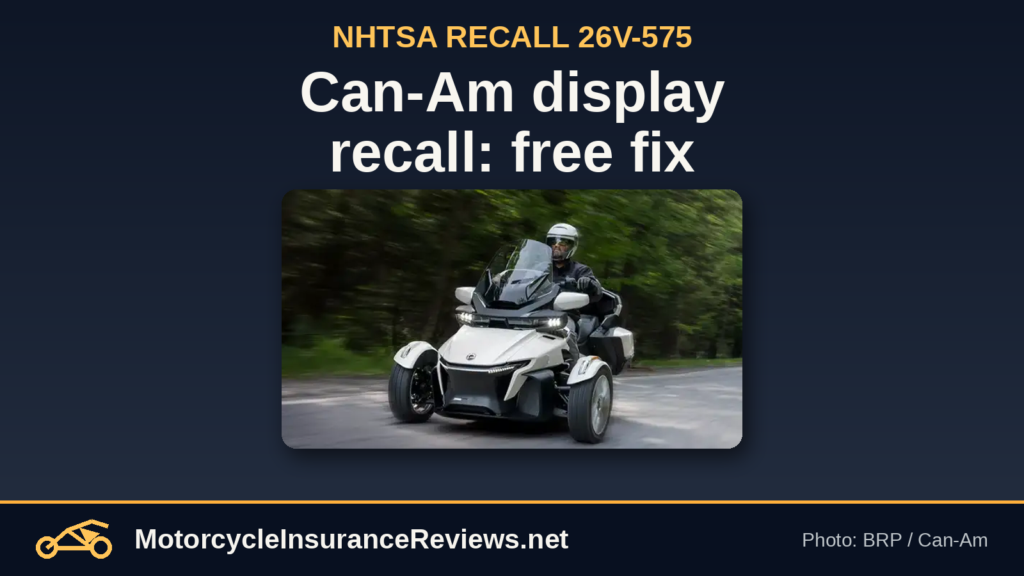
If you ride a Can-Am Spyder, Canyon, Pulse or Origin, your dash may need a software update. BRP is recalling certain 2024–2027 Spyder F3 and RT, 2025–2027 Canyon, and 2025–2026 Pulse and Origin models because the touchscreen instrument cluster can reset, freeze or go blank while you ride. The recall is NHTSA campaign 26V-575, and the fix is free.
BRP’s owner notices are dated September 15, and the update has been available since September 16. You can install it yourself over the air or book a dealer visit. Here’s what the recall says, how the update works, and how to confirm it’s done.
The short version
- Who: owners of certain Can-Am Spyder F3, Spyder RT, Canyon, Pulse and Origin models with the touchscreen cluster (model years below).
- The problem: a communication failure or memory leak in the cluster can make the screen reset, freeze or stay blank.
- What still works: BRP says the physical warning lights (telltales) keep working.
- The fix: a free instrument-cluster software update, over the air (OTA) or at an authorized Can-Am dealer.
- Version needed: BRP Connect V6.0.0 or higher.
- Time: about 10 to 20 minutes for the OTA download and install, depending on your internet speed.
Which Can-Am models are in recall 26V-575?
BRP posted two owner notices for the same campaign: one for its three-wheel vehicles and one for its two-wheel motorcycles. They describe the same defect and the same remedy.
Three-wheelers (Spyder and Canyon):
- 2024 to 2027 Can-Am Spyder F3
- 2024 to 2027 Can-Am Spyder RT
- 2025 to 2027 Can-Am Canyon
Two-wheel motorcycles (Pulse and Origin):
- 2025 to 2026 Can-Am Pulse
- 2025 to 2026 Can-Am Origin
NHTSA’s recall record says the campaign covers certain vehicles “equipped with a touchscreen instrument cluster” and lists 14,014 potentially affected units. A model year alone doesn’t settle whether your vehicle is included. Check your VIN through NHTSA or BRP, as explained below.
What goes wrong with the display
BRP says that, depending on how a rider uses USB and Bluetooth connections, the cluster can suffer a communication failure or a memory leak. The result can be a cluster that resets, freezes or goes persistently blank.
BRP says the physical telltales, meaning the warning lights, keep working. But a frozen or dead screen can stop showing two things riders rely on: your speed and the warning lights shown on the display.
The notice adds a second problem. During a cluster reset, turn signals and hazard lights can temporarily deactivate or fail to respond. BRP says that reduces your awareness of the vehicle’s status and makes it harder for other road users to read your intentions, which raises the risk of a crash.
The recall filing ties the defect to two federal safety standards: FMVSS 123, which covers motorcycle controls and displays, and FMVSS 122, which covers motorcycle brake systems. NHTSA’s summary says the vehicles fail to meet both while the cluster is affected.
The notices don’t tell owners to stop riding. NHTSA’s record doesn’t carry a “park it” or “park outside” warning either. BRP’s instruction is to get the software update. The two BRP notices and NHTSA’s API summary checked here don’t provide crash or injury counts.
The dates, in order
Several dates float around this recall, and they mean different things.
- July 9, 2026: NHTSA lists this as the date it received BRP’s report.
- September 15, 2026: the date on BRP’s owner notices.
- September 16, 2026: the software update became available to owners.
- September 22, 2026: NHTSA says affected VINs become searchable on NHTSA.gov from this date.
- October 12, 2026: NHTSA says BRP’s owner notification letters are expected to be mailed.
So the update is ready now, and you don’t need to wait for a letter. The notice is addressed to owners on BRP’s records. If you bought your Can-Am used or moved recently, the letter may not reach you, and BRP asks anyone who knows a vehicle’s current owner to forward it.
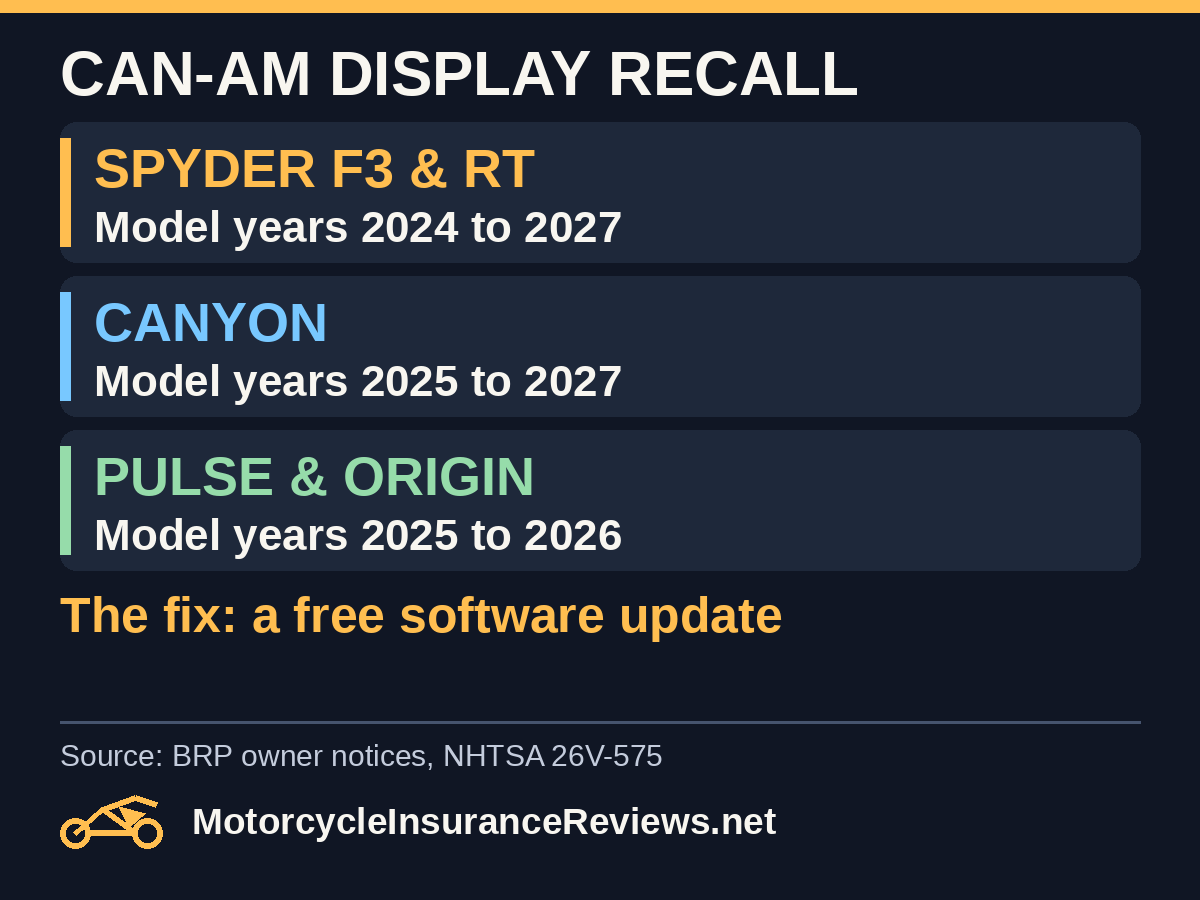
BRP owner notices (Sept. 15, 2026) and NHTSA campaign 26V-575, checked Sept. 30, 2026. A model year alone doesn’t confirm a vehicle is included; check your VIN.
How to install the update over the air
Your vehicle has over-the-air capability, so BRP says you can do the update yourself. BRP points owners to a video walkthrough and to canamonroad.com/ota for the current steps. Use BRP’s own instructions rather than a forum summary, because the network requirements are picky.
BRP’s notice says to follow these guidelines when you connect the vehicle:
- Use a 2.4 GHz network. The touchscreen will not connect to a 5.0 GHz network.
- If you use a phone hotspot, switch it to 2.4 GHz. On an Apple phone, turn on Maximize Compatibility. On an Android phone, choose Band and then the 2.4 GHz setting.
- Use a network with a password, and keep special characters out of both the network name and the password. BRP gives “!”, “@”, “#” and spaces as examples.
- Install software version BRP Connect V6.0.0 or higher. That’s the version the recall requires.
BRP estimates the download and install at 10 to 20 minutes. A weak connection will stretch that, so a garage with a strong signal beats a parking lot.
If you’d rather have a dealer do it
You can also schedule an appointment at any authorized Can-Am dealer, and the update is free there too. BRP says to use this route if you’d rather not install the update wirelessly, or if your vehicle has trouble receiving the OTA update.
If a dealer can’t fix the defect without charge, or takes an unreasonable time, the notice tells owners they can complain in writing to NHTSA’s Administrator. You can also call the Vehicle Safety Hotline at 1-888-327-4236 or go to nhtsa.gov. BRP customer service is at 1-888-272-9222, 8 a.m. to 8 p.m. Eastern, seven days a week.
How to tell the recall is actually done
A finished download isn’t the same thing as a closed recall. BRP’s notices don’t say a completed OTA install automatically updates your recall record, so don’t assume it does.
Here’s a reasonable way to handle it:
- Look up your VIN on NHTSA’s recall search (nhtsa.gov/recalls). NHTSA lists September 22 as the start date for searchable VINs.
- Check the software version on your vehicle after the update. The recall calls for BRP Connect V6.0.0 or higher.
- Ask BRP or your dealer how they record an OTA completion against your VIN, especially if you plan to sell the vehicle.
- Save the paperwork. Keep a screenshot of the version screen, your VIN lookup, and any dealer work order.
If you already paid for this problem
BRP says that if you already paid to have your vehicle repaired for this issue, you should contact BRP customer service. Its team will evaluate whether you’re eligible for reimbursement of the repair costs. The notice adds that your vehicle still needs the safety recall performed.
If you lease a Can-Am, BRP says to send a copy of the letter to the lessee within ten working days of receiving it, and to do the same with future recall letters.
Buying or selling a used Can-Am
A recall sticks to the VIN, not the owner. If you’re shopping for a used Spyder, Canyon, Pulse or Origin in these model years, run the VIN before you buy and ask the seller for proof that the update was installed.
If you’re selling one, do the update first. It’s free, takes a short time, and means one fewer question from a buyer.
What we don’t know yet
The public documents leave a few gaps:
- Which VINs are in. The notices list model-year ranges, and NHTSA describes “certain” vehicles with the touchscreen cluster. The VIN check is what answers it for your vehicle.
- How often the defect happens. BRP’s notices describe the failure conditions but don’t give a failure rate. Neither those notices nor NHTSA’s API summary provides crash or injury counts.
- Any workaround. The notices tie the problem to USB and Bluetooth use, but BRP doesn’t tell riders to avoid those connections, and it doesn’t offer a workaround. The remedy is the software update.
- Insurance questions. The recall doesn’t say anything about coverage. If you have a question about how your policy treats a known recall, ask your insurer or agent.
If you ride one of these machines this fall, the practical move is simple: look up your VIN, get the update on, and keep a record that it’s done.
References
- BRP, “Instrument Cluster Malfunction – Risk of Crash (3-Wheel Vehicles)” (September 15, 2026) — Spyder F3, Spyder RT and Canyon model years, the display and turn-signal failure conditions, OTA and dealer remedy, network instructions.
- BRP, “Instrument Cluster Malfunction – Risk of Crash (Motorcycles)” (September 15, 2026) — Pulse and Origin model years, the same defect and remedy.
- NHTSA recalls API, campaign 26V575000 — report received July 9, 2026; 14,014 potentially affected units; FMVSS 122 and 123; owner letters expected October 12; VINs searchable from September 22; no park-it or park-outside flag.
- BRP OTA update video — the walkthrough BRP links from the owner notice for the over-the-air update.