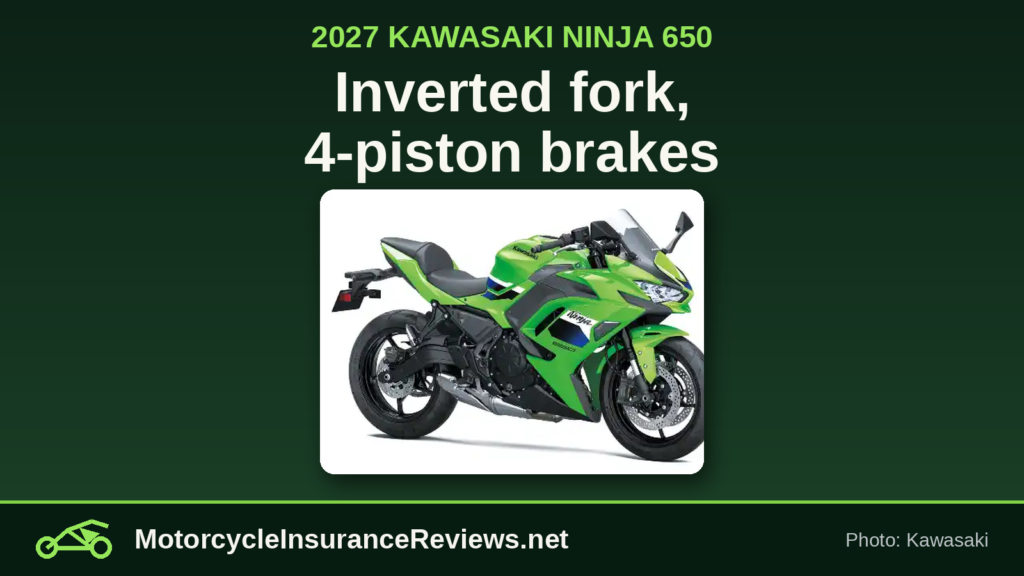
Kawasaki’s 2027 Ninja 650 gets a new front end. On September 30, the company announced that the middleweight sportbike swaps its telescopic fork for a 37 mm Showa inverted fork and trades its two-piston front brake calipers for radial-mount four-piston ones.
The announcement comes from Kawasaki’s European site. Kawasaki’s U.S. Ninja 650 page still shows the 2026 model as of September 30, so U.S. equipment, colors and pricing for 2027 haven’t been confirmed. Here’s what changed, what stayed the same, and what to check before you order.
The short version
- Fork: a 37 mm Showa SFF-BP inverted fork replaces the previous telescopic fork.
- Rear spring: an uprated spring rate goes with the new fork.
- Brakes: radial-mount, four-piston front calipers replace axial-mount, two-piston ones.
- Bodywork: a redesigned front fender is wider and covers more of the fork’s outer tubes.
- Dash: the 4.3-inch TFT display gets a new layout, and the Rideology app now supports navigation and voice commands.
- Not announced for the U.S.: 2027 price, arrival date and U.S. colors.
What Kawasaki changed up front
The fork is the headline. Kawasaki says a ø37 mm Showa SFF-BP (Separate Function Front Fork, Big Piston) inverted fork replaces the telescopic fork on the previous Ninja 650. You can read the company’s full announcement on its European site.
Kawasaki’s description of the benefits is specific. The larger piston “reduces damping pressure,” which it says creates “greater control and more composed attitude changes,” and it claims more stability on corner entry and a planted feel under braking.
An uprated rear spring rate goes with it. Kawasaki says the new spring pairs well with the fork and keeps the bike’s rider-friendly, natural handling feel.
Those are Kawasaki’s design claims. The sources checked here don’t include independent measurements such as braking distances or lap times, so treat them as intent rather than test results.
What “inverted fork” means
In a conventional telescopic fork, the thinner tubes slide up into the larger ones, with the larger tubes down at the wheel. An inverted (upside-down) fork flips that arrangement. The larger-diameter outer tubes sit at the top, held by the triple clamps, and the smaller inner tubes carry the front wheel.
Sportbikes commonly use the layout because the larger tubes at the top can make the front end stiffer. That’s the general reason for it, not a measured result for this bike.
The “SFF-BP” label is spelled out as Separate Function Front Fork – Big Piston. Kawasaki’s announcement doesn’t go into the fork’s internals beyond the larger piston and its effect on damping pressure, so the spring rates, damping settings and travel aren’t public yet.
Four-piston radial calipers
At the brakes, Kawasaki says radial-mount calipers replace the previous axial-mount ones, and the change from two pistons to four improves response to lever input. It describes the result as “linear, controllable braking performance.”
Radial mounting means the caliper’s mounting bolts run in the plane of the brake disc, rather than parallel to the axle as in an axial mount. The mounting arrangement and piston count are separate changes; neither alone tells you how much shorter a stop will be.
Kawasaki’s announcement doesn’t list rotor size, brake line type or pad compound. Anyone comparing the old brakes with the new should wait for the U.S. spec sheet instead of assuming those parts carried over.
A redesigned front fender finishes the front end. Kawasaki says it’s wider and covers more of the fork outer tubes.
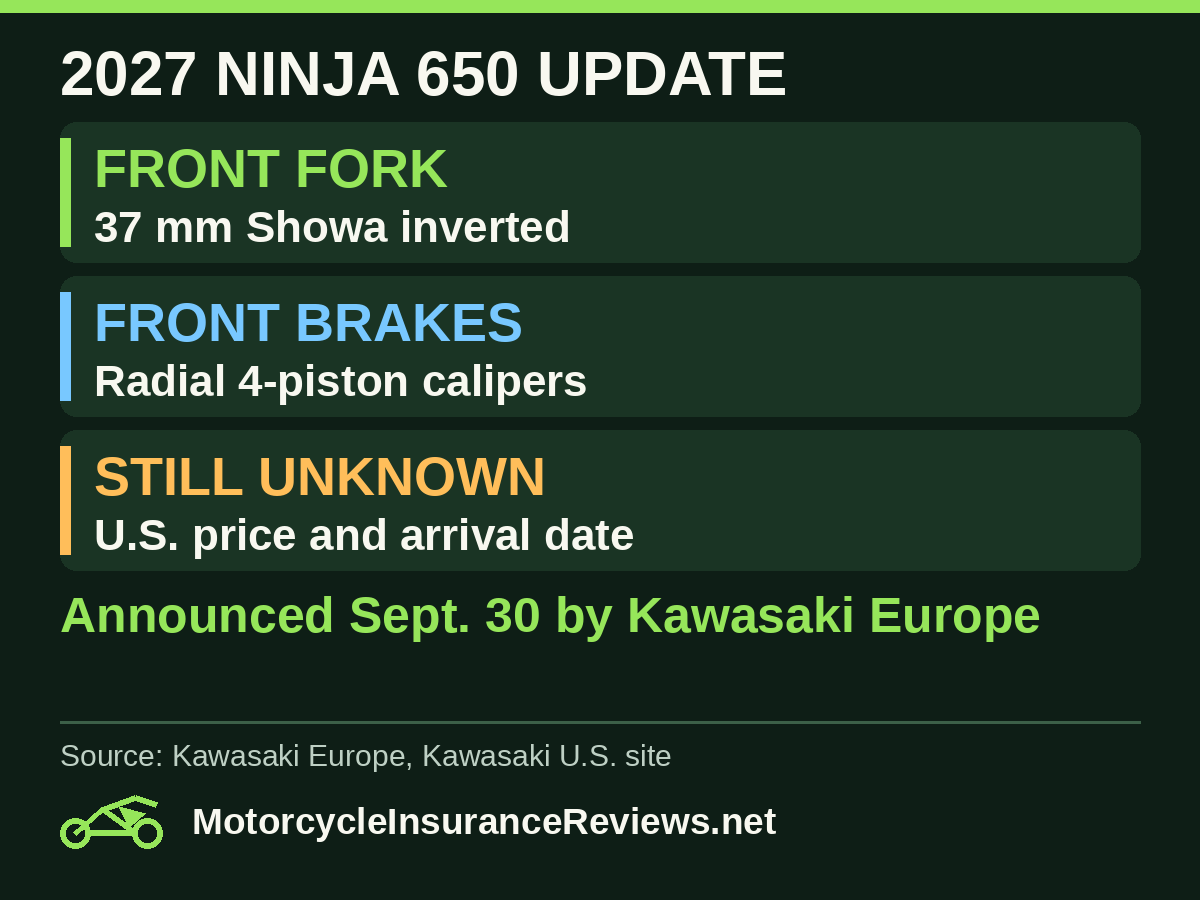
Kawasaki Europe’s Sept. 30, 2026 announcement and Kawasaki’s U.S. Ninja 650 page, checked Sept. 30, 2026. Improvements in handling and braking are Kawasaki’s claims, not test results.
What didn’t change
The announcement is about refinements, not a new bike. Kawasaki calls the engine a “649 cm3 Parallel Twin” and says it’s mated to a lightweight, compact chassis. It doesn’t claim any change in displacement, power or torque, so none should be assumed.
The bike still has:
- A 649 cc parallel twin, which Kawasaki says is tuned for low-to-mid-range strength.
- A lightweight trellis frame and slim, compact chassis.
- Kawasaki TRaction Control (KTRC) with two rider-selectable modes.
Kawasaki also says the 2027 bike has a “lower 785 mm seat” for a reassuring reach to the ground. The announcement doesn’t say how much lower that is than before, so compare it with the 2026 spec sheet if seat height matters to you.
Dash, phone and quickshifter
The 4.3-inch TFT display gets a newly designed layout meant to show key information at a glance. Kawasaki says smartphone connectivity through the Rideology app now supports navigation and voice commands.
Kawasaki’s U.S. site already lists a TFT display and Rideology connectivity on the 2026 Ninja 650. It also carries a note that the app isn’t meant to be used while the vehicle is being operated. What the announcement doesn’t say is which phones, subscriptions or map services the new features need, so check that before you count on them.
Kawasaki also says its Kawasaki Quick Shifter (KQS) is offered as an accessory for “seamless upshifts.” Note the wording: it’s an accessory, and it’s described for upshifts. The announcement doesn’t say it’s standard equipment, doesn’t mention downshifts or auto-blipping, and gives no price.
Colors in the announcement
Kawasaki lists three color options, with a reminder to check with your local dealer for availability in your territory:
- Lime Green
- Metallic Flat Spark Black / Metallic Carbon Gray
- Metallic Matte Graphenesteel Gray / Metallic Spark Black
That caveat means the list is a regional one. U.S. colors haven’t been announced.
What’s still unknown for U.S. riders
This is the important part. The announcement is from Kawasaki Europe, and its own footnote points readers to their local dealers for model and color availability.
As of September 30, Kawasaki’s U.S. Ninja 650 page lists the 2026 Ninja 650 at a base MSRP of $7,599 without ABS and $8,199 with ABS, and a 2025 KRT Edition ABS at $7,999. Those are the current U.S. numbers. The page says “previous model year shown” under its images and carries no 2027 specifications.
That means these questions remain open:
- U.S. price: no 2027 MSRP has been published on the U.S. site.
- Arrival date: there’s no U.S. on-sale date.
- Equipment: the U.S. spec sheet hasn’t shown whether the U.S. model gets the same fork, calipers, display features and accessories Europe announced.
- ABS: the announcement doesn’t mention ABS. The U.S. page currently lists the Ninja 650 as available with or without it.
Questions to ask before you order
If you’re eyeing a 2027 Ninja 650, a few questions to ask your dealer:
- Is the inverted fork standard on the U.S. bike? Ask to see it on the spec sheet, not just in photos.
- What’s the out-the-door price, and does it differ between ABS and non-ABS versions?
- Is KQS available as an accessory in the U.S., and what does it cost and require to install?
- Which colors are coming, and when can the dealer confirm an allocation?
- What happens to 2026 stock, and is an incentive offered? Check the current offer’s terms and expiration date with the dealer.
If you already own a 2026 or earlier Ninja 650, don’t expect a retrofit. Kawasaki hasn’t said the new fork or calipers will be offered for older bikes.
What this update means
It’s a front-end change on a popular, approachable sportbike, and the announced parts are specific: a known fork type, a known fork diameter, and a known caliper layout. That makes it more than a color refresh.
The claims that the changes improve handling, stability and braking feel are Kawasaki’s. They’ll be easier to judge once riders and reviewers get time on the U.S. bike. For now, the useful facts are the hardware changes and the open U.S. questions above.
References
- Kawasaki Europe, “Updates for the Ninja 650 in 2027” (September 30, 2026) — Showa SFF-BP inverted fork, rear spring, radial four-piston calipers, front fender, TFT layout, Rideology, 785 mm seat, KTRC, KQS accessory and color list.
- Kawasaki Europe news listing — the dated listing confirming the September 30 publication of the Ninja 650 announcement.
- Kawasaki U.S., Ninja 650 model page (checked September 30, 2026) — current U.S. listing of the 2026 Ninja 650, base MSRPs, ABS availability and the “previous model year shown” note.