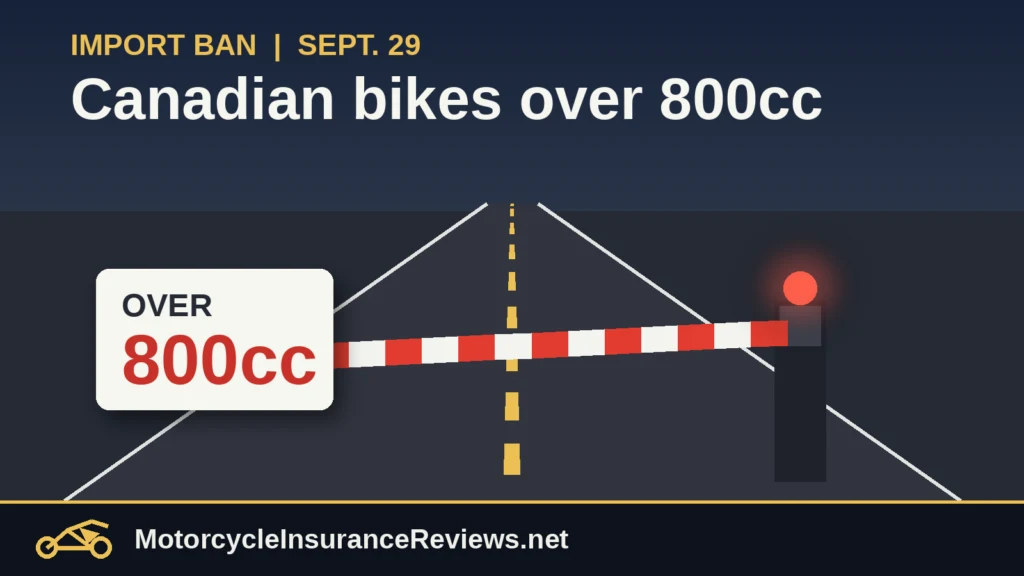
As of 12:01 a.m. Eastern on September 29, 2026, one narrow slice of the motorcycle market is off-limits at the U.S. border. Motorcycles that are products of Canada and have a piston engine larger than 800cc can no longer be imported into the United States under the listed tariff provision. That’s a ban, not a bigger tax bill.
If you ride a Honda in Ohio, a Harley in Wisconsin or a Triumph in Texas, nothing about your bike changes. The rule is about what can cross the border from Canada from now on, and it’s aimed at a specific tariff category. Here’s exactly what’s covered, what isn’t, and what to ask before assuming a particular motorcycle is affected.
On this page
The short version
- The rule: a September 8 presidential proclamation excludes certain “products of Canada” from importation into the U.S. Motorcycles are one of the listed categories.
- The category: tariff code HTSUS 8711.50.00, defined in the annex as motorcycles (including mopeds) with a reciprocating internal-combustion piston engine over 800cc.
- The start time: goods imported on or after 12:01 a.m. ET on September 29, 2026.
- The transition: covered goods that were imported before that moment but not yet formally “entered” stay under the earlier 50 percent duty instead.
- Outside the listing: motorcycles at or below 800cc, and anything that isn’t a product of Canada. Electric models have no piston engine, so the annex’s wording doesn’t describe them.
How a 50 percent duty became a ban
This didn’t come out of nowhere. On July 20, 2026, the White House issued Proclamation 11048, imposing additional duties of up to 50 percent on certain Canadian products. It’s a response to what the administration calls Canadian discrimination against U.S. motor vehicles, under section 338 of the Tariff Act of 1930.
Those duties were briefly suspended in August after Canada signaled it would change course. The proclamation says Canada backed away from that commitment on August 21, and the 50 percent duties took effect at 12:01 a.m. ET on August 22.
The September 8 proclamation takes the next step. Section 338 lets a president exclude a country’s goods from importation if the discrimination continues, and the proclamation finds that it has. So a list of products that had been paying the 50 percent duty now moves to an outright import ban. Motorcycles over 800cc are on that list.
A separate proclamation the same day changed which Canadian products fall under the duty side of the program, and U.S. Customs and Border Protection (CBP) issued guidance for importers on September 11. That scope change took effect September 15. The motorcycle exclusion is its own document with its own start date, and the one that matters for riders is September 29.
CBP then issued separate implementation guidance for the import exclusion on September 28. It confirms the start time and names tariff heading 8711 among the covered categories.
Exactly what’s covered
The annex to the exclusion proclamation lists a single motorcycle entry: HTSUS 8711.50.00, defined as motorcycles (including mopeds) with a reciprocating internal-combustion piston engine of more than 800cc. (HTSUS is the Harmonized Tariff Schedule of the United States, the code book customs uses to sort every imported good.)
Three tests all have to be true before a motorcycle falls under the ban:
- It’s a product of Canada. That’s a customs-origin question, not a brand question.
- It’s classified under 8711.50.00. That means a piston engine over 800cc.
- It’s imported on or after 12:01 a.m. ET on September 29, 2026.
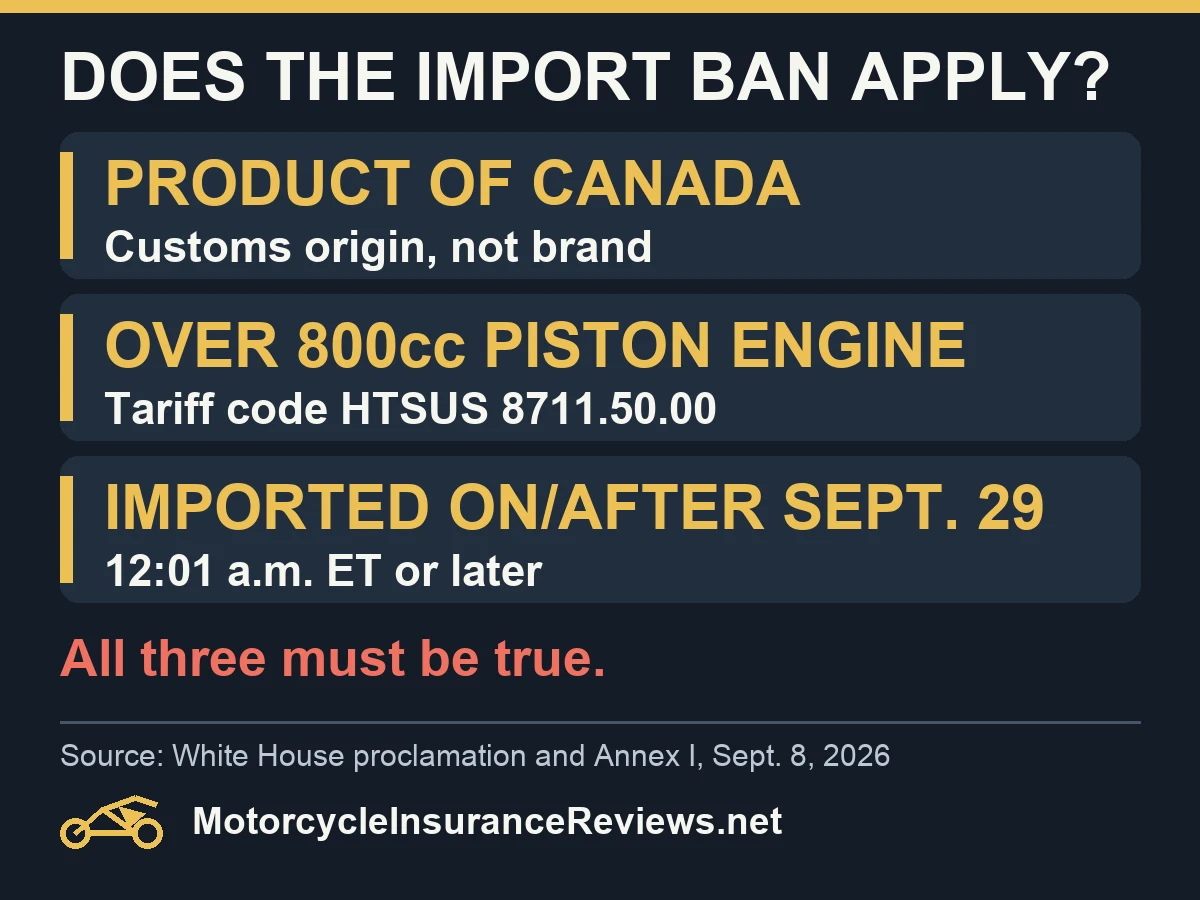
Miss any one of the three and this particular rule doesn’t apply. It’s worth slowing down on each, because the details are where most of the confusion will come from.
“Product of Canada” is a customs question
The proclamation covers “products of Canada.” In customs terms, a product’s country of origin isn’t the same as where a company is headquartered, where a dealer sits, or where you happened to buy it.
A few situations that don’t automatically settle the question:
- A Canadian brand: a company’s home country doesn’t by itself decide the origin of a specific motorcycle.
- A U.S. brand with a Canadian plant, or the reverse: where the bike is assembled and where its parts come from both matter in an origin analysis, and the answer can differ from model to model.
- A bike you bought in Canada: buying a motorcycle from a Canadian seller doesn’t tell you where it was made, and buying a U.S.-built bike in Canada doesn’t turn it into a Canadian product.
None of that is a legal opinion. It’s a reason not to guess. If a specific model or VIN matters to you, the people who can answer are CBP and a licensed customs broker, and it’s worth asking before money moves.
The 800cc line
The annex is specific about engine type: a reciprocating internal-combustion piston engine over 800cc. Some plain-English consequences:
- A bike at exactly 800cc isn’t “over 800cc.” Don’t assume it’s covered.
- An electric motorcycle has no piston engine, so the annex’s wording doesn’t describe it. Classification of a specific model is still a broker or CBP call.
- Displacement is the classification test. Tariff classification looks at how the vehicle is described and built, and rounded marketing numbers can differ from the official cylinder capacity.
The annex also says its product descriptions are for information and don’t delimit the scope of the action; the tariff provision controls. In practice that means the code, not the brochure headline, decides.
What changes for a rider in the U.S.
For most riders, very little, at least directly. Here’s how it breaks down.
If you already own the bike. The proclamation regulates goods being imported. It doesn’t say anything about registering, insuring, riding or selling a motorcycle that’s already in the United States. Existing ownership, titles and insurance policies aren’t what this document is about.
If you’re shopping for a new bike. The ban is on imports, so the question for a dealer is whether a particular motorcycle is being brought in from Canada. Inventory that has already been imported and entered is a different situation from a shipment crossing the border today. The proclamation doesn’t say anything about specific models, dealer stock, delivery dates or retail prices, and nobody should pretend it does. Ask the dealer about the specific motorcycle and its allocation.
If you’re importing a motorcycle yourself, or planning to have one brought over from Canada, this is squarely your problem. A bike that’s a Canadian product, classified under 8711.50.00 and imported on or after the start time is excluded.
CBP says covered goods cannot be admitted into a Foreign Trade Zone or bonded warehouse, moved in bond, or entered for consumption after the cutoff; noncompliant entries will be rejected. One imported before the deadline but not yet entered stays under the earlier 50 percent duty, per the proclamation. Talk to a customs broker before anything ships.
The transition rule, in plain English
There’s a line in the proclamation that will matter to importers: covered products that were imported but not yet entered for consumption (or withdrawn from a bonded warehouse) before September 29 “remain subject to the 50 percent duty rate.”
“Imported” and “entered for consumption” are distinct steps in customs. A shipment can arrive, sit under bond, and be formally entered later. This sentence says that a motorcycle already on U.S. soil before the cutoff doesn’t get banned in retroactive fashion; it keeps paying the 50 percent duty instead.
CBP confirms that covered goods imported before the cutoff remain eligible for consumption entry. It also says unreleased ACE entries containing covered goods will be canceled at the cutoff, so a filer with a shipment in that transition should check its status and next filing step with a customs broker.
What remains unverified
CBP’s September 28 bulletin now explains the entry rejection and pre-cutoff treatment. It does not identify motorcycle models or forecast what dealers will have in stock. The proclamation still allows technical corrections to the annex through Federal Register notices, so check for updates before a shipment.
Things the public record doesn’t say, as of September 29:
- Which specific models are affected. The annex lists a tariff category, not motorcycle models.
- Whether dealers will see shortages. No source verifies inventory effects.
- Whether prices will change. Nobody has published a price consequence for U.S. buyers.
- What happens if the ban is challenged. The proclamation includes a fallback: if the import ban is invalidated as to any import, the 50 percent duty applies to that import instead.
If you’re in the market, treat any claim that “the ban means your bike costs X” as unsupported until a source shows its math.
What about insurance?
The proclamation says nothing about insurance. It concerns customs status at the border, not how a registered motorcycle is insured, and no insurance consequence has been reported. Coverage for a bike you already own isn’t part of what this document changes.
If you’re buying a bike that was imported, the same practical rule applies as with any purchase: get the exact VIN in hand before you ask an insurer for a quote.
A quick checklist before you buy or import
- Ask where the exact motorcycle was made and how it entered the U.S. Get it from the seller in writing.
- Check the engine. Piston engine, and over 800cc.
- Ask when it arrived. Before or after 12:01 a.m. ET on September 29 matters, and so does whether it has been formally entered.
- Bring in a customs broker for imports. Origin and classification calls belong to CBP and licensed professionals.
- Check CBP and the Federal Register. CBP has issued implementation guidance, and the proclamation allows technical corrections.
Tariff rules like this one can be refined by CBP notices, so check the current guidance before a purchase or shipment that depends on it.
References
- White House proclamation excluding certain Canadian products (motor vehicles), Sept. 8, 2026 — Exclusion effective for goods imported on or after 12:01 a.m. ET Sept. 29, 2026; pre-cutoff goods not yet entered remain under the 50 percent duty; CBP implementation authority; severability fallback to the 50 percent duty.
- White House Annex I, Motor Vehicles — Lists HTSUS 8711.50.00: motorcycles (including mopeds) with a reciprocating internal-combustion piston engine over 800cc.
- White House proclamation modifying the scope of Canadian products subject to additional duties (motor vehicles), Sept. 8, 2026 — Companion proclamation changing the duty-side product list effective Sept. 15, 2026; background on Proclamations 11048 and 11056.
- CBP CSMS #69851916, Modifying Section 338 Additional Duties on Certain Goods of Canada — CBP filing guidance for the Sept. 15 scope change, the Aug. 22 start of the 50 percent duties, and background citations.
- CBP CSMS #70050970, Certain Canadian Products Excluded from Importation — Sept. 28 implementation guidance: Sept. 29 start, tariff heading 8711, rejection of covered entries, and treatment of pre-cutoff goods.