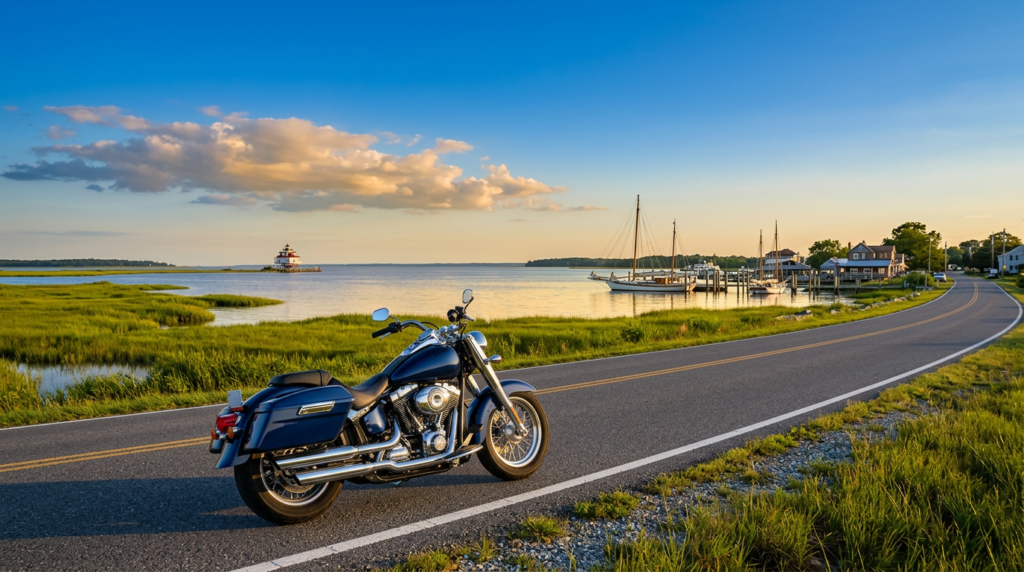
Maryland motorcycle insurance at a glance:
Required UM/UIM: Yes
Helmet law: Universal
Lane splitting: Illegal
Maryland motorcycle insurance is not a generic, copy-paste topic. The headline minimum is easy enough to state, but the real Maryland issues are more important: motorcycle policies can exclude or reshape the state’s normal economic-loss/PIP benefits, Maryland requires uninsured/underinsured motorist protection, and Maryland still applies contributory negligence in negligence cases. That means a rider can be perfectly “legal” on paper and still be badly underinsured after a serious crash.1, 2, 3, 4, 14
If you are publishing for Maryland riders, the right frame is this: the state is strict about uninsured registered vehicles, the MVA’s compliance process catches lapses administratively, helmet use is mandatory for operators and passengers, lane splitting is illegal, and a rider-fault argument can matter more here than many people realize. That combination is what makes Maryland motorcycle insurance worth explaining carefully instead of recycling a generic “minimum limits” article.1, 7, 9, 11, 12, 13, 14
What Maryland legally requires on a motorcycle policy
Maryland’s baseline rule is simple: if the bike is registered in Maryland, it must be insured at all times by a company licensed in Maryland. The MVA’s insurance page and Transportation § 17-103 line up on the minimum required liability limits: $30,000 for bodily injury to one person, $60,000 for bodily injury to two or more people in one accident, and $15,000 for property damage. Maryland also requires uninsured/underinsured motorist protection through the same statutory framework.1, 2, 4
The part many riders miss is Maryland’s PIP/economic-loss wrinkle. Under Insurance § 19-505, the ordinary motor-vehicle framework starts with benefits including up to $2,500 for medical, hospital, and disability benefits and 85% of lost income. But the same statute specifically lets insurers, in the case of motorcycles, mopeds, and motor scooters, exclude those benefits or offer them with deductibles, options, or other specific exclusions. In plain English: you should not assume your Maryland motorcycle policy includes the same no-fault-style economic protection you may be used to seeing on a car policy.3, 2
Key insight for Maryland riders: That makes the declarations page unusually important in Maryland. When you compare motorcycle quotes here, do not stop at the liability limits. Check whether the policy includes any economic-loss protection at all, whether the carrier uses MedPay instead, what deductible applies, and whether the form changes the normal Maryland assumption people bring over from auto insurance. For Maryland riders, this is not a technicality. It is one of the most important coverage questions on the whole page.[3]
Proof of insurance, FR-19, and how Maryland actually enforces coverage
Maryland allows you to carry insurance proof in paper form or electronically on a phone or other portable device, and you must present it on request. The statute itself says a person who violates the proof-of-insurance rule is subject to a $50 fine, but Maryland’s current District Court preset traffic fine schedule, effective October 1, 2025, lists $83 as the preset fine for failing to carry or present evidence of required security, with 0 points. For a rider, the practical move is simple: keep a paper card on the bike and a digital copy on your phone.5, 6
Maryland also enforces insurance administratively, not just through traffic stops. The MVA says it validates vehicle insurance at registration renewal, and the proof/compliance page explains that if the MVA receives a cancellation notice and cannot verify replacement coverage, you may need your insurer to submit an e-FR-19. If the MVA has already sent you a proof-needed letter, it says acceptable documentation must come from the insurance provider. This is one reason riders get surprised by Maryland: a coverage lapse can surface through MVA records even if no police officer ever pulls you over.1, 10
Important Maryland tip: If you are canceling a policy because you sold the bike, stored it long-term, or moved out of state, the MVA tells consumers to return the plates before canceling insurance. Cancel first and sort out the tags later is exactly how riders create expensive Maryland compliance problems.[1]
What happens if your Maryland motorcycle insurance lapses
Maryland separates “I forgot the card” from “the bike is actually uninsured.” If your policy is active and you simply cannot produce proof, that is a proof-of-insurance violation. If the motorcycle is registered and the required insurance has actually lapsed, Maryland treats that as a much bigger problem, and the issue can develop entirely through MVA records instead of a roadside stop. Transportation § 17-106 says registration is automatically suspended as of the date of the lapse, not later than 60 days after notice, and the suspension stays in place until the required security is replaced, proof is submitted on the required form, and the penalty fee is paid.7, 9
The MVA’s uninsured-vehicle page and insurance-requirements page spell out the money side. The penalty is $200 for the first 30 days a vehicle is uninsured, then $7 per day after that, up to $3,500 per violation in a 12-month period. The MVA also warns about loss of registration privileges, a restoration fee of up to $25, a block on future registration transactions, possible impoundment, authorized tag recovery agents who can confiscate plates after suspension takes effect, and a 17% collection fee plus tax-refund intercept if the matter goes to the Central Collections Unit. In Maryland, a “cheap break” in coverage can turn into a very expensive paperwork problem fast.1, 7, 9
Criminal exposure: Knowingly riding uninsured is worse. Transportation § 17-107 makes it unlawful to knowingly drive an uninsured vehicle or knowingly let someone else drive it. Maryland’s current District Court schedule marks that offense as must appear and assigns 5 points. The statute allows a fine of up to $1,000 and up to 1 year in jail for a first conviction, with up to 2 years in jail for a later conviction. Submitting false evidence of insurance is also a must-appear offense, and the MVA’s uninsured-vehicle page warns that false evidence can bring up to $1,000 and/or 1 year in prison.8, 6, 9
The practical takeaway for riders is simple: if you are done riding for a season, either keep the Maryland policy in force or turn in the plates. A bike sitting in a garage with active Maryland registration can still become a compliance problem if the policy ends and the tags stay live.1, 7, 9
Why the Maryland minimum is usually not enough
The legal minimum makes the bike registrable. It does not make the rider well protected. A $15,000 property-damage limit is thin in a state where even a relatively modest collision can involve a late-model SUV, a pickup, a barrier, and a tow bill. The minimum also does nothing to repair your own motorcycle unless you bought collision or comprehensive, and it may do very little for your own lost income or medical bills if your bike policy excludes Maryland’s economic-loss benefits. For Maryland riders, “legal” and “adequate” are two different things.1, 2, 3
The Maryland court-side issue is contributory negligence. In Coleman v. Soccer Association of Columbia, Maryland’s high court reaffirmed that contributory negligence remains the rule in Maryland negligence cases, and in that case the plaintiff was barred from recovery because the jury found his negligence contributed to his injuries. For motorcycle claims, that matters a lot. A rider who is lane splitting, making an aggressive same-lane pass, running too hot into traffic, or otherwise giving the other side a viable rider-fault argument can see the whole claim change shape very quickly.14, 12, 13
Helpful Maryland rule: Maryland does give riders one unusually helpful rule: helmet nonuse cannot be used as evidence of negligence, contributory negligence, assumption of risk, mitigation of damages, or limitation of liability in a civil action. That does not make riding without a helmet legal; Maryland’s helmet law is universal. It does mean an insurer or defendant cannot use helmet nonuse as an easy shortcut to cut down a civil claim the way many riders assume.[11]
Maryland’s mandatory UM/UIM rules are another reason minimum coverage is often too thin. Uninsured/underinsured motorist coverage is required, but the minimum required amount is still only the minimum. The stronger Maryland-specific question is whether your quote gives you standard UM/UIM or enhanced underinsured motorist coverage (EUIM). The Maryland Insurance Administration’s current form explains the difference directly: with EUIM, the amount available is not reduced by the at-fault driver’s liability insurance; with standard UM/UIM, the amount available is reduced by the at-fault driver’s insurance. The MIA also expressly stated that EUIM offers are required for motorcycle policies because those policies are filed as private-passenger motor-vehicle-liability forms.4, 26, 27
Key distinction: That is not a trivial distinction. If you carry robust liability limits on your own bike and get hit by a driver with thin limits, the difference between standard UIM and enhanced UIM can be the difference between a badly constrained recovery and a much stronger one. Maryland also prohibits mandatory binding arbitration clauses in UM/UIM coverage, another detail riders rarely know but should. When you buy Maryland motorcycle insurance, do not just ask, “How much UM do I have?” Ask, “Is this standard UM/UIM, or is it enhanced UIM?” and “What did I sign?”4, 26, 27
Coverage upgrades that make sense for Maryland riders
If you are only going to improve one part of a Maryland motorcycle policy, the best place to start is usually higher liability limits paired with stronger UM/UIM or EUIM. The legal minimum is a registration floor, not a serious risk-management plan. Maryland’s Beltway and I-95 traffic, expensive vehicles, and injury exposure make 100/300/100 a much more realistic starting point for many riders than 30/60/15. The same logic applies to your first-party protection against uninsured or underinsured drivers.1, 4, 26, 27
Collision coverage is also unusually valuable in a Maryland motorcycle context because fault disputes matter so much. If the claim turns into an argument about rider fault, contributory negligence, or an illegal lane-use maneuver, collision coverage gives you a first-party path to get the bike repaired or totaled out without waiting for the liability fight to resolve in your favor. For Maryland riders, collision is not just about “own damage.” It is often about escaping the risk that a fault argument sinks the third-party claim.14, 12
Comprehensive coverage is the other add-on Maryland riders should take seriously. The Maryland Insurance Administration has a dedicated deer-collision advisory telling consumers to review coverage as deer collisions increase and explaining that comprehensive coverage handles animal strikes, along with things like theft, vandalism, fire, and storm loss. If you ride Route 50 toward Ocean City, spend time on rural roads on the Eastern Shore, or ride early mornings in Western Maryland, comprehensive is not a luxury add-on. It is one of the most obviously useful coverages on the page.[28]
Medical payments, or at least some other first-party medical/economic protection, also deserve real attention in Maryland because of the motorcycle PIP carveout. A rider who assumes “Maryland is a PIP state, so I’m covered” can get a rude surprise if the bike policy excludes or narrows those benefits. Ask the carrier exactly what pays first for ER bills, follow-up treatment, deductibles, and lost income. If the answer is vague, keep pressing until it is not.[3]
After that, the Maryland-specific shopping checklist is straightforward: ask how the policy treats custom parts and accessories, whether riding gear is covered, whether roadside assistance is motorcycle-specific, whether the policy has a lay-up or storage option for winter months, and whether gap coverage is available if the bike is financed. Those are not state-mandated coverages, but they are the kinds of details that separate a useful Maryland motorcycle policy from a cheap one. A rider in Garrett County dealing with winter storage and salt exposure may not shop exactly the way a commuter on the Capital Beltway does, but both should read the fine print far beyond liability limits.
Maryland riding laws that directly affect insurance and claims
Helmet law. Maryland’s helmet law is universal. Operators and passengers must wear protective headgear, and operators must also wear an eye-protective device unless the motorcycle is equipped with a windscreen. That is straightforward. The more interesting insurance angle is the statute’s civil-case language: failing to wear the required headgear may not be considered evidence of negligence, contributory negligence, assumption of risk, or mitigation of damages. Riders are often surprised by that, because it is more claimant-friendly than they expect.[11]
Lane splitting and lane filtering. Lane splitting and lane filtering are not legal in Maryland. Transportation § 21-1303 says a motorcycle may not be operated between lanes of traffic or between adjacent lines or rows of vehicles. The same statute makes clear that a motorcycle is entitled to the full use of a lane and that no more than two motorcycles may ride abreast in a single lane. Maryland also now treats certain motorcycle-specific lane violations as qualifying offenses in its aggressive-driving statute when combined with two other listed violations. For insurance purposes, that matters. Illegal lane behavior is not just a ticket risk here; it can become powerful evidence in a liability dispute.12, 13, 14
Licensing. Maryland licensing rules matter to insurers too. The MVA’s motorcycle-license page says riders under 18 must complete the Maryland Motorcycle Safety Program’s Basic Rider Course before applying. For adults who already hold a Maryland driver’s license, completing a Maryland Motorcycle Safety Program course with a valid completion certificate can let you skip the learner’s permit, knowledge test, and skills test when adding Class M. Without that certificate, you generally need the Class M learner’s permit and skills test. The MVA also notes the completion certificate is valid for six months.[15]
As of March 2026, MDOT MVA’s current FAST TRACK page also says riders can take the knowledge test and riding test the same day during FAST TRACK Licensing, without a learner’s permit and without the normal 14-day waiting period, at full-service branch offices throughout May. That is licensing detail rather than insurance law, but it still matters to quote shopping because a properly licensed rider with a completed safety course can look different to an insurer than someone newly endorsed without documented training.16, 15
Maryland draws real lines between motorcycles, mopeds, scooters, and e-bikes
Maryland does not treat every two-wheeled machine the same. Under Transportation § 11-136, a motorcycle is generally a motor vehicle with motive power, a seat or saddle, not more than three wheels in contact with the ground, and the capability of speeds greater than 35 mph. A moped and a motor scooter are separately defined smaller categories with their own statutory definitions, and the MVA says operators and owners of mopeds and motor scooters must carry proof of insurance while operating them. Operators need either a valid driver’s license of any class or a valid moped operator’s permit.18, 19, 20, 17, 23
Electric bicycles are different again. Maryland separately defines electric bicycles and excludes them from the definition of motor vehicle. That means a true Maryland e-bike is not operating under the same registration, licensing, and motor-vehicle insurance framework as a motorcycle. The practical takeaway for insurance-shopping content is simple: do not casually call every scooter or e-bike a “motorcycle,” and do not assume a larger scooter escapes motorcycle rules just because the seller markets it that way. In Maryland, the statutory category matters.21, 22, 20, 18
What moves a Maryland motorcycle premium
Maryland does not publish a neat public chart of statewide motorcycle rates, but the Maryland Insurance Administration does publish property-and-casualty reports including a recent Report on Rate Assignment by ZIP Code and an affordability workgroup report for private-passenger auto insurance. The direct lesson for riders is not that motorcycle pricing equals auto pricing; it is that Maryland territory and ZIP code matter enough that the state is formally studying them. In practice, that means riders should expect meaningful premium differences across Baltimore City, close-in D.C. suburbs, rural deer-heavy counties, and lower-density areas. That is an inference from the state’s broader insurance reporting, but it is a grounded one.[24]
The controllable part of the quote is where riders should focus. When you compare Maryland motorcycle insurance quotes, keep the deductibles the same, keep the liability limits the same, and ask direct questions about economic-loss/PIP, UM/UIM versus EUIM, accessory coverage, and motorcycle-specific roadside assistance. A cheap quote that quietly excludes economic-loss benefits, gives you only minimum UM/UIM, and caps accessory coverage at a token amount is not actually cheap if you have a claim. Before picking a carrier, also review the Maryland Insurance Administration’s complaint portal and property-and-casualty reports. If claim handling or underwriting turns ugly later, the MIA gives consumers a direct online complaint channel.24, 25
Maryland motorcycle insurance FAQ
Do you need motorcycle insurance in Maryland?
Yes. Maryland requires all Maryland vehicles, including registered motorcycles, to be insured at all times by an insurer licensed in Maryland. To stay legal, the bike must carry at least 30/60/15 liability limits plus the required UM/UIM coverage.1, 2, 4
What is the Maryland minimum for motorcycle insurance?
The statutory floor is $30,000 for bodily injury to one person, $60,000 for bodily injury to two or more people in one accident, and $15,000 for property damage, with required UM/UIM benefits. That satisfies the law, but it is often not enough to protect a rider well after a serious crash.1, 2, 4
Does Maryland PIP apply to motorcycles the same way it applies to cars?
No. This is one of the biggest Maryland-specific differences riders need to understand. Insurance § 19-505 allows a motorcycle insurer to exclude economic-loss benefits or offer them with deductibles, options, or specific exclusions. Do not assume your bike policy mirrors your auto policy.[3]
Can you show proof of insurance on your phone in Maryland?
Yes. Maryland law allows required insurance evidence to be shown electronically on a portable device. Just remember that electronic proof solves only the card problem; it does not solve an actual coverage lapse.[5]
What happens if Maryland motorcycle insurance lapses?
The MVA can suspend the registration, impose $200 for the first 30 days and $7 per day after that, up to $3,500 per violation in a 12-month period, and add restoration/collection consequences. If you knowingly ride uninsured, the offense becomes much more serious and can carry points, a must-appear citation, and criminal penalties.7, 8, 9, 6
Is lane splitting legal in Maryland?
No. Maryland bans operating a motorcycle between lanes of traffic or between adjacent lines or rows of vehicles. Maryland does allow full-lane use and up to two motorcycles riding abreast in one lane.[12]
Can not wearing a helmet reduce a Maryland injury claim?
Maryland requires a helmet, so not wearing one is still illegal. But the statute also says helmet nonuse may not be used as evidence of negligence, contributory negligence, assumption of risk, mitigation of damages, or limitation of liability in a civil action. That is an unusually important Maryland claim rule.[11]
Do mopeds and motor scooters need insurance in Maryland?
Yes. The MVA says operators and owners of mopeds and motor scooters must carry proof of insurance while operating them, and operators need either a valid driver’s license of any class or a valid moped operator’s permit. Maryland treats true electric bicycles differently because they are separately defined and excluded from the motor-vehicle definition.17, 23, 21, 22
Can you keep an out-of-state policy after moving to Maryland?
Usually not for long. The MVA says Maryland vehicles must be insured at all times by an insurer licensed in Maryland, and its proof/compliance guidance says a vehicle registered in Maryland requires a Maryland insurance provider. New residents who do not convert coverage properly are a common source of compliance trouble.1, 10
Should Maryland riders ask about enhanced underinsured motorist coverage?
Yes. Maryland requires UM/UIM, and the MIA’s bulletins make clear that EUIM offers are required on motorcycle policies. The core difference is that EUIM is not reduced by the at-fault driver’s liability insurance, while standard UM/UIM is reduced by it. For many Maryland riders, that is one of the best upgrades available.26, 27, 4
Primary Maryland Sources Used in This Article
- MDOT MVA — Insurance Requirements for Maryland Vehicles
- Maryland Transportation Article § 17-103
- Maryland Insurance Article § 19-505
- Maryland Insurance Article § 19-509
- Maryland Transportation Article § 17-104.2
- Maryland District Court — Preset Traffic Fine Schedule (effective Oct. 1, 2025)
- Maryland Transportation Article § 17-106
- Maryland Transportation Article § 17-107
- MDOT MVA — Uninsured Vehicle Owners
- MDOT MVA — Insurance Proof / Compliance Guidance
- Maryland Transportation Article § 21-1306
- Maryland Transportation Article § 21-1303
- Maryland Transportation Article § 21-901.2
- Maryland Court of Appeals — Coleman v. Soccer Association of Columbia
- MDOT MVA — Obtaining a Motorcycle License
- MDOT MVA — FAST TRACK Licensing
- MDOT MVA — Mopeds and Motor Scooters
- Maryland Transportation Article § 11-136 (Motorcycle)
- Maryland Transportation Article § 11-134.1 (Moped)
- Maryland Transportation Article § 11-134.5 (Motor Scooter)
- Maryland Transportation Article § 11-117.1 (Electric Bicycle)
- Maryland Transportation Article § 11-135 (Motor Vehicle)
- Maryland Transportation Article § 16-101
- Maryland Insurance Administration — Property and Casualty Reports
- Maryland Insurance Administration — File a Complaint
- Maryland Insurance Administration Bulletin 17-07 — Enhanced Underinsured Motorist Coverage
- Maryland Insurance Administration Bulletin 23-12 — Enhanced Underinsured Motorist Coverage Opt-Out Option
- Maryland Insurance Administration — Deer-Vehicle Collisions
Editorial note: This guide reflects Maryland statutes, MVA guidance, and MIA bulletins available as of March 2026. For future updates, re-check the Maryland General Assembly’s statute pages, the MVA’s insurance and licensing pages, and the MIA’s bulletins and reports before revising policy limits, rider rules, or endorsement procedures.